
Former New York Gov. Andrew M. Cuomo said US crypto policy remains vulnerable to political change unless Congress passes a durable law that can outlast the next election cycle.
In an opinion article published by Cointelegraph, Cuomo wrote that the digital asset revolution is already reshaping the financial system. The question, he said, is no longer whether the sector will keep developing, but whether the United States will create clear and lasting rules so that development happens at home. His answer: not yet.
The CLARITY Act stalled after passing the House
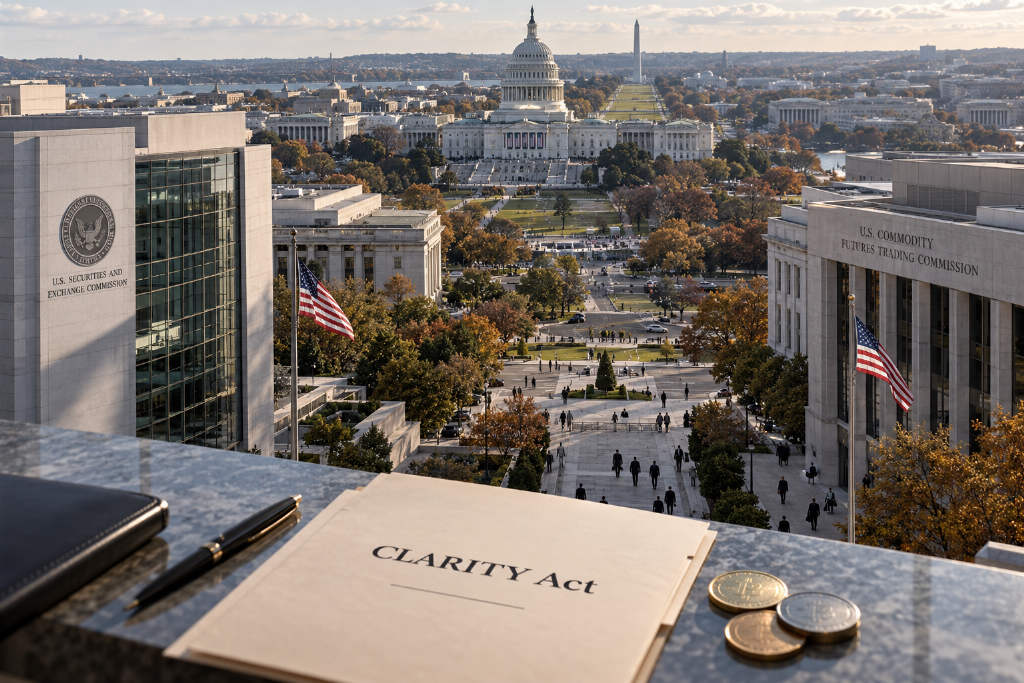
Cuomo said the CLARITY Act was meant to address that gap. According to the article, the bill would have created a national framework for digital assets, clarified the responsibilities of federal agencies including the Securities and Exchange Commission (SEC) and the Commodity Futures Trading Commission (CFTC), and given businesses, investors and consumers a clearer view of the rules.
The House passed the CLARITY Act in 2025, he wrote, but Congress has still not sent a bill to the president. The Senate failed to advance the measure in September, leaving the effort in limbo and prompting the question of what comes next.
Agencies moved ahead as Congress failed to act
Cuomo argued that federal regulators have rushed into the vacuum with new rules that materially reshape the market. He said both the SEC and CFTC have been highly aggressive in issuing regulations, including a proposed federal framework for crypto trading platforms and a tailored regulatory regime for certain crypto assets.
He said that is positive in the short term and could open many new market opportunities. But he added that these rules were adopted without a market structure law enacted by Congress and depend on agencies' existing statutory authority, which leaves them with less staying power than a new law.
From the Democratic point of view, he wrote, the rules were adopted despite congressional opposition, making them politically vulnerable from the outset.
Cuomo wrote, 「And hell hath no fury like a Congress scorned.」
The midterms could reshape the regulatory path
Cuomo said prediction markets and current electoral trends suggest Democrats could control one chamber of Congress, if not both, after the midterms. He argued that Congress has broad power to derail or disrupt agency action, and that power should not be underestimated.
The article cited Kalshi as saying Democrats have a 64% chance of controlling the Senate.
To illustrate the point, Cuomo drew on his own experience in the Clinton administration at the Department of Housing and Urban Development (HUD). After the 1994 midterm elections delivered both the House and Senate to Republicans, he wrote, the department's power was sharply constrained. Oversight intensified, funding was used as leverage, and Congress deployed every available tool to challenge and limit the administration. In his telling, that is what Congress does when it believes the executive branch has gone too far.
He added that Democrats will be looking to support their claims that the Trump administration was corrupt and that agency actions were designed to benefit individuals personally and political donors collectively. Whether those claims are fair or not, he wrote, they will shape the politics, and the politics will shape the oversight.
Cuomo listed the tools Congress can use
According to Cuomo, lawmakers have many ways to intervene in agency action. New rules and regulations must be submitted before they take effect, giving Congress a chance to weigh in.
Congress can restrict funding for agency programs.
It can pass legislation overriding agency action.
It can use the Congressional Review Act to repeal certain regulations.
It can also investigate and issue subpoenas, which he said can cause major disruption when paired with public hearings.
He added, 「Just ask Anthony Fauci and Jack Smith!」
He called for bipartisan legislation
Cuomo argued that the broader challenge is to align private-sector technological innovation with intelligent government regulation. After the CLARITY Act failed, he wrote, ambiguity prevailed. He described that outcome as bad for business, bad for investors, bad for consumers and bad for the United States.
Companies should not have to guess whether today's rules will survive the next election, he said. Nor should they have to decide whether to build and invest in the United States based on which party controls Washington. They should know what is legal, what is prohibited, who regulates what, and how the rules will be enforced.
He said the United States needs a system that encourages innovation while protecting consumers and investors. It also needs rules that prevent illicit activity and protect market integrity. Companies choosing where to hire, invest and build need a framework they can rely on.
He pointed to Europe and Singapore
Cuomo said other jurisdictions have already moved ahead with clearer frameworks. He cited Europe's Markets in Crypto-Assets (MiCA) regulation and Singapore's Payment Services Act as examples that provide regulatory certainty and establish standards. In his view, the United States cannot let political gridlock decide the future of financial innovation.
He said a top priority for the next Congress should be to put politics aside, even briefly, and pass bipartisan legislation authorizing digital asset activities so companies can invest in the United States safely and intelligently.
Author disclosure in the article
The article's author note said Cuomo served as governor of New York from 2011 to 2021. It also said he previously served as New York attorney general and US secretary of Housing and Urban Development.
He currently sits on the board of OKX and co-chairs OKXICE, a joint venture between OKX and Intercontinental Exchange focused on tokenized and digitally native financial products.