
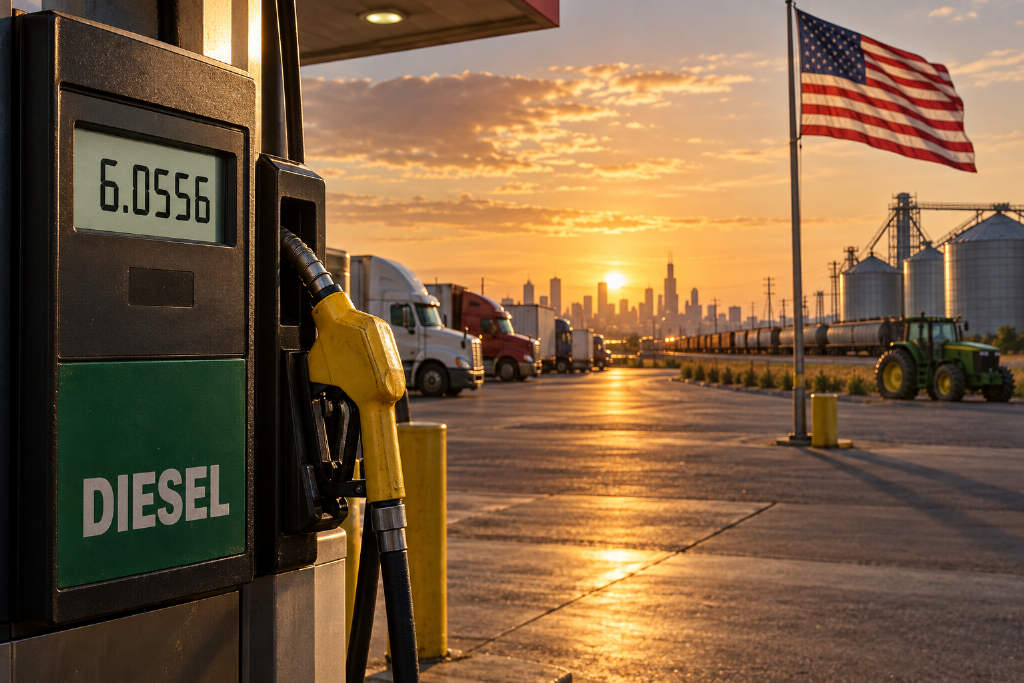
U.S. average diesel prices rose to $6.0556 a gallon on Sept. 11, crossing the $6 threshold for the first time and setting a fresh record.
Bank of America said in a Friday report that the real threat to the U.S. economy is diesel prices, not the sharp move higher in Treasury yields.
That view cuts against the market’s recent fixation on bonds. The 30-year U.S. Treasury yield approached 5.3% this week, its highest level since 2007. But Jared Woodard, ETF strategist at Bank of America, wrote in the bank’s Flow Show report that yields may not be hurting the economy yet, while diesel can.
Why diesel matters more broadly
Diesel has a wider economic footprint than gasoline because it is a production input, not just a consumer fuel. Trucks, freight rail, ships and farm equipment all run on it. It is also used for home heating and in parts of power generation.
Former Pimco chief executive Mohamed El-Erian wrote on social media Friday: 「Although less visible than the gasoline used in private cars, diesel is a critically important production input. Trucks, freight trains, and farm equipment that produce and transport the vast majority of our consumer goods depend on diesel.」
Patrick De Haan, head of petroleum analysis at GasBuddy, told CNBC that if diesel stays near current levels, it will become a “silent killer” for the economy.
California nears $8 a gallon
According to the latest AAA data, average diesel prices rose another 21 cents over the past week. The cost for truckers and farmers to fill up has jumped about 63% from a year earlier. In California, the average has reached $7.9827 a gallon.
De Haan said California diesel could move above $8 a gallon, adding that some gas pump hardware is not even configured to display prices beyond that level.
On that basis, Americans are now spending about $700 million more per day on gasoline and diesel than they were a year ago.
Two forces behind the surge
The source report pointed to two drivers behind the jump in diesel prices.
The first is crude itself. As fighting between the U.S. and Iran intensified this month, U.S. crude futures moved above $100 a barrel on Sept. 10 for the first time since May and were up about 20% month to date. Since the conflict began, diesel prices have climbed more than 55%, while gasoline has risen about 40%. AAA data showed this year’s gains could be the largest on record.
The second is refining capacity. Refining facilities in the Middle East and Russia have been hit by successive damage, while Russia has also limited diesel exports, tightening global supply at the same time.
Even though U.S. refiners have pushed output to a record and utilization has reached 98%, Andy Lipow, president of Lipow Oil Associates, said refineries are already running flat out on diesel and the system has little room left to produce more.
The report added that some refiners have delayed routine maintenance in an effort to preserve output, increasing the risk of unexpected outages during Gulf Coast hurricane season. It also said Trump met with nearly 10 refining companies last week to discuss ways to expand capacity.
Harvest season and port demand add pressure
The timing is difficult. The U.S. is entering the fall harvest season, when farm machinery depends heavily on diesel. At the same time, the ports of Los Angeles and Long Beach are heading into the holiday shopping container rush. Trucking and rail freight operators have already started passing higher fuel costs downstream through surcharges.
Goldman Sachs warned of a risk of a sharp rise in global food prices, citing three factors: the Strait of Hormuz crisis raising diesel and fertilizer costs, the Black Sea situation threatening grain trade, and drought and high temperatures linked to El Niño.
Inflation and rate expectations
The effect of higher energy costs is already showing up in inflation data. The source report said U.S. August CPI rose 0.4% month on month, above expectations, with gasoline and diesel among the main drivers. It also cited an earlier U.S. August PPI release showing diesel up 24%, a sign that raw-material costs are moving more quickly into consumer prices.
After the August CPI report showed energy pushing inflation higher, federal funds futures had nearly fully priced in a 25-basis-point rate increase from the Federal Reserve next week. Some institutions were also assessing the possibility of multiple additional hikes this year.
Other weak spots in financial markets
Derek Tang, a policy economist at Monetary Policy Analytics, pointed to two vulnerable areas in financial markets: the optimism supporting the AI capital-expenditure boom and private credit held by insurers. If funding costs move higher, that could end the AI boom. With Treasuries offering 5% yields, the room for large technology companies to raise money through bond issuance would be squeezed.
The IMF also warned that some insurance companies controlled by private equity have limited transparency and continue to allocate to higher-risk fixed-income assets. If sharp rate swings lead to losses, the risks could spread into the banking system.