

The US dollar index climbed 0.49% to 101.096 on Sept. 23, marking an eight-week high. The 10-year US Treasury yield moved above 5%, its highest level since 2007, spot gold fell below $4,300, and all three major US stock indexes closed lower. As pressure in the Treasury market persisted, Bloomberg reported exclusively that the US government is considering promoting dollar-denominated stablecoins overseas in an effort to cultivate a new pool of foreign buyers for US government debt.
Why the dollar index reached a fresh eight-week high
S&P Global said Wednesday that the preliminary US composite Purchasing Managers’ Index for September rose to 58.4, well above the market expectation of 55.3 and the highest reading since July 2021. The underlying components were also strong: services PMI rose to 58.7 and manufacturing PMI jumped to 57, both ahead of expectations. S&P Global said that, excluding the rebound period after pandemic lockdowns were lifted, the improvement in business activity was the largest since early 2015. By its estimate, a 58.4 reading is broadly consistent with annualized economic growth of about 5%. While the PMI is not an official government release, markets often treat it as the first leading read on monthly activity because the flash estimate arrives earlier than most other data.
The report said the bigger issue for bond markets was not just stronger growth, but the return of broad-based price pressure in the survey. The input price index rose to 66.4, the highest since October 2022, while supply-chain bottlenecks also reappeared. The article argued that strong growth alone would still leave room for the Federal Reserve to wait, but a simultaneous rise in growth and costs makes the case for another rate increase much harder to ignore. After the PMI release, market pricing for a 25 basis point hike in October jumped from 55% to nearly 70%.
Bond markets reacted quickly. The nominal 10-year Treasury yield rose by about 15 basis points, 10-year Treasury Inflation-Protected Securities rose 12.5 basis points, and breakeven inflation expectations increased only about 2 basis points. The article said that points to a move driven mainly by real rates rather than inflation expectations, a setup that directly supports the dollar. As FHN Financial strategist Will Compernolle put it, 「An economy strong enough to withstand rate hikes and an economy strong enough to start pushing inflation higher are two very different macro stories.」
Four other forces the report said are lifting the dollar
The article said the PMI was not an isolated event but the release of pressure that had been building for a month.
First, Federal Reserve officials turned more hawkish. Fed Governor Michael Barr said Wednesday that further policy adjustment is 「likely to be necessary in the baseline scenario」 if inflation is to return to 2% in a timely way. The report placed even more weight on comments this week from Chicago Fed President Austan Goolsbee, who said US inflation may have moved beyond the earlier effects of tariffs and energy-price shocks. That was read as a sign that a more aggressive pace of tightening may be needed. Because Goolsbee has generally been seen as a dove, the article said his shift carried more force than a routine reiteration from an official already known for hawkish views.
Second, short-end rate differentials have kept widening. In foreign exchange markets, short-dated yield spreads matter most, and the US 2-year Treasury yield has risen by about 55 basis points since late August. The article described that move as the direct driver of the dollar’s month-long advance. In that framing, the break above 101 in the dollar index was not a one-day event but the result of a sustained rate advantage, with the strong PMI simply accelerating a trend already in place.
Third, the AI buildout has continued to pull in global capital. The report said corporate AI capital expenditure is expected to reach $800 billion, venture fundraising has exceeded $400 billion, and bond financing by mega-cap technology companies has climbed to roughly ten times recent average levels. Those financing flows helped attract more than $400 billion in foreign equity capital in the second quarter of 2026 alone, a record high, according to the article. Unlike short-term carry trades, those inflows are described as longer-duration direct investment and equity capital, giving the dollar a stickier source of support. The article also flagged the risk: if AI’s commercial model fails to hold up, or if the technology lead narrows, a large reversal in capital flows could hit the currency directly.
Fourth, a wider fiscal deficit and heavier Treasury supply have, in the short run, become another support for the dollar. Goldman Sachs strategist Privorotsky said the US is running a fiscal deficit ratio above 6% and an annual fiscal gap of nearly $1.9 trillion. To finance that shortfall, the Treasury has to issue more debt. More supply pushes bond prices lower and yields higher, while investors demand a larger term premium for holding longer-dated paper. The article cited a weakly received $70 billion five-year Treasury auction that was followed by an almost 20 basis point rise in yields that day. Higher yields then widen the spread between Treasuries and other sovereign bonds, drawing global capital into dollar assets. The report said this dynamic also helps explain why Washington is interested in overseas dollar stablecoins: reserve requirements could create a new class of structural Treasury buyers.
Bloomberg report on an overseas dollar stablecoin push
Bloomberg reported on Sept. 23 that the Trump administration is considering an initiative to promote dollar-denominated stablecoins abroad in order to reinforce the dollar’s status as the world’s reserve asset. According to the report, the administration is weighing cooperation with the private sector through an interagency initiative focused on overseas adoption of dollar stablecoins.
The effort would involve the Treasury Department, the State Department and the US International Development Finance Corporation, or DFC, and would rely on the GENIUS Act signed into law last year. Under that regulatory framework, stablecoin issuers are required to hold reserves in US dollars and short-term Treasuries. The article said that the broader the global use of stablecoins becomes, the larger the private sector’s hard reserve demand for short-dated Treasuries will be.
At the time of the report, neither the Treasury Department nor the White House had responded to requests for comment. Bloomberg said the initiative remains under consideration.
How a stronger dollar reprices US and global assets
The article framed the stronger dollar as more than a currency move. In its view, it acts as a discount rate for global assets.
Inside the US, borrowing and financing costs have risen across the board. By mid-September, the average rate on a 30-year fixed mortgage had climbed to 7.12%, a multi-year high. Real estate and utilities came under pressure, and higher corporate borrowing costs weighed on capital spending plans.
Risk assets also faced a higher valuation hurdle. The forward price-to-earnings ratio for the S&P 500 has fallen to about 19 times, described in the article as a cyclical low. As the yield curve shifts higher, the required return on risk assets rises as well. At the same time, the build-up in short positions has left markets more volatile, meaning even a modest rebound can trigger short covering and amplify two-way price swings.
Non-yielding assets have also lost appeal as opportunity costs rise. With five-year Treasuries offering a risk-free return of as much as 5%, the relative attraction of gold and silver has weakened. Spot gold fell below $4,300 and silver also retreated sharply, reflecting the pressure that higher real rates can place on precious metals.

The article said the effects spill beyond the US. A stronger dollar makes dollar-priced commodities more expensive for other economies, adding imported inflation. It also raises the cost of servicing offshore dollar debt, increasing pressure on emerging markets and highly leveraged borrowers. At the same time, capital flowing back into the US weighs on non-US equity and bond markets.
Why other central banks are following the Fed
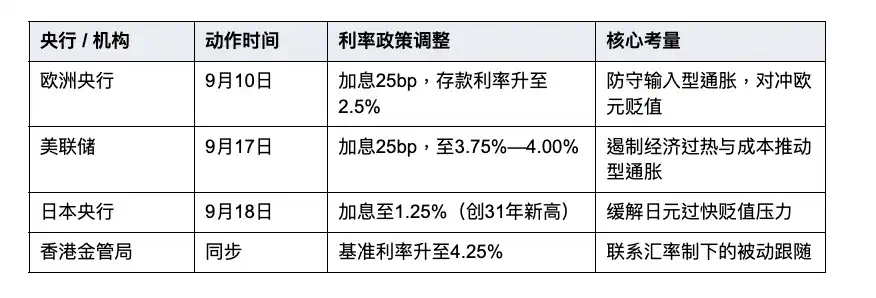
During the recent week of major central bank meetings, the US, Europe and Japan all raised rates in the same month. The European Central Bank lifted its deposit rate to 2.5%, the Bank of Japan raised rates to 1.25%, the highest in 31 years, and the Hong Kong Monetary Authority also followed by lifting its base rate to 4.25%. The article described that as an unusually synchronized tightening cycle.
In the report’s account, the so-called siphon effect is global capital chasing the highest risk-free return at the same time. When the US policy rate rises to 3.75%–4.00% and the five-year Treasury yield moves above 5%, dollar assets become one of the most attractive and liquid options available. Capital then shifts out of other markets and back into the US. For economies losing that capital, the pressure comes in three forms: domestic equity and bond markets weaken, local currencies depreciate as demand for dollars rises, and governments and companies with dollar debt face higher repayment costs as exchange rates move against them.
The article said many central banks are not raising rates primarily to cool domestic overheating, but to defend their currencies and slow capital outflows. Higher local rates are meant to keep domestic assets competitive, while a narrower gap with US rates can ease depreciation pressure. If a central bank allows a sharp currency decline, imported inflation becomes harder to control. That, the article argued, helps explain why Europe and Japan have continued to tighten even though their domestic fundamentals are weaker than those of the US.
The cost of synchronized tightening is slower growth. When major economies all tighten credit conditions at once, financing costs rise globally, corporate capital expenditure is restrained, and household spending on durable goods weakens. For economies that depend heavily on external demand, defensive rate hikes amount to braking into a slowdown. The article pointed to eurozone manufacturing PMI remaining below the expansion-contraction line as one example. It also said weaker global demand can eventually feed back into the US through exports and multinational earnings.
Middle East developments and oil: intraday volatility, not a new trend
The article also reviewed how Middle East developments affected oil prices this week.
On Sept. 22, Trump addressed the 81st session of the United Nations General Assembly and presented Iran with what the article described as a binary choice: either reach a deal and receive help rebuilding the country, or face the prospect of the Islamic Republic being 「swiftly eliminated」 with no hope of survival. Iran’s delegation left the hall. In the same speech, Trump said a US-Iran nuclear agreement would be reached after the November midterm elections. Energy was another major theme. He said the Pentagon would take a stake in a company holding extraction rights to 17 oil fields in Venezuela, said he met Venezuela’s acting president during the UN gathering, and predicted that if all sides stayed united, 「oil prices will collapse, even below where they were when the conflict began.」 The article noted that two claims in the speech were later checked and found exaggerated: that the US and Venezuela together hold more than 60% of the world’s oil, when the actual figure is about 22%, and that oil flows through the Strait of Hormuz are at a record high, when they remain below prewar levels.
On Sept. 23, Iranian President Masoud Pezeshkian responded at the UN, after which the US delegation left mid-session. His remarks had three main points, according to the article: Iran will not surrender in a war with the US but welcomes dialogue and will not yield under sanctions, threats or military pressure; Iran will not give up its right to peaceful nuclear technology, saying, 「We need nuclear energy, not a nuclear bomb」; and on the Strait of Hormuz, he rejected any arrangement under which outside powers use the waterway while threatening Iran, adding that the strait cannot be used to transport weapons aimed at Iran.
The market, however, focused more on a closed-door meeting in New York during the UN gathering. Iranian Foreign Minister Abbas Araghchi met US envoy Steve Witkoff for about three hours, and Trump’s son-in-law Jared Kushner also took part. Afterward, Trump called the talks 「productive」 and said Iran appeared willing to reach an agreement with him. Following that news, WTI crude briefly fell 2.31%, dropping below $90 and touching a three-week low. Iran then restated three preconditions for keeping the strait open: the US must immediately lift the maritime blockade, immediately unfreeze all Iranian assets, and end the wars across the region’s fronts. The article said the gap between the two sides remains clear: the US wants a comprehensive agreement that includes the nuclear issue, while Iran wants the blockade lifted first and other matters discussed later.
Oil then completed a full V-shaped move in the same session. WTI first fell below $90 on the talks, then rebounded after Pezeshkian repeated at the UN that there would be no discussion of freedom of navigation unless the blockade was lifted. Brent moved back above $103, and WTI settled up 2.4% at $92.68, ending a five-session losing streak. The article said that kind of round trip suggests geopolitical headlines can drive intraday volatility, but do not easily reset the broader trend on their own.
What markets are watching next: payrolls and CPI
The article said the next two key releases, nonfarm payrolls and CPI, both arrive before the Federal Reserve’s October policy meeting.
The September payrolls report is the first test. As the nearest official hard-data release, it will show whether the overheating implied by the PMI is real. If payrolls are also strong, doubts about the PMI’s reliability would fade and the probability of an October rate hike could move from nearly 70% toward something close to fully priced. If payrolls weaken materially, part of the latest repricing in yields and the dollar could reverse.
The more decisive release, the article said, is September CPI. The central question is not whether growth is strong, but whether growth has become strong enough to push inflation higher, echoing Compernolle’s distinction. The PMI input price index at 66.4 reflects how companies feel about costs in a survey. CPI is the evidence of whether those costs have actually passed through to consumers. If September CPI confirms that transmission, the case for another round of Fed tightening would be much stronger.
The article ended by noting that the stablecoin-related material came from media reporting based on people familiar with the matter and has not been officially confirmed by the US government. The initiative remains under discussion, and both its final form and whether it proceeds at all remain uncertain.