

US equity exposure has become a key battleground for centralized exchanges, and a seven-day review of public API data shows Binance leading the field in both tokenized stock spot trading and stock perpetuals.
The sample covers Binance, Bybit, Gate, Kraken and Bitget. The data spans July 8 to July 14, 2026, using full UTC calendar days. The review counts actual turnover that can be clearly attributed to each platform’s CEX order books.
For consistency, the spot comparison used four 1:1 tokenized stocks — NVDA, TSLA, META and GOOGL. The perpetual comparison used AAPL, NVDA, TSLA and GOOGL. The perpetual figures represent notional turnover, not net buying, open interest or exchange revenue.
Binance posted the highest turnover in both categories
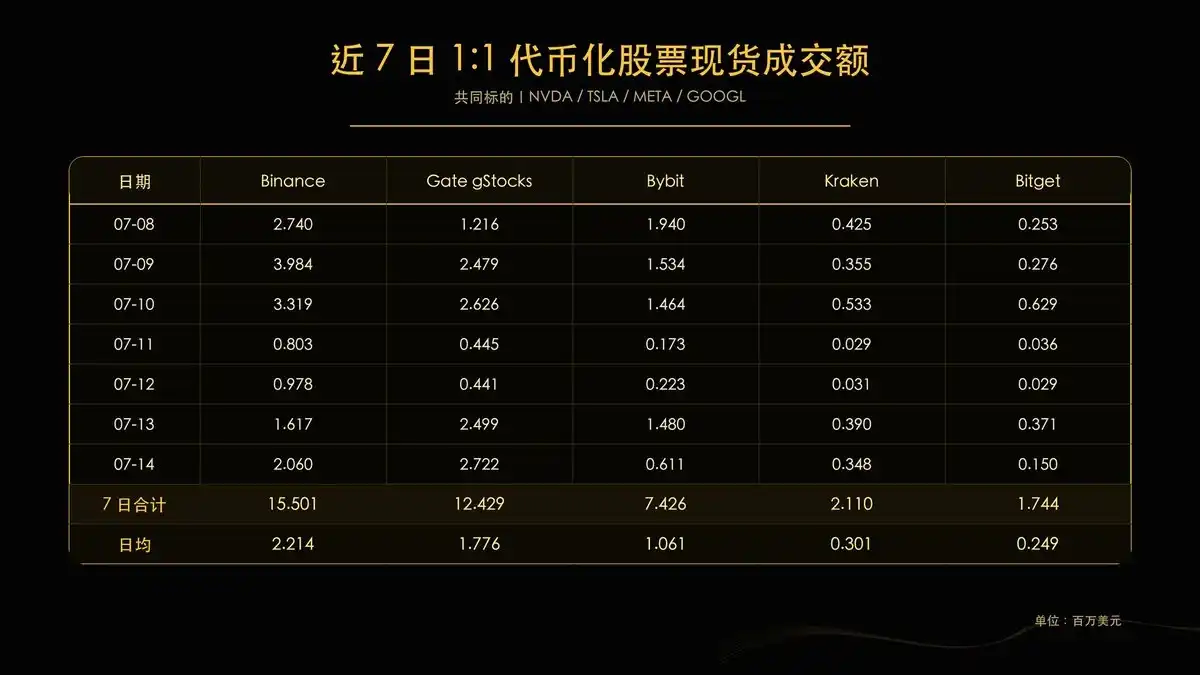
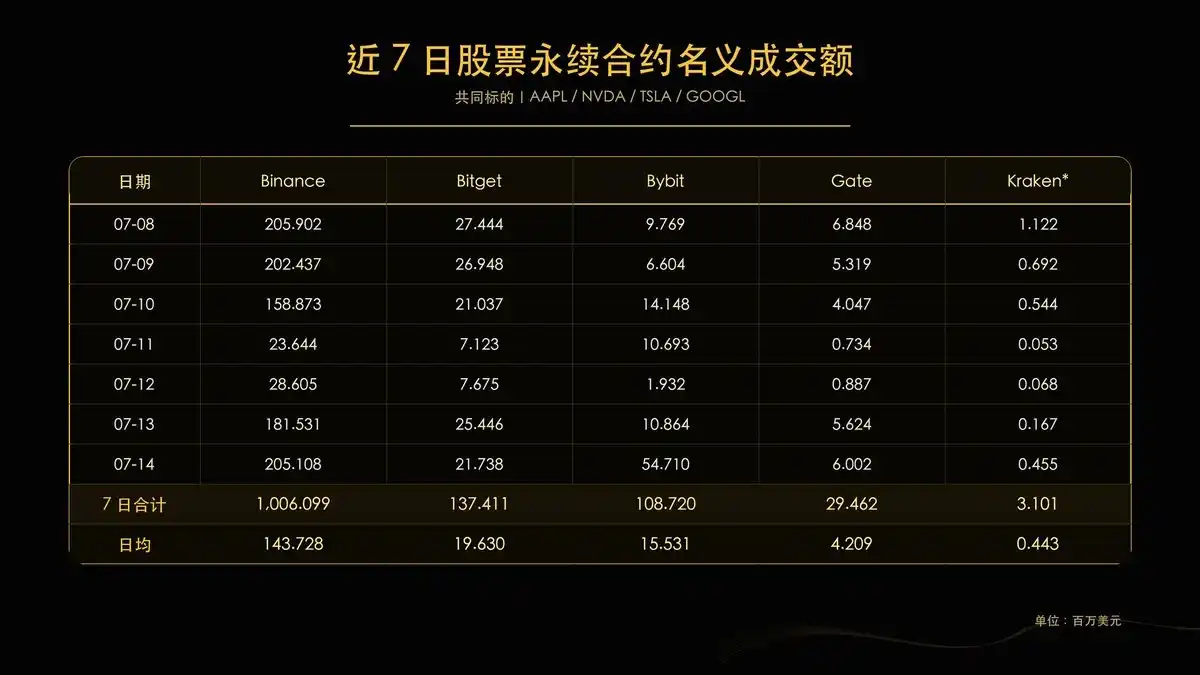
Over the past seven days, Binance recorded about $15.5013 million in 1:1 tokenized stock spot turnover and about $1.006 billion in stock perpetual turnover.
The spot count includes CEX order-book turnover in Binance bStocks for the four shared names: NVDA, TSLA, META and GOOGL. The perpetual figure covers the AAPL, NVDA, TSLA and GOOGL stock perpetual order books.
The review did not include Binance Wallet activity or volume generated through on-chain aggregated trading.
Bybit ranked behind Binance in both spot and perpetuals
Bybit logged about $7.4257 million in 1:1 tokenized stock spot turnover and about $109 million in stock perpetual turnover over the same seven-day period.
Its spot tally comes from the xStocks product line and the same four shared spot names. The perpetual figure reflects notional turnover in the corresponding stock perpetual order books.

Bybit Wallet activity, on-chain DEX trading and other third-party liquidity sources were not counted as part of platform turnover.
Kraken data was estimated into dollar terms
Kraken recorded about $2.1096 million in 1:1 tokenized stock spot turnover and about $3.1010 million in stock perpetual turnover over the seven-day window.
The spot side covers the shared names in xStocks order books. The review noted that some of Kraken’s public candlestick data returns base-asset volume rather than direct dollar turnover. Because of that, the dollar figures here were estimated by multiplying daily VWAP or average OHLC prices by base-asset trading volume.
That keeps Kraken on the same notional dollar scale as the other venues, though the precision may be slightly lower than on exchanges that publish quote turnover directly.
Bitget spot numbers exclude rToken and only count Ondo order books
Bitget posted about $1.7438 million in 1:1 tokenized stock spot turnover and about $137 million in stock perpetual turnover over the period.
On the spot side, the review counted only the Ondo Stock Token line — NVDAON, TSLAON, METAON and GOOGLON — and excluded rToken issued by Reality Protocol.
The stated reason was attribution. According to the review, public market data for Bitget rToken appears closer to underlying US stock or directly connected broker liquidity, making it hard to tie that volume clearly to Bitget customers trading inside the CEX.
One example cited in the piece was rNVDA, whose 24-hour volume at one point exceeded $25 billion, already close to the scale of NVIDIA’s underlying full-market stock turnover. Counting that figure directly as Bitget platform volume would materially overstate the exchange’s actual business size.
As a result, only spot order-book turnover that could be confirmed through the public API, together with Bitget’s stock perpetual order books, was included.
Gate runs three spot product lines, but the main ranking uses only gStocks
Gate reported about $12.4290 million in gStocks spot turnover and about $29.4617 million in stock perpetual turnover over the seven days.
Gate stands out because it has three separate tokenized stock spot order-book lines:
- gStocks: about $12.4290 million
- xStocks: about $2.1444 million
- Ondo: about $4.5283 million
Together, those three spot lines add up to about $19.1017 million. Even so, the main scoreboard used only Gate’s branded gStocks line in order to keep the cross-exchange comparison limited to one representative spot product line per platform, rather than stacking three order books against another venue’s single product line.
If all visible spot order books for the four shared names on Gate are included, total spot turnover comes to about $19.1017 million. Adding stock perpetuals brings the combined total to about $48.5634 million.
The Gate perpetual figure covers order-book turnover in four USDT-margined stock perpetual contracts: AAPLX, NVDAX, TSLAX and GOOGLX.
What the review includes and what it leaves out
The review measures actual turnover in public API data that can be clearly attributed to CEX order books. It does not include:
- full-market turnover in the underlying US stocks
- wallet aggregation trades that cannot be attributed to a specific platform
- trading volume for on-chain tokens across the wider DeFi ecosystem
- customer execution routed through broker channels but not disclosed by the platform
- market data that cannot be separated from platform customer execution
Using the main-ranking method of one representative spot product line per exchange, the seven-day tokenized stock spot ranking was:
- Binance: about $15.50 million
- Gate gStocks: about $12.43 million
- Bybit: about $7.43 million
- Kraken: about $2.11 million
- Bitget: about $1.74 million
The stock perpetual ranking was:
- Binance: about $1.006 billion
- Bitget: about $137 million
- Bybit: about $109 million
- Gate: about $29.4617 million
- Kraken: about $3.1010 million
Perpetual turnover was about 32.8 times spot turnover
Across the five exchanges and the current shared-ticker framework, stock perpetual turnover was about 32.8 times larger than 1:1 tokenized stock spot turnover.
The piece said that, at this stage, demand from CEX users seeking US equity exposure is still concentrated in perpetual contracts rather than 1:1 tokenized stock spot products. It cited the ability to go long or short, use leverage and achieve higher capital efficiency, which fits more closely with existing crypto trading habits.
Weekend volumes still dropped sharply
Another observation from the review was that weekend turnover fell markedly even though many tokenized stock and stock perpetual products are marketed as available for 24/7 trading.
That suggests round-the-clock availability does not mean liquidity has fully detached from the US equity market. At the current stage, US stock trading hours, price discovery in the underlying market and the active hours of market makers still have a large influence on liquidity in CEX products tied to US equities.