
The United States and Japan have reportedly coordinated a direct intervention in the foreign exchange market to support the yen, the first such joint action in nearly 30 years. The operation was carried out by the Federal Reserve Bank of New York on behalf of the U.S. Treasury, using a sell-euro, buy-yen structure.
Citing the Financial Times and Reuters, ABMedia reported that sources from both governments said Washington and Tokyo reached coordination and formally entered the market on Friday to intervene in the yen. Nikkei also reported that the Japanese government was carrying out large-scale yen purchases.
New York Fed executed the trade for the U.S. Treasury
Under the reported process, the Federal Reserve Bank of New York executed the transaction for the U.S. Treasury by selling euros (EUR) in exchange for Japanese yen (JPY). Market sources said Goldman Sachs and Morgan Stanley played key roles in arranging the cross-border foreign exchange trade.
European Central Bank officials were also said to have been briefed in advance so that major international monetary authorities remained aligned on the measure.
Rate check appeared a day before the intervention
A signal surfaced before the move was carried out. According to people familiar with the matter, the New York Fed on Thursday asked several FX trading banks to conduct a rate check in USD/JPY on behalf of the U.S. Treasury.
In the foreign exchange market, a rate check by a central bank or finance ministry is commonly treated by traders and other market participants as a sign that direct buying or selling may follow.
Reuters added that after the yen fell to its weakest level since 1986, the U.S. Treasury had already notified several major FX banks about a possible intervention plan in the yen market. That notice gave major participants time to assess liquidity conditions and the possible impact.
Bessent had previously spoken about the yen
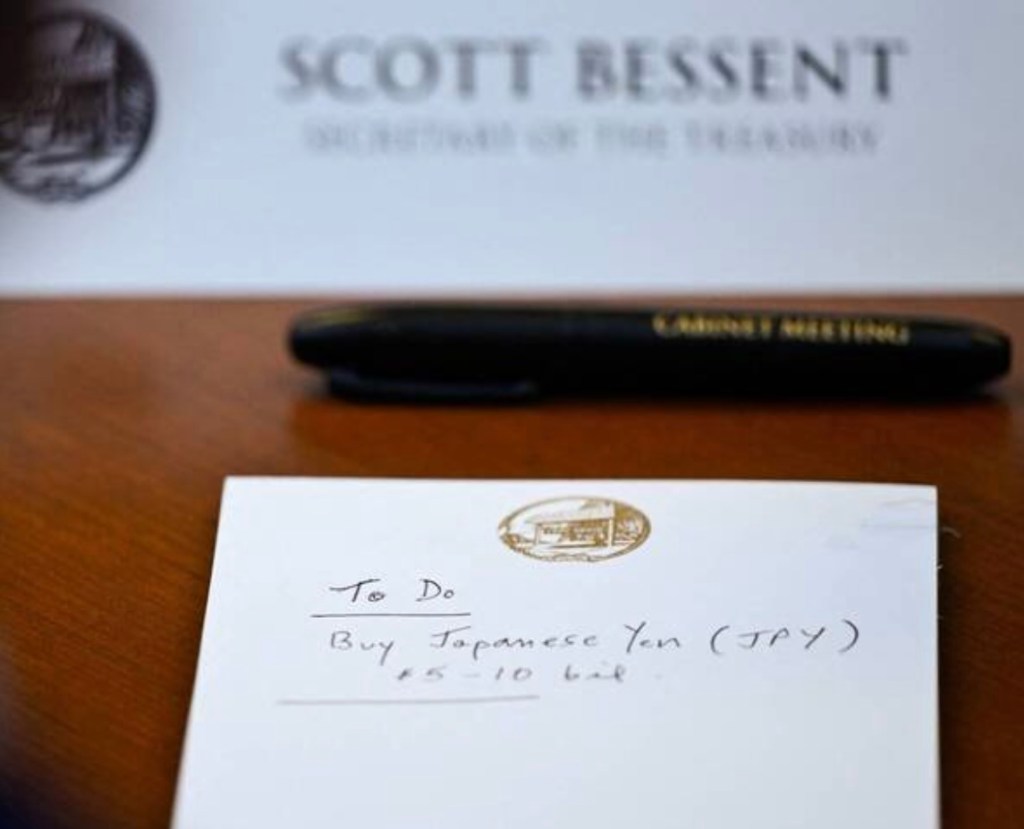
ABMedia said U.S. Treasury Secretary Bessent had previously stated in public that the yen was severely undervalued and excessively volatile. Media outlets also photographed a note listing a task to “buy $5 billion to $10 billion of yen.”
Before publication, USD/JPY had fallen to 157. The report said the yen’s prolonged weakness had briefly eased inflation pressure on Japan, though it also meant the exchange rate was less favorable for those converting U.S. dollars into yen.