
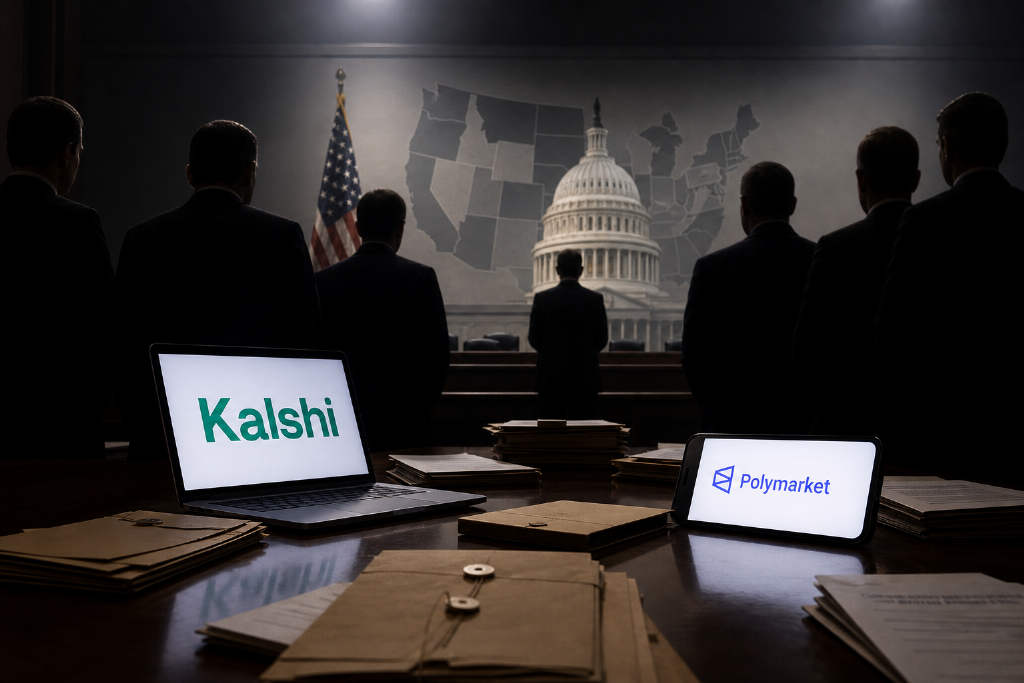
A legal fight over the future of prediction markets such as Kalshi and Polymarket is pulling in the Trump administration, Donald Trump Jr. and attorneys general from across the United States. The central question is whether these platforms, which let users wager on sports, politics and other real-world events, should fall under federal oversight or be regulated under state sports-betting laws.

According to The New York Times, Donald Trump Jr. spoke in early March at the Ritz-Carlton in New Orleans to a group of Republican state attorneys general attending a three-day closed-door meeting. People familiar with his remarks said that, during a question-and-answer exchange with Montana's attorney general, he suggested state leaders were being misled by "vested interests" and that gambling companies were attacking prediction markets to preserve their "monopoly position." He said the markets were already tightly regulated and described them as sophisticated financial instruments that should be overseen by federal officials, not state attorneys general.
Those familiar with the speech said his tone was friendly. Still, the remarks, which had not previously been reported, matched the message his father's administration has delivered to state leaders: stay out.
Lawsuits have now spread across the country. Republican- and Democratic-led states alike are moving against prediction market platforms including Kalshi and Polymarket, and the outcome of the court fight will shape whether Americans can continue using these venues to bet on sports, politics and almost any other event.
The report says 20 states are involved in litigation over whether prediction markets should be governed by state sports-gambling laws. Last month, 44 states signed a joint letter attacking the platforms as a "new form of casino" that preys on young people. State officials argue the markets are dodging regulation and avoiding state taxes. The nonpartisan Tax Foundation has estimated that states are losing at least $2 billion a year in tax revenue.
Trump administration and CFTC back the platforms
The dispute has turned into an unusual political struggle between the federal government and the states. President Trump has said he wants prediction markets to "thrive" under his leadership and not be controlled by the states. His administration has lined up with Kalshi in court, arguing that the Commodity Futures Trading Commission, or CFTC, is the only regulator with authority over the industry.
The CFTC is a small federal agency that oversees commodity markets such as oil and agricultural products. The agency said it had never sued a state over a regulatory issue in the half-century since its 1974 founding. This year, however, it has sued nine states, all led by Democratic governors. It has also twice instructed prediction markets to ignore court orders, using emergency powers that had not been deployed in decades.
That aggressive intervention has aligned the agency's position with the Trump family's financial interests in the sector. In January last year, Kalshi hired Donald Trump Jr. as an adviser. His compensation included Kalshi stock worth more than $300,000, and the value of those shares has multiplied several times. Last year, he also became an adviser to Polymarket and holds a stake in the company through his investment firm, 1789 Capital.
A spokesperson for Donald Trump Jr. said he "does not engage with the federal government on behalf of any company he invests in or advises." A Kalshi spokeswoman said he provides the company with marketing advice.
The fight has also attracted a powerful coalition of traditional gambling operators, which see prediction markets as a competitive threat and have pressed states to act. An industry group representing casino operators is working with former New Jersey Governor Chris Christie, who has publicly criticized prediction markets.
"There's a lot of money involved," said Rob Schwartz, who served as the CFTC's general counsel until last year and has tracked the 17-month wave of litigation. "This is definitely going to the Supreme Court. It's just a matter of time."
The core dispute: financial contract or gambling product
At the center of the litigation is a basic argument over what counts as gambling.
For years, Kalshi and other prediction market companies have been registered with the CFTC and have classified wagers on their platforms as "event contracts," financial instruments whose value is derived from real-world outcomes. These contracts often take the form of yes-or-no propositions, such as whether it will rain on a given day. The companies argue that because the instruments are regulated at the federal level, prediction markets should be free to operate nationwide.
As the largest prediction market in the United States, Kalshi has faced the heaviest legal pressure. Polymarket, by contrast, handles most of its wagers outside the United States, though it now has a small U.S. app.

In a statement, Kalshi said it has safeguards for customers and a business model that gives people a real chance to win money. The company said it operates under a "national regulatory framework, not a patchwork of state-by-state regimes," adding that state efforts to shut down a federally licensed exchange are "too aggressive."
State officials reject that view. Attorneys general argue that Kalshi's product is almost indistinguishable from sports betting but lacks protections required under state law. In nearly every state except a handful, residents under 21 cannot legally place sports bets. Kalshi's app, however, is open to anyone 18 or older.
"You can go onto a website and place a bet on the outcome of a sporting event," said Washington Attorney General Nick Brown, a Democrat who won an early court victory against Kalshi this month. "That's gambling."
From Super Bowl ads to a national legal campaign
Kalshi co-founder Tarek Mansour has argued that what his company offers is fundamentally different from traditional gambling. State officials see the issue very differently.
On the morning of the Super Bowl this year, Utah Attorney General Derek Brown saw a Kalshi advertisement pushed to his college-age son. The ad invited him to "legally trade on football outcomes." Brown said he was stunned. In his view, Kalshi was using clever wording to get around Utah's constitutional ban on gambling.
"It's wink, wink, nod, nod," he said.
Over the next two weeks, Brown and Utah's governor, both Republicans, publicly criticized prediction markets and called them "almost dystopian." Brown received a text message from a Kalshi lobbyist asking to speak with him. He ignored it.
At the end of February, Kalshi sued Utah in federal court, saying the state "intends to prohibit Kalshi from operating." That case is one front in a nationwide legal war involving Kalshi and several of its top competitors, including Polymarket and the trading website Crypto.com.
After the U.S. Supreme Court struck down the sports-betting ban in 2018, most states legalized the business and began taxing it. According to the Tax Foundation, licensed operators generated more than $3 billion in tax revenue in the last fiscal year.
Prediction markets took a different route. In 2024, Kalshi won a court ruling allowing it to offer election betting, opening the door for such markets to operate under CFTC approval. This year, Kalshi and Polymarket became cultural phenomena, drawing tens of billions of dollars in wagers each month. With new entrants arriving, the number of registered prediction markets has reached 13.
Much of the public attention has focused on unusual contracts, including wagers tied to celebrity drug use or an Israeli missile strike. But according to data provider The Block, about 75% of activity on Kalshi this year has come from sports. Kalshi has also reached a partnership with The Athletic, the sports media site owned by The New York Times Company.
Mansour said in a January interview, "We're regulated exactly like the New York Stock Exchange or Nasdaq." His argument is that Kalshi does not act as the house taking the opposite side of every bet. Instead, it matches buyers and sellers and earns revenue by charging fees.
Some of Kalshi's own marketing has undercut that argument. One social media ad cited in state lawsuits urged customers to "bet on the NFL." Kalshi said it no longer uses that ad.
The rise of Kalshi and Polymarket has angered traditional gambling operators that pay state taxes and hold state licenses. Some companies, including DraftKings and FanDuel, quickly built their own prediction market offerings. Others fought back, led by the American Gaming Association, which represents casinos and other betting companies.

Kalshi is a "backdoor sports betting operator" that is flouting state law, association spokesperson Rob Lockwood said in a statement.
Emails obtained by The New York Times show that in December last year, association executive Tres York had dinner at Joe's Seafood in Washington with Kentucky Attorney General Russell Coleman. York later pitched Coleman's office on the need to push back against prediction markets and said a coalition of states was preparing a legal brief.
"I'd be happy to connect you with the Nevada deputy attorney general, who is spearheading recruitment to defend states' rights," York wrote in an email to one of Coleman's deputies.
Kentucky did not sign that brief, but Coleman later sued Kalshi and Polymarket in state court. "These multibillion-dollar companies and their compliance do not hold up under scrutiny," he said in a statement.
Federal agency steps in and uses emergency powers twice
Another party soon entered the battle more directly.
In December 2025, Michael S. Selig, Trump's pick to lead the CFTC, was sworn in as chair. Selig, now 36, is described as a technology enthusiast who previously worked as a corporate lawyer with prediction market and cryptocurrency companies.
After taking control of the agency, Selig sued Kentucky, Illinois and seven other states fighting prediction markets. "This is existential for the agency," he said in an interview. "If states try to undermine our regulations, that is a problem for us."
In some states, the agency has treated the matter as an emergency and invoked unusual powers. Michigan became the clearest example. In July, a state judge ordered Kalshi to stop taking wagers from Michigan residents because the company lacked the proper license.
The CFTC then used its rarely exercised emergency authority to direct Kalshi to ignore the court order, even though the company had already begun canceling wagers. In filings, the agency said Michigan's order "could undermine public confidence in prediction markets."
The last time the CFTC used that power was in 1980, when President Carter banned grain sales to the Soviet Union. The agency halted grain futures trading to calm panic in commodity markets.
"This is really unprecedented and, frankly, outrageous," said Aitan Goelman, who served as the CFTC's enforcement director during the Obama administration. "How is being unable to bet on sports online a market emergency?"
This month, after a federal judge refused to block New York from shutting down Kalshi's local operations, the CFTC launched a second emergency intervention and instructed Kalshi to keep operating. Within days, the company cited that move in a case in Connecticut.
The federal judge handling that suit was not persuaded. "The CFTC lacks authority to issue orders that conflict with this court's ruling," he wrote.
Asked why the agency was trying to move around judges, CFTC spokesperson Zach Fulton said it needed to "maintain the status quo while the courts are still deciding these questions."

Like the growing alliance of Democratic-led states, Republican-led Ohio, Nevada, Montana and Tennessee have also sued or issued cease-and-desist orders to force prediction markets to comply with local rules. But while the CFTC sued nine states led by Democratic governors, its strongest move against Republican-led states has only been to file amicus briefs. Judges are not required to adopt those arguments.
Fulton said politics played no role in the agency's legal strategy and that it sued the states it viewed as the most aggressive.
"The CFTC didn't choose these states; they chose themselves," he said.
North Carolina budget language becomes a model
At the same time, Kalshi has been trying to secure friendlier treatment through state-level policymaking.
Last month, North Carolina state Representative Pricey Harrison, a Democrat, was reading a printed copy of the state's latest budget bill when she found a provision on page 626 that alarmed her. Harrison had recently introduced a bill to limit prediction markets. The budget language instead said that CFTC-licensed prediction markets "may legally operate in the state by virtue of their registration with the commission."
Under the provision, those markets would pay a 6% tax on revenue, lower than the 23% tax rate imposed on sports-betting operators. "I'm not the most observant person," Harrison said, "but I thought, 'Oh, that doesn't sound right.'"
The measure would let prediction markets operate in North Carolina without facing the threat of state lawsuits. Two people familiar with the conversations said a Kalshi lobbyist, former North Carolina legislator Jim Harrell, helped shape the language during discussions with Republican leaders in the state House. The report says Kalshi's feedback helped keep the tax rate below what lawmakers had initially considered.
Lawmakers also heard from the White House, another sign of federal involvement in a state-level fight. A spokesperson for House Speaker Destin Hall said the Office of Intergovernmental Affairs shared information about the "federal government's position on state regulation of prediction markets." The budget was signed into law on July 7.
A White House spokesperson said President Trump believes it is "critical" that the CFTC retain exclusive authority over these markets.
Hall's spokesperson denied that the tax provision was a giveaway, noting that prediction markets had not previously been taxed. Kalshi said the North Carolina arrangement is fair to the industry and added that because many people win money on prediction markets, the state will also tax those profits.
Mixed court outcomes as lobbying expands to all 50 states
So far, the litigation has produced mixed results. All nine CFTC cases remain pending in federal court. Judges in places including Nevada and Washington have ruled against Kalshi and ordered it to stop operating. The company won an early victory in a federal appeals court in New Jersey, but other appellate courts are still weighing similar disputes.
Even so, policy wins such as the one in North Carolina are already being used as examples. Two weeks after the budget was signed, one of Kalshi's lawyers cited the arrangement in filings in an appeal and described it as a possible compromise for other jurisdictions.
According to one person familiar with the matter, Kalshi had deployed lobbyists in all 50 states as of this month as it pushes for more ground.
