

Stocks Closed Mixed on Aug. 24 as Money Shifted Toward Defensive Names
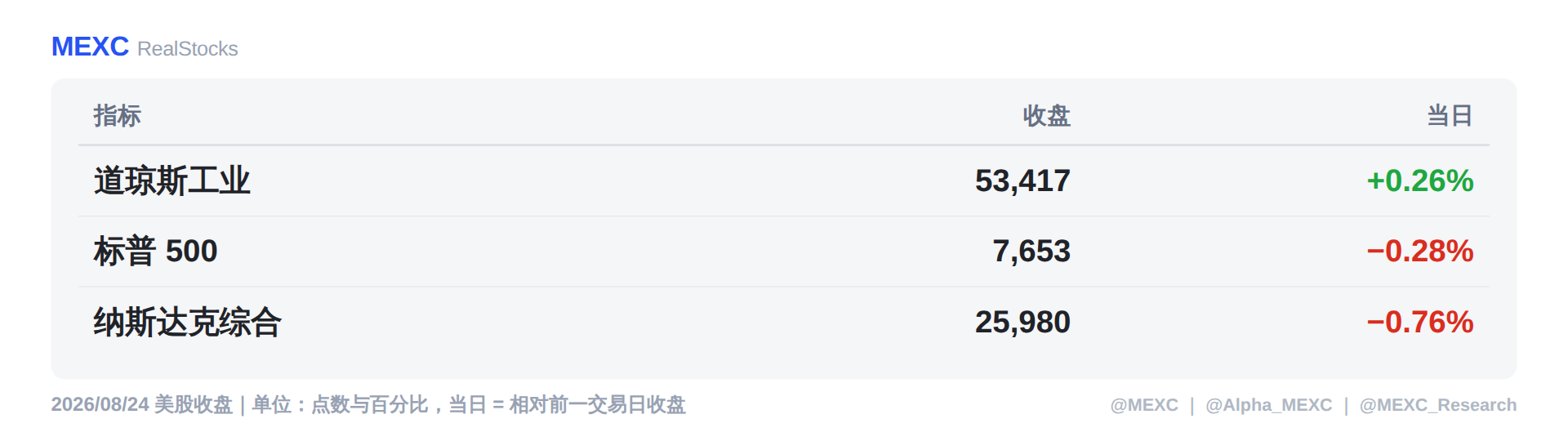
U.S. stocks ended Aug. 24 with a split close. The Dow Jones Industrial Average rose 0.26% to 53,417, while the S&P 500 fell 0.28% to 7,653 and the Nasdaq Composite dropped 0.76% to 25,980.
The report framed that session as more than a simple mixed close. It described a visible repositioning ahead of earnings, with capital moving out of growth and into defensive areas. Technology stocks fell about 0.97% on average during the day, while the consumer defensive sector gained about 1.82%.
NVIDIA (NVDA) closed down 2.91% at $208.48. The report said there was no new company-specific headline behind the move and treated the decline as pre-earnings risk reduction ahead of Wednesday’s post-close results rather than a direct change in the market’s view of fundamentals.
PDD Holdings (PDD), which released earnings before the bell on Monday, fell 1.48% to $87.07. Revenue rose 8% year over year to RMB 112.4 billion, but adjusted net profit fell about 13% from a year earlier. The report said heavier ecosystem investment weighed on profit and noted that management also referenced changes in the global trade and regulatory environment.
Precious metals moved the other way. December gold futures were holding near the historic high area around $4,700, the Nasdaq gold sector averaged a 0.74% gain on the day, and the semiconductor sector averaged a 1.82% decline. Put together, those moves pointed to a clear change in risk preference during the session.
Strategy Rose 2.83%, but the Bigger Story Was What It Did Not Buy
Strategy (MSTR), formerly MicroStrategy, was the strongest performer highlighted in the report. The stock closed at $122.63, up 2.83% for the day. Its market capitalization increased by about $1.1 billion to $40.6 billion, and turnover reached 41.02 million shares, roughly double its daily average.
Still, the report said the real news was not the gain in the share price. Strategy raised $2.01 billion through a new stock sale last week, issuing 18.26 million shares, yet did not increase its Bitcoin holdings by even one coin.
Of that financing, $1.59 billion went into a newly established U.S. dollar cash account, pushing the company’s dollar reserves to $5.1 billion. Its Bitcoin holdings stayed at 840,447 BTC, with an average acquisition cost of $75,385 per Bitcoin. With Bitcoin back above $77,000, the report said that position had moved back into positive mark-to-market territory.
There was also an intraday-versus-close detail. Strategy traded as high as $125.11 during the session, which implied an intraday gain of 4.9%, before ending the day up 2.83%. The article noted that different media outlets may cite different figures because they are using different timestamps, so readers need to check whether a move refers to an intraday high or the closing price. The next update on holdings and cash, it added, will come in a later 8-K filing.
The Key Metric in Equity Issuance-for-Bitcoin Trades: Bitcoin Per Share
The report argued that the most useful way to read these equity-financed Bitcoin accumulation announcements is to focus on Bitcoin per share.
When a company sells stock at market prices and raises cash, the share count increases, which means dilution. But if the cash raised is converted into more Bitcoin, the amount of Bitcoin backing each share can still rise. In that case, dilution can work in favor of existing shareholders. If the share count rises and Bitcoin holdings do not, Bitcoin per share moves lower.

That was the article’s point in the Aug. 24 example: the company sold stock, but did not add Bitcoin. The suggested method was straightforward. Look at two numbers together: how much the share count increased, and how much the Bitcoin holdings increased. Looking only at the fundraising total, or only at the stock’s one-day move, can lead to the wrong conclusion.
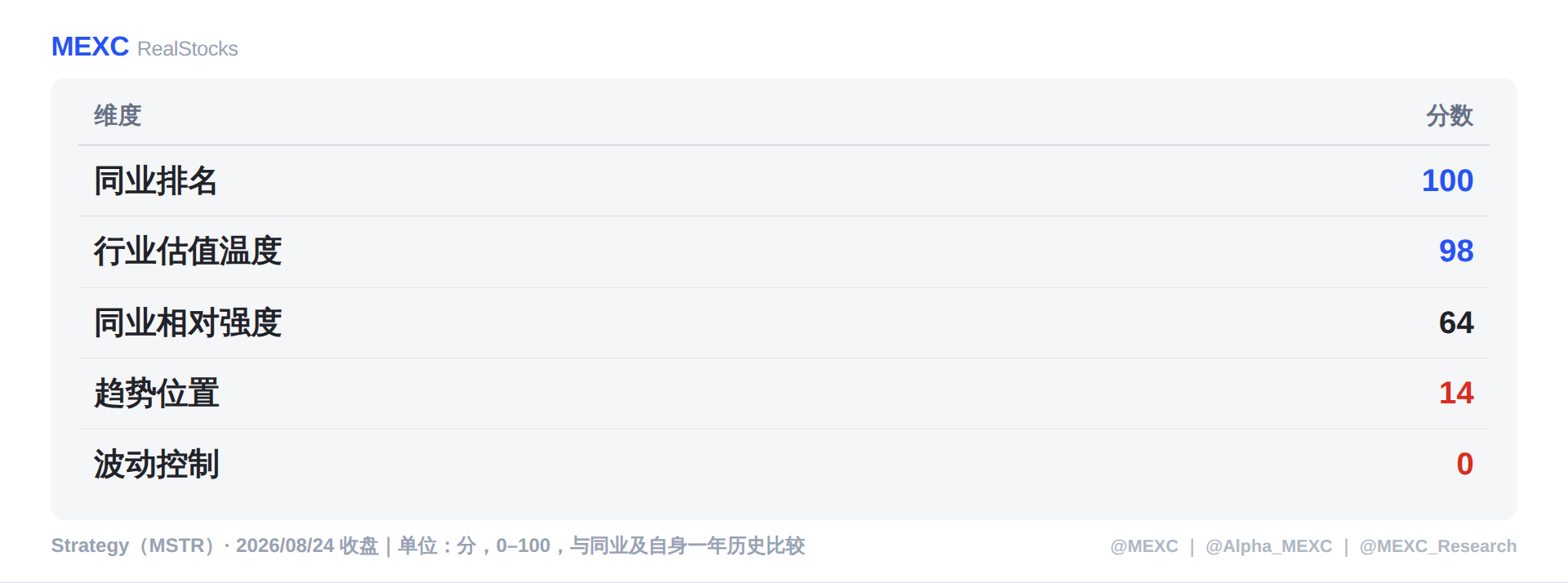
The report also referenced a five-dimensional scoring table and said the shape of that scorecard was a conclusion by itself. Strategy scored full marks in peer ranking and 98 in industry valuation temperature, but only 14 in trend position and 0 in volatility control. In plain terms, the article said, that meant Strategy remained the strongest company in its peer group, while its share price still sat in the bottom 14% of its own one-year range and its volatility was heavily amplified, with a beta of 3.56.
Bitcoin Gained 22% in a Week, but Most Crypto Stocks Still Fell
The report set up another contrast as the more memorable comparison of the day. Bitcoin posted its best weekly performance in nearly two years, up 22% over the week. Yet among six U.S.-listed crypto-linked stocks tracked in the piece, only two closed higher on the same day and four ended lower. The spread between the best and worst performers was close to 8 percentage points.
The Nasdaq financial capital markets sector also averaged a 1.53% decline that day. For the report, that was evidence that Bitcoin and crypto equities do not move on the same line.
It explained the gap through business models and balance-sheet transmission. Companies that directly hold Bitcoin can reflect price moves on their books much more directly. Companies that rely on trading commissions need trading activity to turn price action into revenue. Mining operators and compute-facility businesses carry large fixed assets and debt in their cost structures, so a higher Bitcoin price does not automatically translate into better near-term profit and loss.
The practical takeaway in the article was to regroup companies by how revenue is generated rather than by headline sector labels whenever a market theme is assumed to move as one.
Beta 3.56: A Position Multiplier, Not a Simple Risk Score
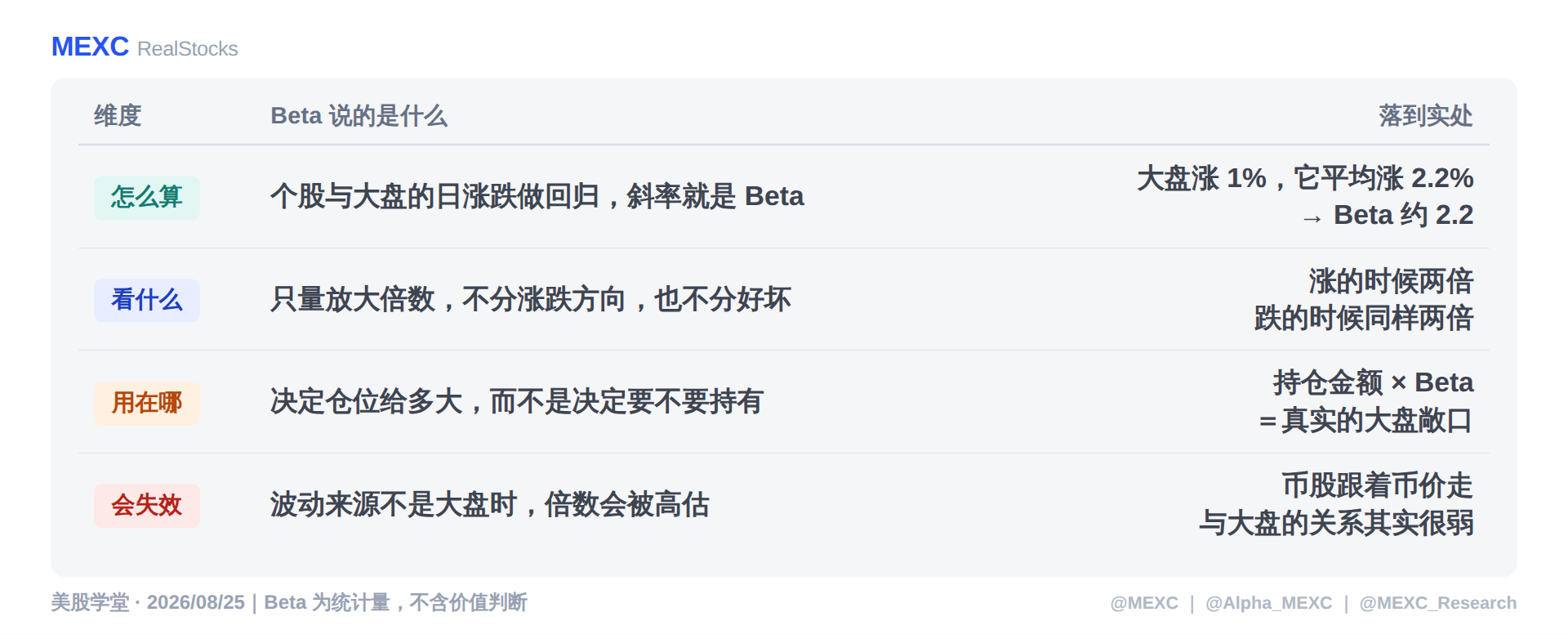
The piece then used Strategy’s 3.56 beta to explain how beta should be handled in practice. Its central point was blunt: beta is not a risk score. It is a position multiplier.
Two investors can each put in $100,000 and still end up with very different market exposure. The difference is not the dollars invested but how many times the stock magnifies broader market moves.
The report stressed that beta answers only one question: how much a stock tends to move relative to the market. It does not explain why it moves. Two stocks can both have a beta of 3, while one trades mainly on interest-rate expectations and the other on Bitcoin. Same multiple, very different behavior.
That is why a beta of 3 does not automatically mean a stock is “three times more dangerous” than the market. In the article’s formulation, beta 3 means that when the market moves 1%, the stock moves 3% on average. It says nothing about the extra company-specific moves that can come from earnings, regulation, or a lost major customer.
The report also said beta should not be read without the regression’s explanatory power, or R². If R² is low, the market itself does a poor job of explaining the stock’s moves, and a high beta may be measuring broad volatility rather than true sensitivity to the index. The article said that is often the case with crypto-related equities: beta is high because the stocks are volatile, not because they track the market cleanly.
It added two questions investors should ask whenever they see a beta figure: how long the sample period is, and whether the company changed its business during that period. If the business changed, the old beta may be describing a different company than the one trading today.
Six U.S. Stocks, More Than a Tenfold Spread in Beta
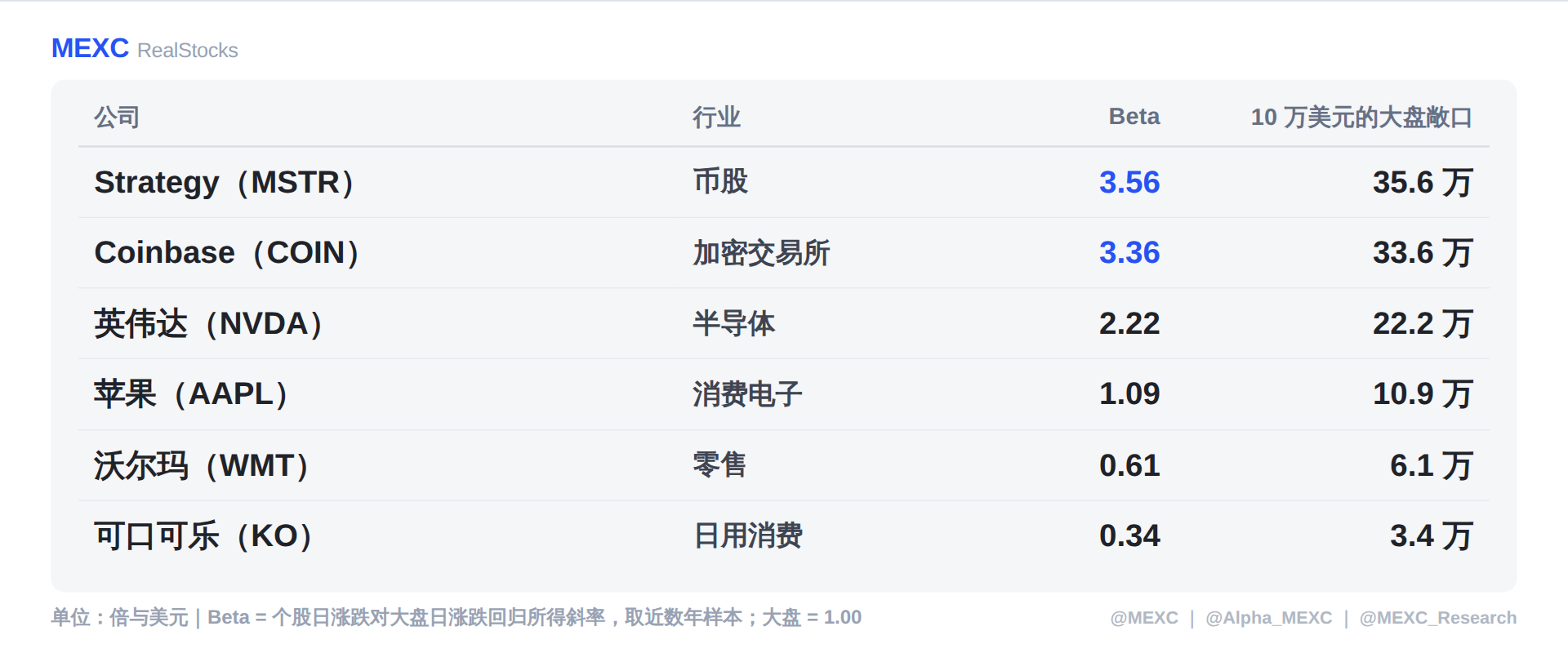
The report widened the lens by comparing six U.S.-listed companies. From Coca-Cola at 0.34 to Strategy at 3.56, the gap in beta was more than tenfold, even though all of them trade in the same equity market.
Using a $100,000 position, Coca-Cola would imply about $34,000 of market exposure, while Strategy would imply about $356,000. Same capital, completely different exposure to market volatility.
From that, the article drew two practical rules. First, convert the nominal position into real market exposure before deciding on trade size. Its formula was position size multiplied by beta. Second, a high beta does not mean a stock is simply moving with the market. Investors still need to identify what is actually driving the volatility. If the source is misread, the multiple can turn into little more than statistical noise.
What the Market Was Watching Next: Consumer Confidence at 14:00 UTC and Semtech After the Close
On the macro side, the next release on the calendar was the August consumer confidence index at 14:00 UTC, alongside new home sales. The report said the week’s broader macro focus would then shift to Wednesday’s 12:30 UTC core PCE inflation data and second-quarter GDP revision, followed by speeches at the Jackson Hole meeting on Friday. For the first half of the week, though, the consumer confidence reading was described as the only demand-side data point.

After the bell, attention was set to turn to Semtech (SMTC), scheduled to report at 20:30 UTC. Options were implying a move of ±21.07%.
The article described Semtech as a supplier not of switches or optical modules themselves, but of the signal chips inside those modules. Its FiberEdge drivers and transimpedance amplifiers push electrical signals onto optical fiber, while CopperEdge serves as an active equalization chip that helps copper cables run at higher data rates. When 800G and 1.6T optical modules ship, the company ships with them. That is why the report said investors use SMTC as an early read on AI networking demand.
For SMTC, the Real Test Was Data Center Revenue, Not Total Revenue
The report argued that total revenue was not the number to watch most closely in Semtech’s results. Data center revenue was.
The reasoning was simple. Internet of Things and high-end consumer products still make up a large share of total revenue and tend to move on a steadier cadence, which can smooth over the segment that is actually changing. The line that matters most for valuation, according to the report, is whether data center growth is still accelerating.
It listed three reported quarters of sequential growth in the data center segment at +8%, +12%, and +14%. Management’s second-quarter guidance, however, pointed to a much steeper step-up: +35% quarter over quarter and +85% year over year, or about $97 million. The previous quarter came in at $71.6 million, already a record level and up 39% from a year earlier.
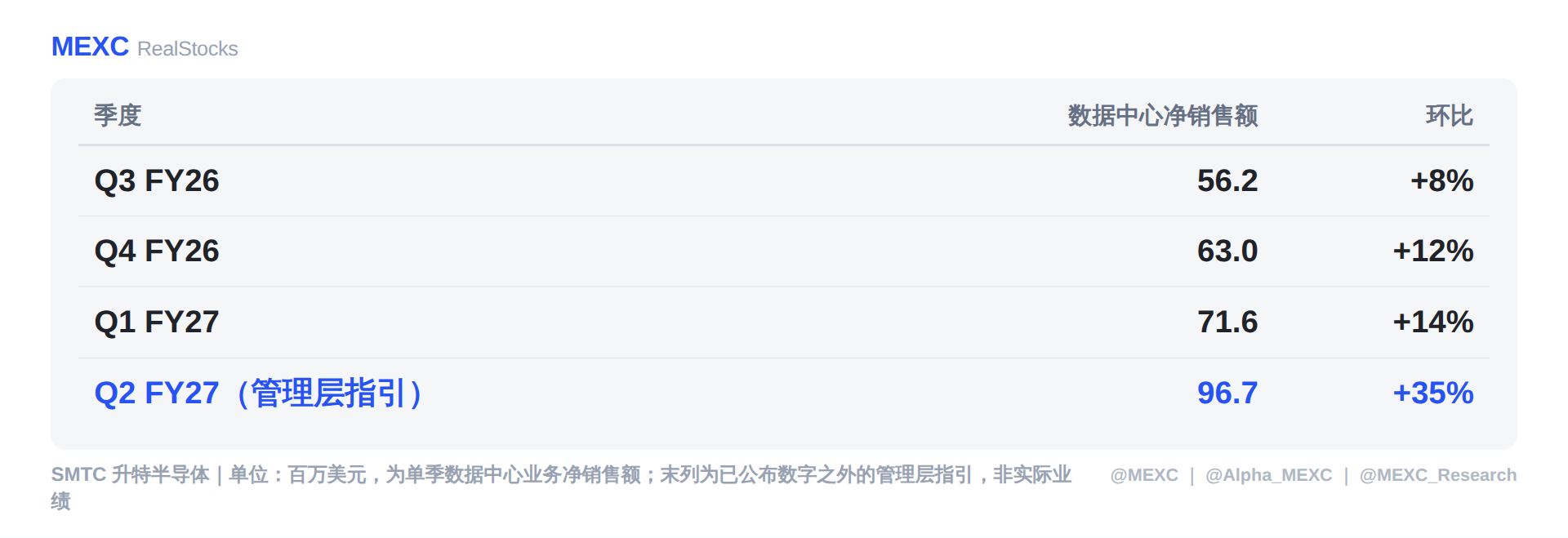
The article said investors should focus on two questions in the release and the earnings call. First, whether quarterly net sales in data center crossed roughly $97 million, the line needed to satisfy the +35% sequential guidance. Hitting it would signal acceleration; falling short by a visible margin would suggest a delay in pace. Second, what management said about customer adoption progress for CopperEdge active copper cable products and the shipment pace of 1.6T FiberEdge. Those two lines were presented as key determinants of the slope for the second half of the year.
Implied Volatility Measures Magnitude, Not Direction
The report also compared implied volatility across the week’s earnings names. SMTC’s ±21.07% was the highest, more than three times NVIDIA’s ±6.17%. It linked that level of disagreement to the stock having fallen more than 30% from its June high and said the smallest company by market value was, in this case, the one producing the deepest market split.
It also made a clear distinction about how implied volatility should be read. Because the figure is backed out from options prices, it measures the expected one-day swing after earnings. It speaks only to size, not direction. A larger number means deeper disagreement in the market, not a higher probability of a decline.
Key Takeaways the Report Spelled Out in Its FAQ Section
The article closed with a set of direct answers to common questions around the day’s themes.
- When a company issues stock to raise cash for Bitcoin purchases, the decisive variable is not how much money was raised but whether Bitcoin per share goes up or down. In Strategy’s Aug. 24 case, the company sold $2.01 billion of stock and did not change its Bitcoin count.
- Bitcoin can rise 22% in a week while most crypto equities still fall because each business model transmits the move differently. Direct holders, commission-based platforms, and mining or compute operators do not convert Bitcoin strength into financial results in the same way.
- Beta has two practical uses in the report: dividing a one-day stock move by beta to judge whether the move is unusual, and using position size multiplied by beta to estimate true market exposure.
- If different media reports show different percentage gains for the same stock, they are often using different timestamps. In Strategy’s case, the stock was up 4.9% at its intraday high but 2.83% at the close.
- Implied volatility cannot be used to call direction. It only indicates the market’s expected range of movement.
- For semiconductor companies with several business lines, total revenue can hide the segment that is actually changing. In Semtech’s case, the market is paying closer attention to the slope in data center revenue, which rose from $56.2 million to $71.6 million and was guided to $97 million.
The report said it was compiled and written by the MEXC RealStocks team. It stated that market data were based on U.S. stock closes on Aug. 24, 2026, and that earnings and forward-looking data were current through the premarket of Aug. 25, 2026. It also said the content was a compilation of public market information, did not represent a recommendation or opinion from MEXC, and did not constitute investment advice.