
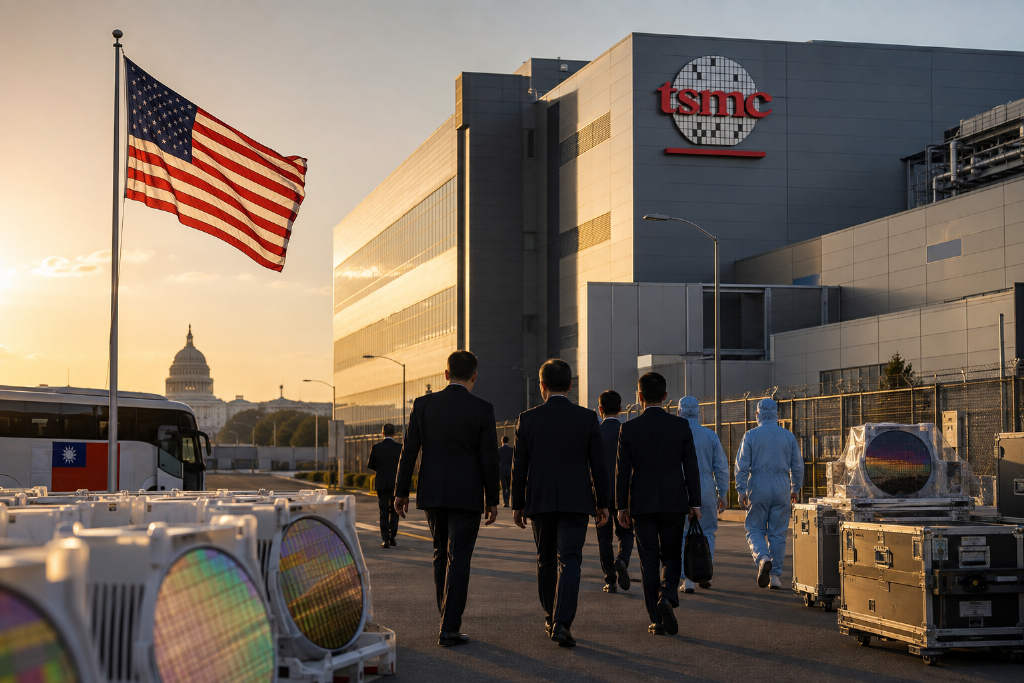
U.S. Commerce Secretary Howard Lutnick said on Sept. 2 that the Trump administration is advancing the next phase of semiconductor tariffs, with tariff relief available to companies that manufacture in the United States and added costs for those producing abroad and selling into the U.S. market.
Lutnick outlines the next phase of semiconductor tariffs
According to a report cited from Liberty Times Net, Lutnick made the remarks during an interview in North Carolina on Sept. 2. He described the policy as a "targeted and measured" semiconductor tariff arrangement. In his account, the operating principle is straightforward: companies that build and produce in the U.S. can avoid tariffs, while companies that do not produce in the U.S. but still want access to that market will have to pay.
When asked whether tariff relief would be linked to the scale of a company’s U.S. investment, Lutnick said it would.
The current framework was built as a two-stage plan
The article says the U.S. has imposed a 25% tariff on certain advanced computing chips since Jan. 15 this year under the Trade Expansion Act. The original notice was structured in two stages. The first phase applied to a narrower set of products. The second phase is expected to expand the scope to a broader range of semiconductors, semiconductor equipment, and derivative goods, while also introducing tariff offset mechanisms for companies investing in U.S. operations.
Lutnick’s latest comments were presented as an external explanation of what that second stage could look like.
Drug pricing model cited as a reference
Lutnick said the pharmaceutical sector could serve as a reference point for the semiconductor tariff framework. Under that model, companies that manufacture innovative drugs in the U.S. and comply with most-favored-nation, or MFN, pricing can receive tariff relief. He said semiconductors could adopt a similar structure.
He also pointed to large U.S. chip investments
Lutnick argued that tariffs have already helped bring semiconductor manufacturing investment into the U.S. He cited Taiwan Semiconductor Manufacturing Co. (TSMC) as investing $265 billion in Arizona and Micron as committing $250 billion to build memory capacity, for a combined total of more than $500 billion.
He also said total semiconductor manufacturing investment secured by the U.S. has reached $1.2 trillion. He added that U.S. chip production capacity accounted for less than 2% when Trump took office, is now moving toward 40%, and could reach 50% before the end of the term.
Taiwan may announce another round of U.S. investment
Lutnick said Taiwan could announce a new round of U.S. investment as early as next week, with the amount potentially ranging from $20 billion to $30 billion.
The article also said Economic Minister Kung Ming-hsin, speaking at the U.S. pavilion during SEMICON Taiwan on Sept. 2, stated that rising AI and semiconductor demand had led Taiwan’s economic authorities to identify 20 Taiwanese companies with plans to invest a combined $35 billion in the U.S. After another review three months later, those companies had added roughly $20 billion more.