
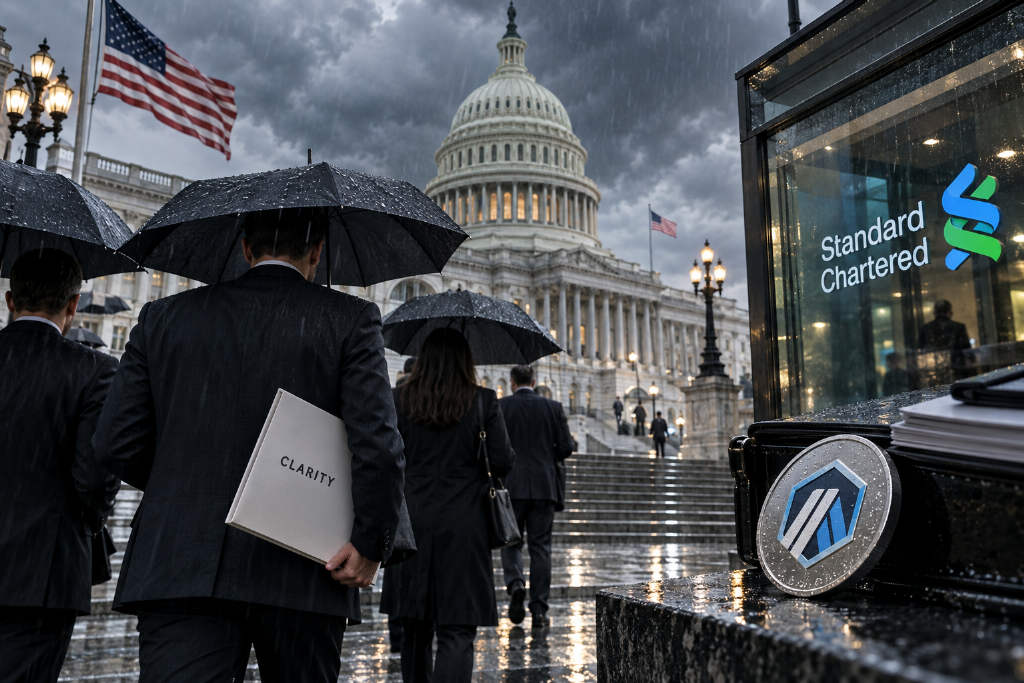
The US Senate failed to advance the Digital Asset Market Clarity Act after a cloture motion received 49 votes in favor and 50 against, well below the 60 votes required.

Republican Senator Thom Tillis later said his “no” vote was strategic. He said he switched sides at the last minute so he could call a new vote in the future.
CLARITY falls short in the Senate
The failed motion does not necessarily end the CLARITY Act. Cointelegraph noted that the GENIUS bill went through a similar failed cloture vote before passing 11 days later.
Still, the path looks narrow. Politics and the number of legislative days left make another successful push unlikely in the near term.
Congressman Shri Thanedar, a Democrat who supported CLARITY in the House, told Magazine that the timeline was a “major barrier.” Seven Democratic senators who voted against the bill said they “remain committed” to passing it at some point.
Sen. Angela Alsobrooks said: “We were ready to strike a deal today and in discussions right up until the vote. Republican leadership shut it down at the very last minute.”
Abhishek Vaidyanathan, chief legal officer at NEAR, said the House had already canceled two sitting weeks and that the Senate’s state work period begins on Oct. 5.
“Now that cloture failed, the next Congress is the likely next opportunity to address crypto market structure,” he said.
SEC sets out tokenized stock relief
After the Senate vote failed, Ripple CEO Brad Garlinghouse said US regulators would “continue to work hard to issue rules to fill the legislative gap.”
Two days later, the US Securities and Exchange Commission announced a five-year exemption that allows limited trading of tokenized US stocks on decentralized public blockchains.
The Innovation Exemption permits tokenized stock trading through automated market makers and exempts those venues from registering as securities exchanges.

The relief does not extend to “synthetic” stock tokens that do not give holders all the same rights as traditional shares. Cointelegraph said that leaves most stock tokens issued so far by xStocks and Robinhood outside the exemption.
CFTC offers no-action relief and drafts new crypto rules
The Commodity Futures Trading Commission also announced regulatory relief for “passive software” providers that connect users to regulated derivatives firms and exchanges.
In a no-action position, the agency said it would not recommend enforcement against qualifying providers or their personnel for failing to register as introducing brokers or associated persons when they facilitate trading with CFTC-registered firms and exchanges.
The move could make it easier for crypto wallets and other apps to provide access to regulated derivatives, including perpetual contracts and prediction markets.
The CFTC has also sent draft crypto rules to the White House, titled “Regulation Crypto Asset Transactions and Regulation Crypto Asset Markets.” Both items are listed at the prerule stage, which means they have not yet been formally proposed.
Coinbase filed an application with the CFTC this week to offer 24/5 perpetual futures trading tied to individual US stocks. Kalshi submitted a very similar proposal on the same day.
House committees back Bitcoin reserve and tax bill
The American Reserve Modernization Act of 2026 passed the US House Committee on Financial Services this week. The bill would place the existing executive order establishing a Strategic Bitcoin Reserve into law.
It would also create a Digital Asset Stockpile inside the Department of the Treasury to hold other forfeited cryptocurrencies.
The legislation requires all federal agencies to provide a full audit of the digital assets they hold and to submit quarterly proof-of-reserve reports.
It also directs a study of budget-neutral acquisition strategies for buying additional Bitcoin for the reserve.
Connor Brown, executive director of the Bitcoin Policy Institute, called the move on Wednesday a “genuinely historic step for Bitcoin policy.”

The House Ways and Means Committee also passed the Digital Asset Tax Certainty Act with bipartisan support, moving forward a bill aimed at changing federal tax treatment for digital assets.
Revolut data theft draws a second ransom demand
The theft of customer passport data and KYC selfies from Revolut took another turn when a second hacker demanded $3 million.
The actor, using the name “IAmNotAVillain,” publicly demanded 6,000 Monero from Revolut within 24 hours and said the customer records would otherwise be sold to criminal groups.
Earlier, a group calling itself “Revolut Smilik” demanded 10,000 Bitcoin, which Cointelegraph said was worth about $780 million, in exchange for the data. IAmNotAVillain said that demand came from a former associate who had only a small sample of the records.
The case renewed criticism of KYC systems that leave identity documents stored across large numbers of companies online. The report added that zero-knowledge proofs can now verify identity without sending documents to third parties, though the technology is not yet widely used.
Weekly market moves
By the end of the week, Bitcoin (BTC) was up 5.9% at $81,185, Ether (ETH) was up 6.6% at $2,639, and XRP (XRP) was up 5.4% to $1.40. Total crypto market capitalization stood at $2.78 trillion, according to CoinMarketCap.
Among the top 100 cryptocurrencies by market cap, the week’s three biggest gainers were NEAR Protocol (NEAR), up 76.4%, Arbitrum (ARB), up 64.3%, and Ethena (ENA), up 61.6%.
The three largest losers were Stable (STABLE), down 11.6%, Pi (PI), down 11.3%, and SPX6900 (SPX), down 1.8%.
Standard Chartered puts a high target on Arbitrum
Standard Chartered said layer-2 network Arbitrum could reach as high as $10 by 2030. From current levels, the bank said that would amount to roughly a 70-fold increase, far above its projected returns for Bitcoin and Ether over the same period.
Geoff Kendrick, the bank’s global head of digital assets research, said Arbitrum’s economics offer significant upside because the network receives 10% of net protocol revenue generated by companies building on it. He pointed to Robinhood Chain as the first major example.

Kendrick said Robinhood fees will lift Arbitrum’s September revenue to $5 million, a fivefold increase from before Robinhood Chain launched in July.
He said the biggest risks to his ARB price forecast are “a slower-than-expected pace of asset tokenization and more competition from alternate blockchains.”
Chainalysis, BIS and a Hong Kong court add to the week’s headlines
Chainalysis reported that the number of cases in which attackers stored malware instructions or infrastructure information on public blockchains rose 420% over the past 12 months. State-linked hackers accounted for about two-thirds of new activity each quarter.
The firm identified operators linked to North Korea and Iran among the state actors using the tactic. It also tied previously unattributed activity across Tron, Aptos and BNB Smart Chain to UNC5342, a North Korea-linked group tracked by Google Threat Intelligence.
Chainalysis said public blockchains make malware campaigns more durable because the stored information can remain accessible after domains, servers or code repositories are taken down.
Researchers at the Bank for International Settlements found that estimates of Bitcoin onchain transfer value can differ by as much as sixfold depending on how transactions are measured.
They said the gap stems from differences in methodology, including how change outputs and transfers back to the sender are treated. The problem also affects Bitcoin market capitalization. The researchers found that the conventional measure has at times been as much as four times higher than realized capitalization, which values each coin at the price when it last moved.
In Hong Kong, a former bank official who falsely authenticated letters of credit worth more than $1.6 billion was sentenced to four years in prison and ordered to make restitution of more than $470,000 received in cryptocurrency bribes.
The Standard reported on Saturday that Lam Chun-yin, 32, a former customer relationship manager at China Construction Bank (Asia), had previously pleaded guilty in District Court.
Magazine features highlighted by Cointelegraph
Cointelegraph also highlighted three magazine features this week: whether the CLARITY Act can still be saved, whether Bitcoin treasury firms can outperform BTC, and how the Revolut identity theft case exposes the risks in KYC systems.