
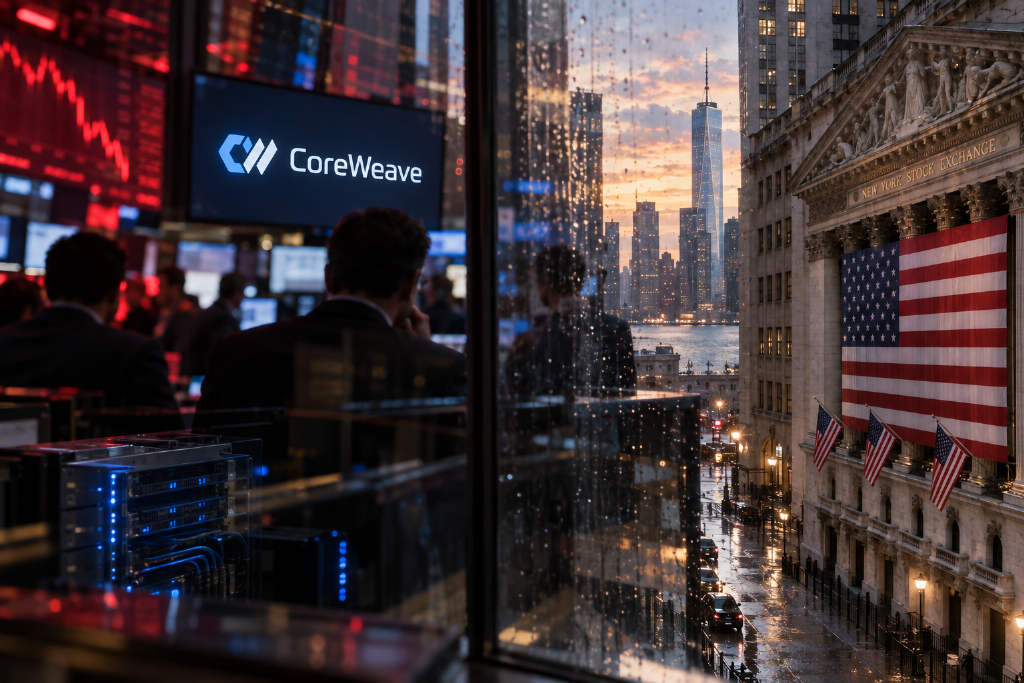
US stocks erased early losses on Oct. 15 after technology shares opened under heavy selling pressure, sending the Nasdaq down more than 1.4% at one point before a late-session recovery lifted all three major indexes into positive territory.
By the close, the Dow Jones Industrial Average had risen 1.08% to 52,177.69, the S&P 500 gained 0.33% to 7,744.06, and the Nasdaq added 0.08% to 26,713.03.
Tech shares recover after a sharp early drop
Trading across large-cap technology names was mixed. Microsoft rose 1.08%, Alphabet gained 0.45%, and Amazon added 0.27%. Meta fell 0.11%, Apple slipped 0.28%, Tesla lost 1.29%, and Nvidia declined 1.84%.
The Philadelphia Semiconductor Index fell 0.88%. That was much narrower than its early-session drop, but it still marked a seventh straight day of losses for the index. Individual chip names moved in different directions: Qualcomm rose 3.35%, Arm gained 2.85%, and ASML added 0.45%, while Broadcom fell 0.55%, AMD lost 1.50%, TSMC dropped 1.73%, and Intel declined 2.80%.
Micron Technology closed up 1.87% at $931.24 after falling more than 6% early in the session and becoming one of the first memory names to turn positive. Micron also led the US market in trading value for the day at $35.255 billion. SanDisk and Western Digital had each dropped more than 8% and 6%, respectively, early on, though both narrowed their losses by the close.
Chinese stocks outperform
Chinese ADRs broadly advanced, with the Nasdaq Golden Dragon China Index rising 1.96%.
Among actively traded names, BeiGene rose 6.43%, New Oriental gained 4.81%, H World Group climbed 3.94%, Amer Sports added 3.92%, NetEase rose 2.73%, Trip.com Group gained 2.70%, JD.com added 2.66%, Vipshop climbed 2.45%, XPeng rose 2.28%, and Futu Holdings edged up 0.32%. Alibaba slipped 0.05%, while TAL Education fell 0.08%.
In Asia, equities in Japan and South Korea opened higher. South Korea’s KOSPI opened up 1.8% and was later up 1.47% at the time of writing. Japan’s Nikkei 225 opened 0.78% higher, with its gain widening to 1.04%.
Jensen Huang publicly backs CoreWeave
Cloud services startup CoreWeave was one of the key drivers behind the market’s intraday reversal. After dropping 15% on Wednesday, the stock fell more than 9% again at Thursday’s open before reversing course after Nvidia CEO Jensen Huang publicly voiced support for the company.
Speaking to Bloomberg at an event in Stockholm, Huang said CoreWeave’s financial condition was improving and noted that Nvidia is a supplier of computing equipment to the company. “CoreWeave is getting stronger every day,” he said. “There is no need for Nvidia to provide financial guarantees to CoreWeave. I’m optimistic. In fact, their cost of capital is coming down.”
The report said confidence in CoreWeave had deteriorated in credit markets, where investors were increasingly concerned about rising default risk. CoreWeave has also become an important test case for the sustainability of the business model used by newer artificial intelligence infrastructure companies. Many of those companies were built to meet what the report described as nearly unlimited growth in AI computing demand from firms including Nvidia. At the same time, heavy borrowing by companies such as CoreWeave, supported by suppliers that include Nvidia, has fueled concerns that circular financing could be creating artificial demand.
CoreWeave ultimately reversed from a drop of nearly 10% to a gain of nearly 6%.
September PPI comes in above expectations
On the macro front, the US September Producer Price Index came in stronger than expected on Thursday, following the CPI report released a day earlier. Retail sales data also exceeded expectations, adding to concerns that inflation remains sticky and pushing rate-hike expectations higher.
Data released by the US Department of Labor on Oct. 15 showed that headline PPI rose 1.3% month over month in September, up from 0.5% in August and the largest monthly increase since March 2022. On a yearly basis, the index rose 6.3%, up from 5.6% in August and the biggest annual increase since December 2022.
The goods price index increased 2.6% from the previous month, with energy prices accounting for more than 80% of that gain. The services price index rose 0.8%, the largest increase since April this year. Excluding food and energy, core PPI rose 0.7% month over month and 5% year over year in September, compared with 0.2% and 4.6% in August.
US Labor Department data released on Oct. 14 had already shown faster month-over-month and year-over-year CPI growth in September. According to the report, higher energy prices were a major driver behind both the PPI and CPI increases. Taken together, the two reports pointed to persistent inflation pressure. Market participants said the data could reinforce the Federal Reserve’s willingness to keep raising rates in the coming months, especially as energy costs continue to climb and inflation returns to the center of market attention.