
Top line
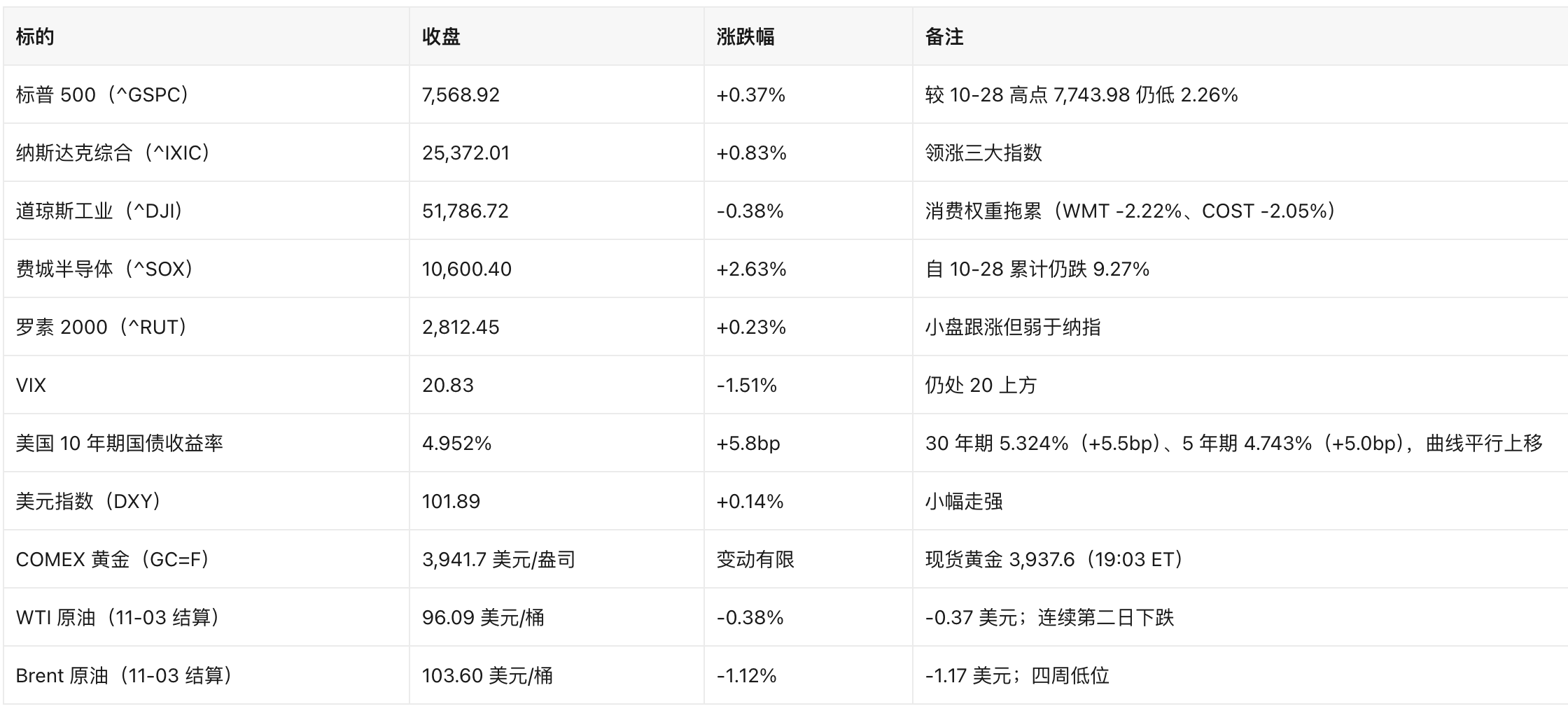
U.S. stocks finished mixed on Nov. 3, with AI-linked trades rebounding and chip shares leading the move. The Nasdaq Composite rose 0.83% to 25,372.01, the Philadelphia Semiconductor Index climbed 2.63% to 10,600.40, and the S&P 500 added 0.37% to 7,568.92. The Dow Jones Industrial Average fell 0.38% to 51,786.72. The source cited Reuters and CNBC, noting that Intel’s 29% one-day drop last Friday, described as its worst single-day fall since the 1970s, had combined with concerns over AI capital spending to trigger selling before the market stabilized ahead of AMD’s earnings.
AMD reported third-quarter revenue up 45% year over year, with data center revenue nearly doubling. The stock rose 8% after hours. CNBC said the data center segment accounted for 64% of total revenue, up from 47% a year earlier. Chief Executive Lisa Su said server revenue will double year over year in 2027.
Apple fell 1.90% after issuing December-quarter gross margin guidance of 45% to 46%, below the 46.3% consensus compiled by LSEG. If realized, that would mark a third straight quarterly decline in gross margin, after 50.1% in the June quarter and 47.9% in the September quarter. CNBC said new CEO John Ternus described memory pricing as "unprecedented."
Oil prices extended their decline. Brent settled at $103.60 a barrel, down $1.17, or 1.12%, while WTI settled at $96.09, down $0.37, or 0.38%. Both contracts fell for a second straight session. CNBC reported that Qatar was mediating in Tehran, while Iran’s foreign ministry said it would not accept "coercive diplomacy."
On U.S. midterm elections, voting ended on 11-03 but counting was still underway. The Block said pricing on Polymarket and Kalshi implied bettors saw a path for Democrats to win both the House and the Senate. Stifel said Democrats were expected to win the House, while the Senate remained hard to call.
Broader market and macro
AI capex and funding structure
Oracle rose 5.85% as the market focused on its $20 billion financing plan. Meta gained 2.36% after strong demand for its $20 billion bond sale. Microsoft added 2.74% as investors digested its disclosed $44.9 billion Anthropic-related commitment.
MarketWatch said the same day that AI’s influence on the bond market was rising to the point where it could be discussed alongside wars and elections. The article’s framework was that AI capital spending is shifting from operating cash flow to debt financing, making long-end yields a more direct constraint on technology valuations. It also argued that the rebound in tech shares with the 10-year Treasury yield near 4.95% was driven by earnings, especially AMD, rather than by multiple expansion.
Economic data
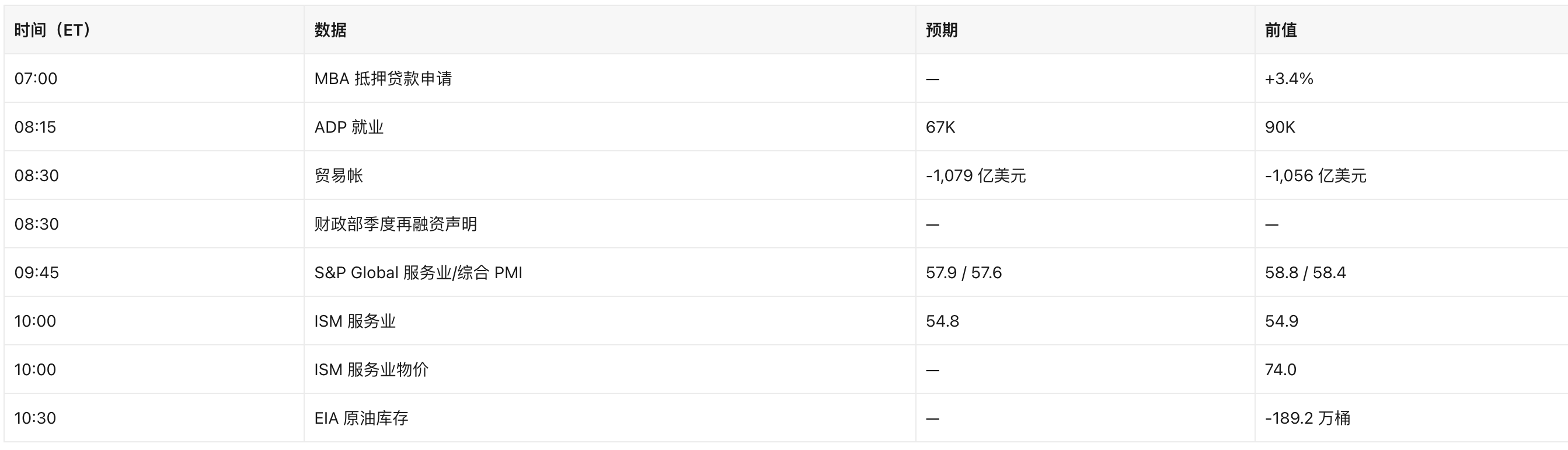
Data released on 11-03 showed ISM manufacturing at 55.5, above the 54.5 forecast and the prior 54.5. New orders came in at 55.5, also above the 54.5 expectation. The prices component was 75.2, down from 77.9 but still elevated. JOLTS job openings were 7.523 million, above the 7.15 million forecast and the prior 7.19 million. Factory orders rose 1.8%, ahead of the 1.2% estimate. Durable goods orders excluding transportation rose 0.5%, in line with expectations. Construction spending fell 1.9% against a forecast for a 0.4% increase. The Atlanta Fed’s GDPNow estimate rose to 3.7% from 3.2%.
The article said the 75.2 reading in the prices component suggested inflation pressure had not disappeared even as oil prices eased, reinforcing the Federal Reserve’s hawkish bias.
Federal Reserve path
The report said the Fed resumed rate hikes in September for the first time in three years, then left rates unchanged at its 10-28 meeting. Bloomberg described that decision as a pause in the AI era. Chair Kevin Warsh said politics had not affected policy decisions. CNBC reported on 10-30 that Fed officials had begun signaling the need to raise rates again, while Treasury Secretary Bessent said another hike "may not be a mistake."
Against that backdrop, the 10-year Treasury yield stood at 4.952% and the 30-year yield at 5.324%.

Key stocks and sectors
AMD: the week’s main AI hardware test
AMD rose 3.65% in regular trading and another 8% after hours. Third-quarter revenue increased 45% year over year. Data center revenue nearly doubled and made up 64% of total revenue, versus 47% a year earlier. Revenue from the PC and gaming segment was $3.7 billion, down 8% year over year, with gaming down 40%.
Management said server revenue will double year over year in 2027 and that wafer, substrate, advanced packaging, and memory supply had been secured.
Nvidia and Apple
Nvidia gained 2.29% and reached a market capitalization of $4.98 trillion, compared with Apple’s $4.84 trillion. Based on Benzinga and Nasdaq data cited in the article, Nvidia retook the top spot globally by market value.
Apple fell 1.90%. Its September-quarter revenue and EPS beat expectations, and iPhone revenue also topped forecasts, but December-quarter gross margin guidance of 45% to 46% came in below the 46.3% consensus and marked the lowest level since fiscal fourth quarter 2023. The CFO attributed the pressure to higher memory costs and Siri AI spending.
Memory and the AI server chain
Micron rose 2.58% to 855.10. Super Micro Computer gained 3.12% and moved higher after hours on strong AI server demand, according to MarketWatch. The article said AI servers and hyperscale cloud companies were buying up RAM, squeezing supply for phones and PCs. CNBC, citing Counterpoint, said global PC shipments fell 4% year over year in the second quarter.
AI funding chain
Oracle, Meta, and Microsoft were grouped together as examples of the AI funding chain. Oracle rose 5.85%, Meta 2.36%, and Microsoft 2.74%. The article said the financing structure for AI capex is shifting from internal cash to public debt markets.
Areas under pressure
Consumer and e-commerce names lagged. Walmart fell 2.22%, Costco lost 2.05%, and Shopify dropped 8.74% after earnings. Tesla fell 1.32% and Palantir lost 1.65%. JPMorgan slipped 0.76% and Exxon Mobil fell 1.23%.
Crypto-linked U.S. equities
Strategy: modest BTC purchase, larger preferred buyback
According to Strategy’s 8-K filed on 11-02, with figures through 11-01, the company bought 811 BTC for $65.5 million at an average price of $80,846 including fees. Total holdings rose to 849,327 BTC. Aggregate cost was $64.08 billion, or $75,451 per bitcoin.
On the funding side, Strategy sold 1,178,552 MSTR shares through its ATM program and raised net proceeds of $164.0 million. Of that amount, $65.5 million went to bitcoin purchases and $98.5 million was added to USD cash. On the buyback side, the company repurchased 2,092,035 shares of STRC variable-rate preferred stock for $208.2 million. Remaining authorization stood at $748.6 million for preferred repurchases and $1.0 billion for MSTR repurchases.
For distributions, shareholders approved a daily dividend plan on 10-28, and STRC began daily distributions on 11-01. The SEC filing said the change did "not alter dividend rates or total dividend amounts across the series."
Strive, trading under ASST, disclosed in an 8-K filed on 11-02 with figures through 10-30 that it bought 124 BTC between 10-24 and 10-30 at an average price of $80,526. Holdings rose to 43,124 BTC. Cash and equivalents were $490.4 million. The company also held 505,000 shares of STRC with a fair value of $50.06 million.
Bitmine, trading under BMNR, added 8,573 ETH last week, bringing holdings to 6.06 million ETH, according to The Block. Chairman Tom Lee said the market reaction to the Binance event had been "mild."
Exchanges and ETF flows
Coinbase rose 5.53% to $145.45. CNBC said in its 10-29 earnings coverage that third-quarter net income increased 66% year over year, helped by fair-value gains on bitcoin holdings. The Block reported that Ark Invest bought $3.4 million of COIN on 11-02 and also added to Circle and Robinhood.
Robinhood rose 2.20% to $85.68. Circle was due to report before the open on 11-04, with Investing.com saying the market was focused on slower USDC growth and the share of distribution costs.
For spot ETFs, U.S. spot bitcoin ETFs saw net outflows of $398.6 million on 11-02, with BlackRock’s IBIT posting the largest outflow. On 10-30, net outflows reached $643 million, the largest single-day outflow in four months, according to The Block. On 11-03, product prices rebounded with the underlying market: IBIT rose 1.62%, FBTC 1.62%, BITB 1.61%, and ETHA 2.05%.
Miners: valuation anchor shifts to AI leases
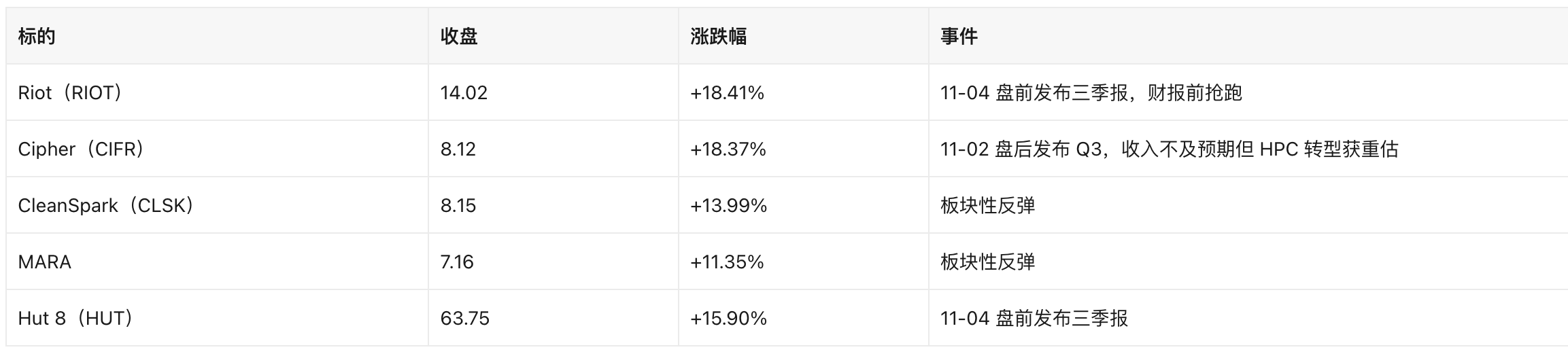
Cipher’s third-quarter results, disclosed in an SEC 8-K on 11-02, showed revenue of $26.7 million, down from $71.7 million a year earlier. Bitcoin mining contributed $20.85 million, while HPC leasing generated revenue for the first time at $5.86 million. Adjusted EBITDA was negative $10.0 million, and net income was $31.6 million.
On the contracting side, the Barber Lake lease was extended for a second 10-year term, adding $5.2 billion in rent and lifting total contract revenue to approximately $9.1 billion. Development pipeline capacity was 5.9 GW.
Sell-side views diverged. JPMorgan cut its target price to $18 from $22 but said the stock was "significantly undervalued." Northland cut its target to $14 from $27.50. Wells Fargo also lowered its target because of the site delivery timeline.
Regulation and accounting
The SEC’s Division of Corporation Finance issued a no-action letter treating Canton Coin as a digital commodity. The article said that gave the market a clearer boundary for non-security tokens.
The CFTC approved single-stock perpetual futures for trading in the United States for the first time. On accounting, The Defiant reported that Strategy posted $20.9 billion in operating profit in the third quarter because of rising crypto prices, with fair-value accounting driving the result.
Watchlist
The article said it found no confirmed case in the current window of a newly listed U.S. company announcing a first crypto treasury purchase or a transition into a DAT model. Changes to the watchlist included Strive’s holdings rising to 43,124 BTC, while Cipher and Hut 8 were increasingly being valued through AI and HPC leasing. One item still awaiting confirmation was how MSCI would handle index eligibility for digital-asset treasury companies before Nov. 11, as no company or index provider announcement had yet confirmed the details.
Geopolitics
U.S.-Iran tensions
The article said the U.S.-Iran conflict had lasted eight months. The Wall Street Journal reported that the United States struck Iran’s Qeshm Island on Monday and had carried out "limited strikes" in recent weeks. Qatar’s foreign minister was mediating in Tehran. Donald Trump said Iran "wants a deal," while an Iranian foreign ministry spokesperson said Tehran would not accept diplomacy based on coercion.
Maritime risk remained. UKMTO recorded at least four attacks on merchant vessels this month, and Rystad said traffic through the Strait of Hormuz was unlikely to return to prewar levels.
Russia-Ukraine talks
CNBC reported that Russia had confirmed new peace talks on Ukraine and said Melania Trump would host a ceasefire meeting.
Midterm elections and policy risk
The Senate remained undecided. Stifel’s base case was a split Congress, with Democrats winning the House and Republicans holding the Senate. Polymarket and Kalshi pricing, however, suggested bettors saw a chance Democrats could win both chambers. The article said that under a split Congress, progress on crypto legislation such as market structure bills and stablecoin rules would depend more heavily on bipartisan compromise, while regulatory action would continue to move through SEC and CFTC guidance and enforcement.
Tariffs and supply chains
Apple’s September-quarter gross margin included a 1 percentage point benefit from tariff refunds. The article also said the memory shortage represented a non-tariff supply-chain shock with a more direct effect.
What the market is watching next
The immediate political focus remains vote counting in the U.S. midterms, especially the Senate outcome. On the macro side, the Treasury’s quarterly refunding statement was identified as an underappreciated risk. The article said that with the 10-year yield at 4.95% and the 30-year at 5.32%, any sign of increased duration supply could push long-end yields higher.
On earnings, the premarket lineup included McDonald’s, with expected EPS of 3.36; Uber, 0.94; Novo Nordisk, 0.81; CVS, 1.62; Datadog, 0.18; Kraft Heinz, 0.43; and Emerson, 1.85. After the close, the list included Qualcomm, 1.46; Arm, 0.22; AppLovin, 3.94; MercadoLibre, 9.41; McKesson, 10.69; Expedia, 8.09; and Coherent, 1.78.
Among crypto-linked equities, Riot and Hut 8 were both due to report before the open, with AI and HPC transition progress and compute leasing agreements at the center of attention. Circle’s report was expected to be judged on USDC circulation and the share of distribution costs. Investors were also watching whether Strategy would continue its ATM issuance and STRC buybacks in future 8-K filings.
The risk list in the article included whether the 10-year Treasury yield breaks above 5%, whether BTC can hold support around 76,677 based on the 11-02 close, whether ETF flows turn positive, whether U.S.-Iran talks reverse, and whether the election outcome diverges sharply from prediction-market pricing, especially if Republicans keep the Senate.



