
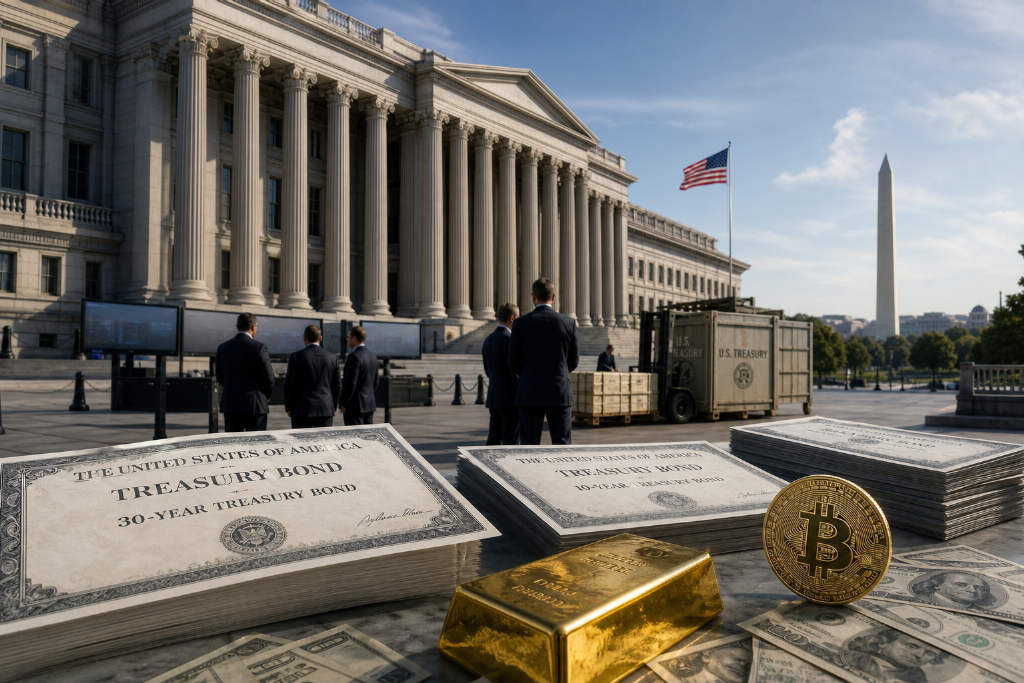
The U.S. Treasury stepped into the bond market with an unexpected move that reset trading across assets on Wednesday, doubling liquidity buybacks for long-dated Treasurys and helping drive a broad rally in gold and Bitcoin while easing pressure on stocks.
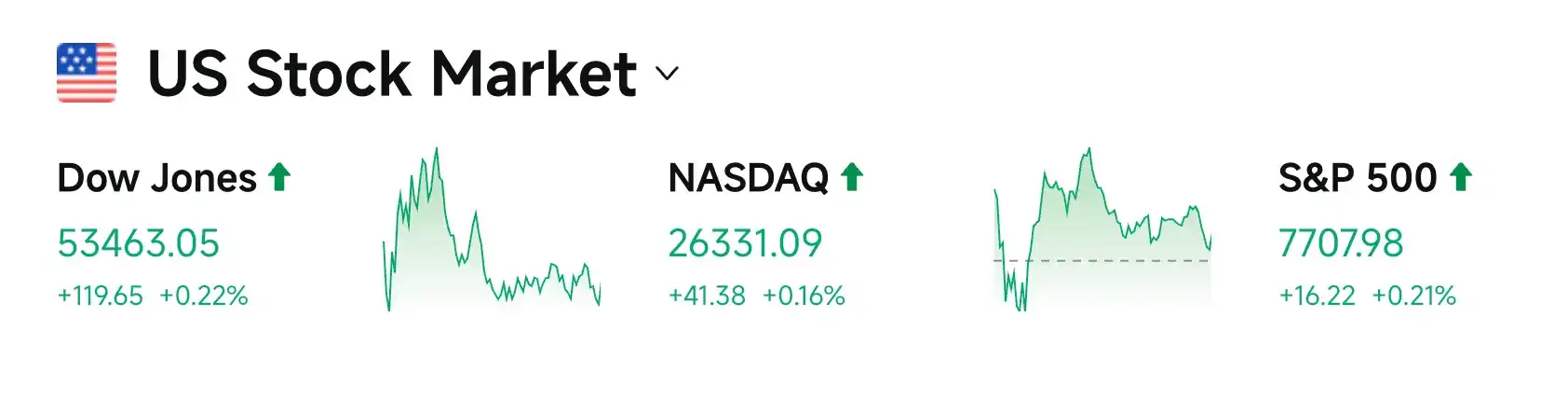
By the close, the Dow Jones Industrial Average rose 0.22%, the S&P 500 gained 0.21%, and the Nasdaq Composite added 0.16%, ending a three-session losing streak.
Treasury moves to calm long-end stress
The Treasury announced that it would raise the size of liquidity buybacks for 10-year to 30-year bonds from a maximum of $2 billion per operation to at least $4 billion. The announcement came outside the normal schedule and landed just a day after the 30-year Treasury yield touched its highest level in nearly two decades, as investors worried about unchecked U.S. debt growth and heavy debt issuance tied to AI companies. That surge in yields had helped push U.S. stocks lower for three straight sessions.
The market read the timing as a clear signal that officials did not want long-term borrowing costs to keep climbing. After the announcement, Treasury yields fell sharply. The 30-year yield dropped by more than 9 basis points on the day, its biggest one-day decline since last October, while the 10-year yield retreated toward 4.64%.
The debt problem itself, though, has not gone away. Fresh data showed total U.S. federal debt topping $40 trillion for the first time. The jump from $30 trillion to $40 trillion took less than five years. So far in the current fiscal year, the U.S. government has spent $1.17 trillion on interest payments alone, up 15% year over year. Interest expense is now the third-largest federal outlay after Medicare and Social Security.
Matthew Luzzetti, chief U.S. economist at Deutsche Bank, said the $40 trillion figure is not, by itself, the end of the world. The bigger danger, he said, is that higher rates keep raising the cost of borrowing and make the government’s fiscal burden snowball.
Wall Street was split on the intervention
- John Briggs, head of U.S. rates strategy at Natixis, said the off-cycle announcement suggested officials “really didn’t like the disorderly state of the bond market at the time.”
- Economists at Evercore described the step as a Treasury version of a “mini Operation Twist,” arguing that it may ease pressure in the short run but does not fix the underlying issues of large fiscal deficits and AI infrastructure financing.
- CNBC host Jim Cramer joked that the move looked like another “Trump put,” with the government stepping directly into the bond market to help sustain equity strength.
- Joe Brusuelas, chief economist at RSM, warned that artificially suppressing yields could make the Federal Reserve’s inflation fight harder.
Fed minutes show a hawkish tilt and flag AI-related risks
While the Treasury was trying to steady bonds, the Federal Reserve released minutes from its July meeting that pointed in the opposite direction. The Fed left rates unchanged at 3.5% to 3.75%, but the debate inside the committee was unusually sharp. Three voters — Logan, Hammack and Kashkari — dissented and backed an immediate 25-basis-point rate increase.
The minutes said several officials believed the Fed could still need to raise rates if inflation does not ease as expected. Some also argued that policy may not yet be restrictive enough.

AI entered the inflation and financial-stability discussion in unusually concrete terms. Fed officials said the buildout of AI infrastructure has pushed up prices for chips, steel, electricity and data-center materials in the near term, adding to inflation through stronger aggregate demand.
The minutes also highlighted fragile financing conditions in the AI trade. Many AI companies, the Fed said, are valued on extremely optimistic earnings assumptions, while a large share of capital spending is debt-funded. If markets cut those earnings expectations, asset prices could fall broadly and spill over to lenders exposed to the sector.
Nick Timiraos, often referred to as the “Fed whisperer,” said the minutes showed support for further tightening inside the Fed was stronger than many had assumed.
Separately, Chair Warsh proposed reducing the number of policy meetings each year from eight to six to allow more time for economic data to accumulate, though the change would not take effect before 2027.
Trump attacks high rates, escalates pressure on Iran, and the dollar falls
Trump said on Wednesday that interest rates “should be substantially lower,” arguing that lower borrowing costs would help reduce the burden of nearly $40 trillion in debt. He also praised Chair Warsh, saying he was “doing a good job.”
At the same time, Trump launched what he called an “economic fury” campaign against Iran and warned that any country providing channels to evade sanctions would face “massive economic consequences.” He specifically pointed to oil smuggling, currency swaps, and shell companies.
Oil prices moved up. WTI crude approached $86 intraday, the highest level in nearly three weeks. Data from the U.S. Energy Information Administration showed refinery utilization had climbed to its highest level since 2019, while the Strategic Petroleum Reserve sat at a 43-year low, adding to supply concerns.
As Treasury yields fell, the U.S. dollar came under heavy selling pressure. The dollar index dropped 0.86% to 98.69, its lowest level in three months. Spot gold jumped nearly 4% intraday, broke above the key $4,500-an-ounce level, and finished up 4.35%, its biggest one-day rise in six months. Spot silver climbed nearly 6% as well.
Ole Hansen, head of commodity strategy at Saxo Bank, said the expanded Treasury buybacks sent a signal that financial conditions were moving in a looser direction, a strong positive for gold.
Major Wall Street banks also laid out bullish gold targets. Deutsche Bank set a year-end target range of $4,700 to $5,100, Goldman Sachs projected $4,900, and JPMorgan said gold could reach $6,000 in the fourth quarter of 2026.
Bitcoin joined the move. OKX data showed BTC rising as high as $70,064 on Wednesday, the highest level since June 2 and its largest single-day gain since March. The rally was linked to several factors cited in the report: Trump’s White House meeting with executives from Coinbase and other crypto companies, a U.S. Securities and Exchange Commission proposal for exemptions covering some digital-asset issuance, and market rumors that Trump told members of a paid Trump group to “Just Buy” all crypto assets. Lower long-end yields and a weaker dollar added fuel to the trade.
AI momentum fades as biotech takes over leadership
The Treasury move helped halt the slide in the indexes, but the real spark for equities came from healthcare. Moderna and Merck reported a successful Phase 3 result for their personalized mRNA cancer vaccine, pushing healthcare to the top of the S&P 500 sector leaderboard with a gain of more than 3.5%. A biotech ETF surged nearly 6%.
At the same time, AI hardware momentum names in semiconductors, memory and optical networking kept falling. The Philadelphia Semiconductor Index dropped more than 2%. Goldman Sachs’ broad U.S. AI basket was down about 7.5% over two sessions, while the SOXX semiconductor ETF lost nearly 7.7% over the same period. The S&P 500 technology sector fell 0.73%, but the S&P 500 excluding AI heavyweights rose 1.03%.
Goldman Sachs trader Guillaume Soria said the market had seen an unusual dislocation between three-month and 12-month momentum portfolios, with the spread between software and semiconductors posting its sharpest two-day divergence since the vaccine rally in 2020. Systematic long-short funds fell about 1.4% on the day, with the momentum factor accounting for roughly 0.6 percentage points of the loss.
In his framing, the market is shifting away from “buy all AI” toward buying only AI companies that can prove cash flow and real orders.
Major movers across sectors
Moderna surged 176.97%, its biggest one-day gain on record and a new all-time high. The company’s personalized cancer vaccine with Merck significantly reduced the risk of recurrence and distant metastasis in a Phase 3 trial for late-stage melanoma, marking the first successful Phase 3 result for an mRNA cancer therapy. Shorts were estimated to have lost about $5 billion to $5.5 billion on paper in one day. Needham called it a “milestone victory,” William Blair upgraded the stock, and Goldman Sachs raised the probability of melanoma success to 100% while sharply increasing its price target. JPMorgan and Citi were more cautious, saying personalized commercialization remains difficult and other tumor types still need validation.
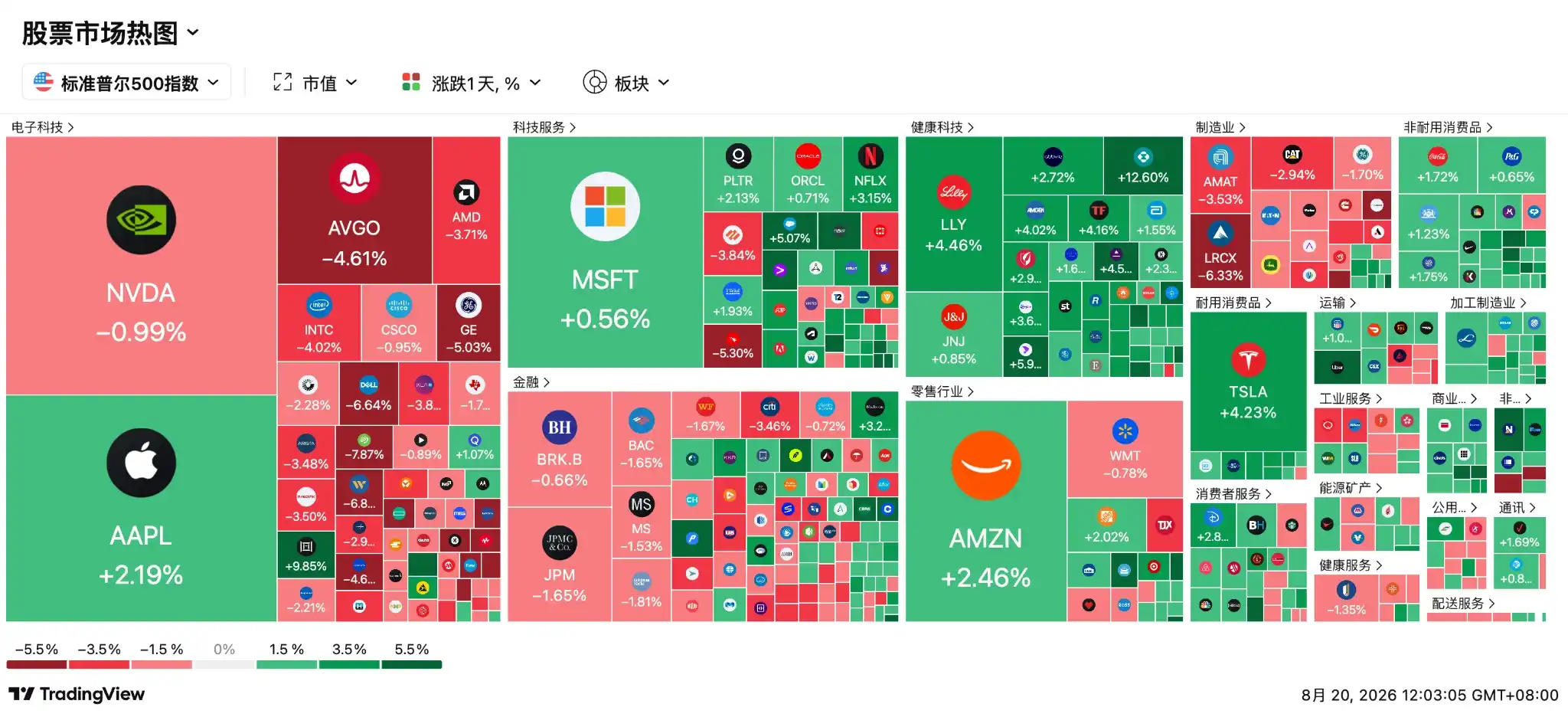
Related healthcare names rallied in tandem. Merck rose 12.60%, BioNTech gained 21.96%, Novavax added 10.8%, the S&P biotech ETF climbed 5.9%, and the Nasdaq Biotechnology Index rose 6.4%. Eli Lilly gained 4.46%, while Johnson & Johnson and AbbVie both hit record highs.
Crypto-linked names also jumped. HYPE treasury company Hyperliquid Strategies (PURR) rose more than 30% after Trump said the Commodity Futures Trading Commission chair was studying how decentralized exchange Hyperliquid could enter the U.S. in a fully compliant way. The comment drove both the stock and options activity sharply higher. PURR options volume was close to eight times its 30-day average, with more than 120,000 call contracts traded versus fewer than 8,000 puts. Strategy jumped 12.68%, Coinbase rose 9.55%, Circle gained 9.56%, Robinhood added 4.63%, and Canaan rose more than 10%.
Storage and optical names stayed under pressure. Seagate fell 7.87%, Western Digital lost 6.87%, and SanDisk slipped about 3.5%. Coherent dropped 6.19% and Lumentum fell more than 5%, making optical networking the weakest AI subsegment in the session.
Marvell Technology rose 9.85% after deepening its AI chip partnership with Google, which gained the right to buy up to $12.2 billion in shares. Analysts said the arrangement could create a medium- to long-term competitive threat to Nvidia and Broadcom. Chip stocks broadly moved lower: Nvidia fell 0.99%, Broadcom lost 4.57%, AMD dropped 3.71%, Intel fell 4.02%, TSMC ADR slipped 0.32%, and the Philadelphia Semiconductor Index fell about 2%.
Gold and silver miners rallied with precious metals. Newmont rose 7.85%, Barrick gained 7.22%, Pan American Silver added 7.94%, First Majestic Silver jumped 12.82%, and Freeport-McMoRan rose 4.18%.
Consumer stocks were mixed. Estée Lauder rose about 16% after reporting a narrower loss and a full-year profit outlook ahead of expectations. Target gained 4.3% after raising its full-year sales forecast and hit a 52-week high. La-Z-Boy fell 17% after unexpectedly swinging to a loss, while TJX dropped 4.2% after quarterly results missed expectations.
Other large-cap names also moved. Apple gained 2.19% even as reports said camera-equipped AI AirPods had been delayed until 2027 because of supply-chain and software issues. Tesla rose more than 4%, and Amazon gained about 2.5%. SpaceX fell 2.57% after reports said it had explored buying AI coding startup Cognition at a $40 billion valuation, though talks were later paused. Google added 0.15%, and YouTube was reported to be offering popular creators exclusive deals worth millions of dollars to keep Netflix from poaching them.
Key events on the market calendar
Thursday, Aug. 20
- Seoul AI Summit, running from Aug. 19 to Aug. 21, with participants including Google DeepMind, Google Cloud, Microsoft Research, Nvidia, LG AI Research and Hyundai Motor. Markets are watching for signals on large models, AI cloud, autonomous driving, AI chips and enterprise applications.
- World Robot Conference, running in Beijing from Aug. 19 to Aug. 23, where Unitree, UBTech, SIASUN, Galaxy General and Tiangong are set to showcase humanoid and industrial robot products. Investors are focused on mass-production progress, orders and cost trends.
- U.S. initial jobless claims at 20:30. Together with previously weak nonfarm payrolls data, the release could affect Fed pricing. A higher number may strengthen expectations that the Fed pauses in September; a stronger labor reading could weaken confidence in no change.
- Earnings and calls: Alibaba (20:00 conference call), Pop Mart, NetEase, Walmart, Ping An Insurance, China Telecom, AIA, Li Ning and Futu Holdings. Alibaba is a key focal point among Chinese ADRs, with attention on e-commerce GMV, cloud intelligence revenue, AI spending and Qwen commercialization.
- St. Louis Fed President Musalem on CNBC at 23:10. He has previously said he would support a July rate increase. If he again stresses inflation risks and the need for tight policy, Treasury yields could rebound, the dollar could stabilize, and pressure could return to gold and richly valued AI assets.
Friday, Aug. 21
- Japan July core CPI at 07:30. A hotter reading could lift expectations for a Bank of Japan rate increase in September and move the yen as well as global yield curves. A softer number could ease pressure from carry-trade unwinds and help cap long-end rates globally.
- South Korea export data for the first 20 days of August at 08:00. The previous reading showed 52.3% year-over-year growth, driven mainly by higher memory prices and AI chip exports. The market treats the release as a leading gauge for the global semiconductor cycle and AI capital spending.
- Second-quarter Hang Seng Index review results. CICC said Zijin Gold International, Zhipu and MINIMAX-W were among the leading candidates for potential inclusion. If those expectations are met, passive fund flows and short-term liquidity could follow; if not, the names may face profit-taking.
- NYMEX September crude rollover. With Hormuz risks and expectations of tighter U.S. sanctions on Iran in focus, the contract switch may amplify front-month volatility. A wider spot premium would point to tighter physical supply, while narrowing spreads could suggest fading upside momentum in oil.