
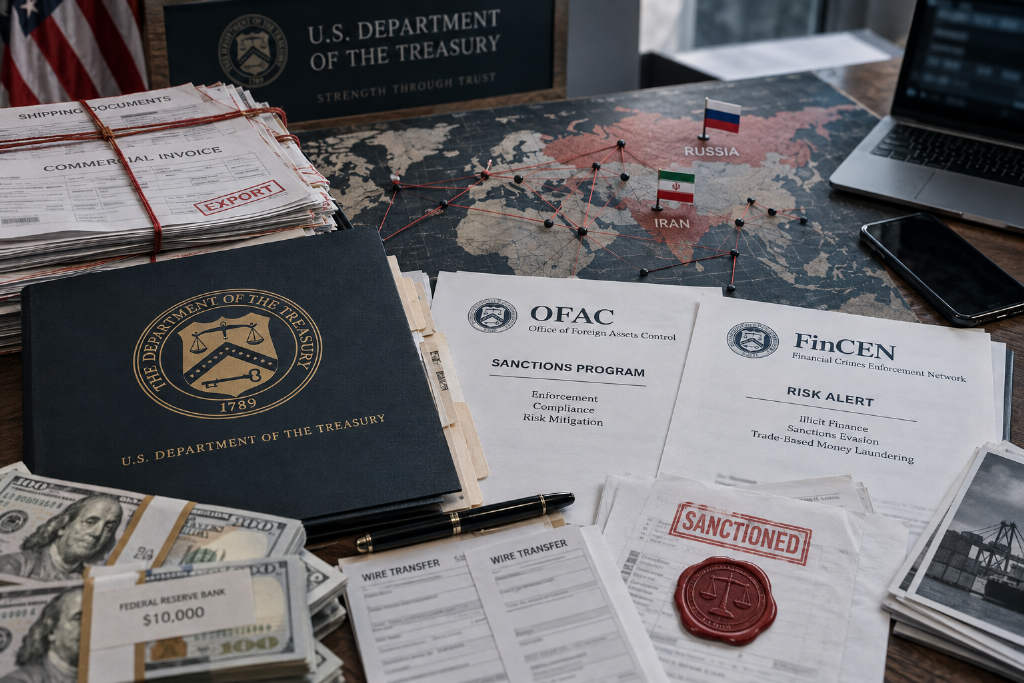
WuBlockchain’s daily crypto news roundup said the US Treasury has taken sanctions action against A7 Network, a Russia-linked shadow banking network. The Treasury said the Office of Foreign Assets Control, or OFAC, designated A7 Network as a significant transnational criminal organization. The Financial Crimes Enforcement Network, or FinCEN, plans to prohibit fund transfers involving its agent network and has issued a risk alert to financial institutions.
According to the Treasury, A7 Network helped evade sanctions through third-country companies and false trade documents. Its proxy network processed more than $17 billion from January 2025 to June 2026. The Treasury said the network was used by the Central Bank of Iran, the Islamic Revolutionary Guard Corps and others to move funds, and that it was tied to Iranian oil sales, weapons procurement and some crypto-related illicit activity. US authorities also said A7 Network includes A7A5, a ruble-backed token issued by Old Vector LLC, and alleged that the token was used for cross-border transactions and sanctions evasion.
Susquehanna and Citadel Securities withdraw lawsuit after settlements
Susquehanna and Citadel Securities said they will withdraw their lawsuit against traders accused of using advance knowledge of Chinese regulatory news to trade options in Futu Holdings (FUTU) and UP Fintech, also known as Tiger Brokers (TIGR). The firms said they have reached settlements with multiple defendants, though terms were not disclosed.
The two firms had previously alleged that the traders bought about $12 million in put options before the regulatory news was announced on May 22 and made more than $100 million in profit. A federal judge in the Southern District of New York had earlier declined to keep the accounts frozen, saying insider trading might be one explanation but that the evidence on record was not enough to justify continuing the freeze. Susquehanna and Citadel Securities still retain the right to refile claims against defendants who did not settle.
Utexo plans to issue USDT on Bitcoin this month
Tether-backed Utexo plans to issue USDT on the Bitcoin network this month. Utexo co-founder Viktor Ihnatiuk said the company has obtained a commercial license to issue USDT on Bitcoin and plans to provide APIs, SDKs and cloud infrastructure for exchanges, wallets and payment service providers.
Utexo will use the RGB protocol and Bitcoin’s UTXO model, keeping most transaction data off-chain. It is focused on three use cases:
- private USDT transfers,
- direct swaps between native BTC and USDT,
- lending backed by native BTC without wrapping BTC onto another blockchain.
USDT was first issued on Bitcoin through the Omni protocol in 2014. Ethereum and Tron later became its main circulation networks. Utexo also plans to expand to the Lightning Network after USDT goes live on Bitcoin.
Fideuram loses at least 36 million euros to AI voice telecom fraud converted into crypto
In February 2026, Paolo Molesini, former chairman of Italian private bank Fideuram, received a WhatsApp message from someone impersonating Intesa Sanpaolo Group CEO Carlo Messina. He also received a phone call using an artificial intelligence-generated imitation of lawyer Paolo Nastasi’s voice. Molesini then instructed the finance department to transfer funds to accounts in mainland China, Hong Kong and other locations. The initial transfers totaled about 95 million euros.
Fideuram later recovered about 40 million euros, while Portuguese authorities separately froze another 13 million euros. Even so, at least 36 million euros was converted into cryptocurrency after multiple overseas transfers. Investigators are tracing the funds through international judicial assistance. Molesini is not under investigation and resigned as chairman on March 12 for what was described as 「personal reasons」.
Ethereum Foundation and Open Anonymity launch zkAPI
The Ethereum Foundation and the Open Anonymity Project have launched zkAPI on Ethereum mainnet. The system uses zero-knowledge proofs to separate API usage from payment identity. Users can deposit balances such as ETH and USDC into an on-chain vault, then authorize one-time or session-based API use through zero-knowledge proofs. Service providers can verify that payment is valid, but cannot see the source of the deposit or the payer’s identity. The payment layer also cannot view the request content.
zkAPI supports short-lived, spending-capped API keys for compatible interfaces including OpenAI and Ollama, with billing based on actual usage. Funds are held in smart contracts, and users can exit and withdraw on-chain. The setup is currently aimed mainly at AI inference, but it can also extend to RPC, image generation, VPN services and machine-to-machine services. It does not hide identity risks created by IP addresses, request timing or the content of prompts themselves.
TRUMP token holder dinner set for Nov. 22
Fight Fight Fight, the promoter of the TRUMP meme coin, plans to hold a token holder dinner on Nov. 22 at Trump National Golf Club. The top 185 TRUMP holders will qualify to attend, and Donald Trump is listed as a guest for the event.
Trump has previously attended similar events for TRUMP holders. The token has fallen about 95% from its post-launch peak, though its price rose about 9% at one point on the day the event was announced. At the same time, Democratic lawmakers are scrutinizing Trump and his family’s crypto businesses. They said they may investigate those commercial activities further if they control either chamber of Congress after the November midterm elections. The White House has previously said Trump does not take part in the day-to-day management of family businesses and denied that his crypto activities create a conflict of interest.