
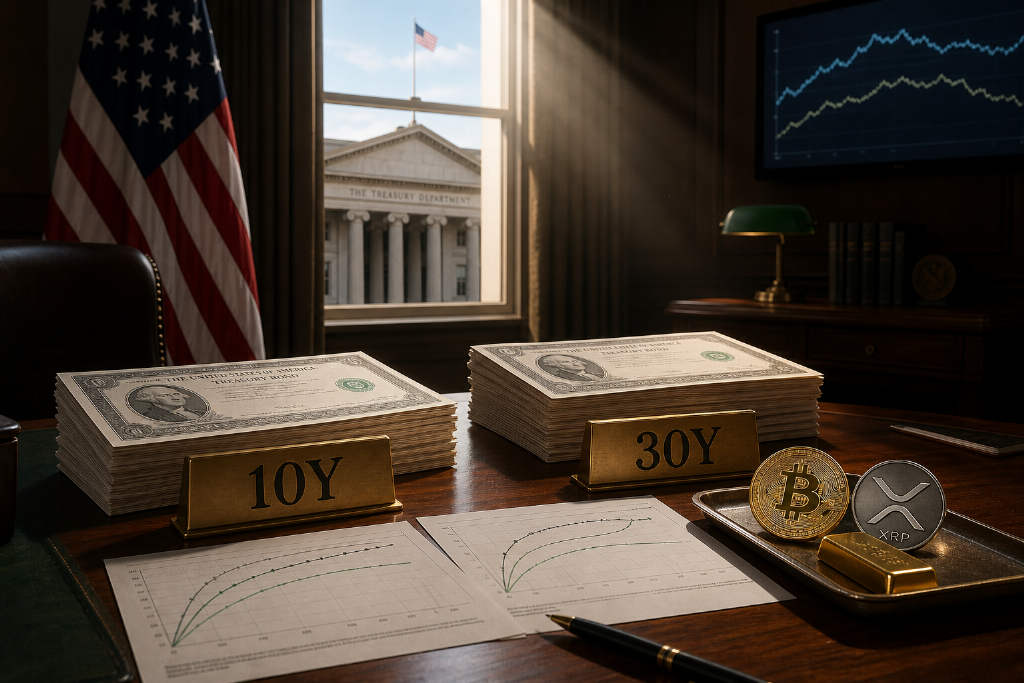
Long-dated US Treasury yields briefly rose to their highest level in nearly 20 years in August 2026. They then pulled back after the US Treasury said it would at least double the buyback cap for long-term bonds to $4 billion. Bitcoin, XRP, and gold also rallied after the move, according to ABMedia, which said the sequence pushed Treasury yields into the middle of conversations spanning equities, bonds, and crypto.
What a Treasury yield means
ABMedia described government bonds as IOUs issued by the state to raise money. Buying a Treasury bond means lending money to the government in exchange for periodic interest payments and repayment of principal at maturity. Yield, in this context, is the annualized return an investor would earn by buying the bond at its current market price and holding it until maturity.
The guide stressed a point that often confuses newer investors: bond prices and yields move in opposite directions. It used a simplified example of a bond with a face value of 100 and a fixed annual coupon of 5. If the bond is bought at 100, the yield is 5%. If weak demand pushes the market price down to 90, the same 5 of annual interest lifts the yield to about 5.6%. If strong demand pushes the price up to 110, the yield falls to about 4.5%. In practical terms, when news reports say yields are surging, the underlying move is usually a sell-off in bonds.
Why the 10-year and 30-year matter
Treasury bonds come in many maturities, ranging from a few months to as long as 30 years. Plotting yields across those maturities produces the yield curve.
Under normal conditions, longer lending periods carry more uncertainty, so investors usually demand higher compensation. That leaves the yield curve sloping upward, with shorter maturities below longer ones. ABMedia said the 2-year yield is commonly treated as a market gauge of where the Federal Reserve’s short-term policy rate is heading. The 10-year yield acts as a major pricing anchor for global finance, shaping mortgage rates, corporate bond yields, and rates used in many countries. The 20-year and 30-year yields, by contrast, are more closely linked to views on long-term inflation, fiscal deficits, and the government’s debt-servicing capacity.
The report pointed to the August 2026 move in the 30-year Treasury yield, which briefly climbed to about 5.3%, a near 20-year high. When long-end yields move that high, it often reflects market concern over public debt and long-term inflation.
Why rising yields pressure risk assets
ABMedia said higher yields raise the return available on so-called risk-free assets. If investors can earn more than 5% by lending to the US government, assets that do not pay income and carry heavy volatility, such as growth stocks and Bitcoin, become less compelling on a relative basis.
There is another transmission channel. Treasury yields are the baseline for funding costs across the economy. As yields climb, borrowing becomes more expensive for corporations issuing debt and for households taking out mortgages or auto loans. That can weaken spending and investment, which in turn weighs on profit expectations for equities.
The guide also noted the burden on the government itself. The higher yields go, the more costly it becomes to issue new debt and refinance old debt. With US debt nearing $40 trillion, ABMedia said that remains one of the market’s concerns.
The reverse also applies. When yields fall, funding costs ease and the return on risk-free assets declines, which can steer capital back toward equities and crypto. That is one reason Bitcoin often reacts quickly to signs of rate cuts or looser liquidity conditions.
How the Fed and Treasury split the job
Interest rates are not set entirely by the Federal Reserve, ABMedia wrote. The Fed directly controls short-term policy rates, shaping the front end of the curve through hikes and cuts. Long-term yields are driven more by market supply and demand, including investor expectations for inflation, growth, and fiscal conditions, and the Fed cannot directly dictate them.
The Treasury, meanwhile, manages bond issuance and buybacks. Issuance adds supply to the market, tends to pressure bond prices, and can push yields higher. Buybacks work in the opposite direction: the Treasury repurchases its own bonds from the market, reducing supply in circulation, supporting prices, and helping push yields lower.
In August 2026, after long-end yields surged to a near 20-year high, the Treasury announced that it would at least double the buyback cap for long-term bonds to $4 billion. ABMedia said the market read that as a signal of yield curve control aimed at putting a ceiling on long-end yields.
Why crypto reacts so strongly
Crypto assets are especially sensitive to yield moves and liquidity signals, the report said. When a Treasury buyback is interpreted as a sign that authorities are willing to inject liquidity, capital can rotate into inflation-hedge trades and risk assets, with Bitcoin and XRP among the first to react.
ABMedia said XRP jumped as much as 51% in a single week after the Treasury buyback news in August 2026, marking its biggest weekly gain in about 21 months.
The article also cited BlackRock research saying Bitcoin’s value is closely tied to the direction of global liquidity and describing it as an asset used to hedge against fiat currency debasement. On that view, signals tied to Treasury support for the bond market and looser liquidity conditions carry outsized weight for crypto pricing.
How investors can track yields
ABMedia said retail investors do not need to be bond specialists to use yields as a market thermometer. The most commonly cited benchmark is the US 10-year Treasury yield, which can be tracked on financial platforms such as TradingView, Investing.com, and CNBC, often under the symbol US10Y. For a read on long-end sentiment, investors can also watch the 30-year yield, commonly listed as US30Y.
The key is not just the absolute level but also the direction and speed of the move. Rapid increases in yields often coincide with pressure on stocks and crypto and a rise in defensive positioning. Pullbacks in yields usually help risk assets. ABMedia added that the shape of the yield curve matters as well. When short-term yields rise above long-term yields, creating an inversion, the pattern has historically been viewed as one of the warning signs for recession.
More than a bond-market term
ABMedia framed Treasury yields as more than a technical concept for bond traders. They influence the level of risk-free return, the cost of money, and the path of capital across markets, which means they can also affect the pricing of equities and crypto. For investors watching digital assets, understanding yields and the policy signals around them has become part of reading the broader macro tape.