

The U.S. Treasury market is sending stronger stress signals into other asset classes, and equities are at the front of that line.
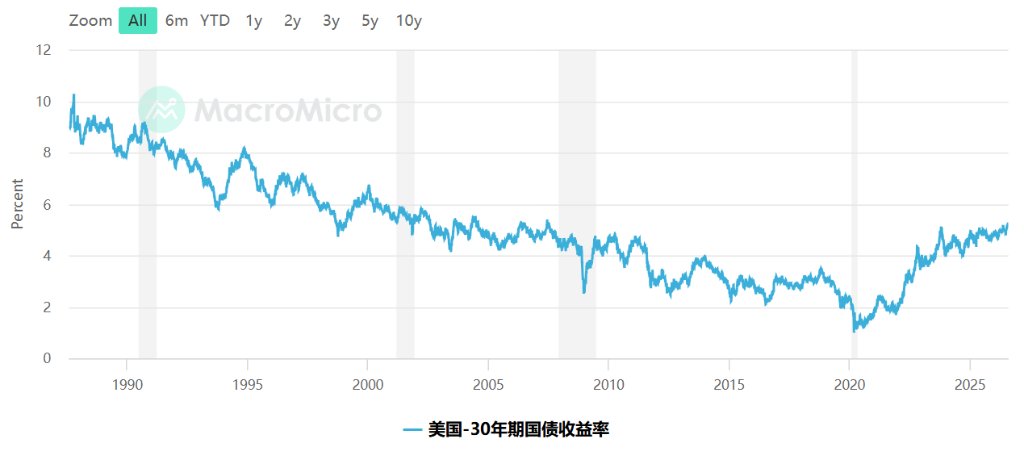
Long-dated Treasury yields jumped last week. The 30-year Treasury yield touched its highest level since 2007, while the 10-year yield broke above the trading range it had held since late 2023. At the same time, the ICE BofA MOVE Index, a gauge of expected volatility in the Treasury market, rose to its highest point since May. Demand for put options tied to falling bond prices also climbed.
According to Chicago Board Options Exchange data, one-month put skew linked to the iShares 20+ Year Treasury Bond ETF reached its highest level since the 2008 financial crisis. The next week is now in focus as the U.S. Treasury is set to disclose details of its funding plans and the July nonfarm payrolls report is due shortly after, events that could add fresh turbulence to the bond market.
Bob Elliott of Unlimited Funds wrote recently, “It’s hard to tell how long other asset markets like stocks can hold up at current rate levels without being dragged lower.” Gennadiy Goldberg, head of U.S. rates strategy at TD Securities, also warned that uncertainty around Federal Reserve guidance, layered with geopolitical noise, has left markets in a fragile state.
Questions over Fed credibility push long-end yields higher
The report describes the latest rise in Treasury yields as being driven largely by doubts over the Federal Reserve’s policy credibility.
Since Federal Reserve Chair Kevin Warsh took over, he has maintained a hawkish stance on inflation. But inflation has remained above the Fed’s 2% target for five consecutive years, leading investors to question whether the central bank is truly willing to raise rates again.
That concern sharpened last Wednesday, when the Federal Reserve’s rate-setting committee showed a rare split. Three regional Fed presidents voted in favor of a rate hike, breaking with the majority. After Warsh concluded his press conference, long-term Treasury yields suddenly jumped while short-term yields moved lower, sharply narrowing the spread between them. Dow Jones Market Data said that marked the biggest “Fed day” yield-curve compression since 2023.
“The market is questioning how committed the Fed really is to controlling inflation,” Goldberg said. He added that his base case still calls for no rate hikes this year or next year, but the probability of a hike has risen “meaningfully.”
Volatility and hedging demand move up together
The unusual move in yields quickly spread into the derivatives market.
The MOVE Index reaching a high for the period since May points to active hedging against the risk of further rate increases. Options tied to the iShares 20+ Year Treasury Bond ETF, known as TLT, showed the same defensive turn.
CBOE analysts said one-month TLT put skew has climbed to its highest level since the 2008 financial crisis. The ratio of put volume to call volume tied to TLT has also moved higher, another sign that traders are paying more for downside protection in long-duration Treasuries.
One detail drew extra attention: this rise in long-end yields has diverged from crude oil. Oil prices fell instead of rising alongside yields, weakening the usual relationship between the two and adding another layer of uncertainty.
Spillover risk to stocks is becoming harder to ignore
Treasury market stress has often acted as an early warning for equities, and the current episode is raising similar concerns.
Elliott said that whenever Treasury yields reach or approach current levels, pressure tends to spread into other markets, with stocks usually taking the first hit. The figures cited in the report put the 30-year Treasury yield at 5.239% and the 10-year yield at 4.693%, both in historically elevated territory.
Goldberg said geopolitical uncertainty tied to Iran, unclear Fed guidance and other market noise are all hitting at once, leaving the backdrop especially fragile. “All of these uncertainties are colliding,” he said.
Funding details and payrolls data set up a critical week
The coming week is being framed as a key test of whether Treasury market stress keeps spreading.
Later this week, the U.S. Treasury will release details of its latest government financing plan. Anything beyond market expectations could trigger another round of bond-market volatility. Several important economic releases are also due, ending with Friday’s July nonfarm payrolls report. That labor-market data is expected to carry significant weight for market pricing around the Fed’s next steps.
The report also noted that last week the U.S. Treasury and the Federal Reserve joined Japanese authorities in what it described as a historic coordinated intervention aimed at stabilizing the falling yen. Analysts cited in the report said part of Washington’s motivation for joining that action was to guard against another bout of volatility in the Treasury market.
The U.S. Treasury market, valued at $30 trillion in the report, sits at the center of the global financial system. It serves as core collateral for short-term institutional liquidity and as a benchmark pricing anchor for trillions of dollars in debt worldwide. If that market keeps moving violently, the shock is unlikely to stay contained within bonds.