
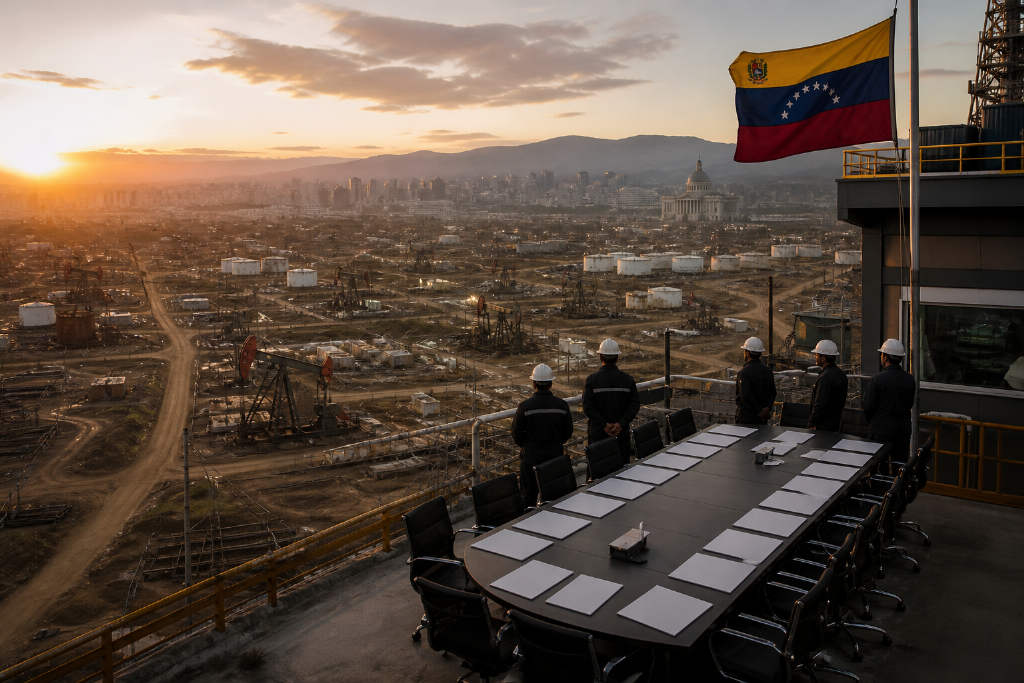
The U.S. government and North America Blue Energy Partners (NABEP), a private oil company, have agreed to a 100-year lease covering 17 Venezuelan oil fields and about 65 billion barrels of crude reserves, BlockBeats reported on Sept. 1.
Under the agreement, the U.S. government would hold a 35% stake in NABEP’s parent company. It would also receive 20% of physical oil production and priority rights to purchase the remaining output. NABEP plans to raise Venezuela’s crude production from about 170,000 barrels per day to more than 1 million barrels per day.
Major producers remain cautious
The agreement has raised concerns among potential investors because of the background of Venezuelan businessman Alejandro Betancourt. The source points to his complex past relationship with the Venezuelan government and previous investigations by the United States and Europe. An unnamed person said large oil companies negotiating the transfer of contracts 「do not want to sit at the same negotiating table as Betancourt」.
Exxon Mobil declined to comment. ConocoPhillips reiterated that its investment decisions would depend on 「policy stability」 and 「the rule of law」. Chevron, Eni and Colombia’s GeoPark are moving forward with Venezuelan projects through existing joint-venture structures.
Whether Venezuela can quickly increase production still depends on whether the United States can bring back major oil companies such as Exxon Mobil and ConocoPhillips, which have financial and technical advantages, the source said.
Russia faces lower projected output
Russia’s energy supply is also facing a decline. A government draft obtained by Reuters projects the country’s crude output at 494 million metric tons in 2026, equivalent to about 9.88 million barrels per day. That would be Russia’s lowest level in 17 years.
The source attributes damage to Russia’s refining capacity to Western sanctions and Ukrainian drone strikes on refining facilities. Russia has also imposed restrictions on fuel exports. Its crude and refined-product exports are expected to fall further from 2027 through 2029, according to the draft. The source says the global energy supply structure may shift further toward the Western Hemisphere as a result.