
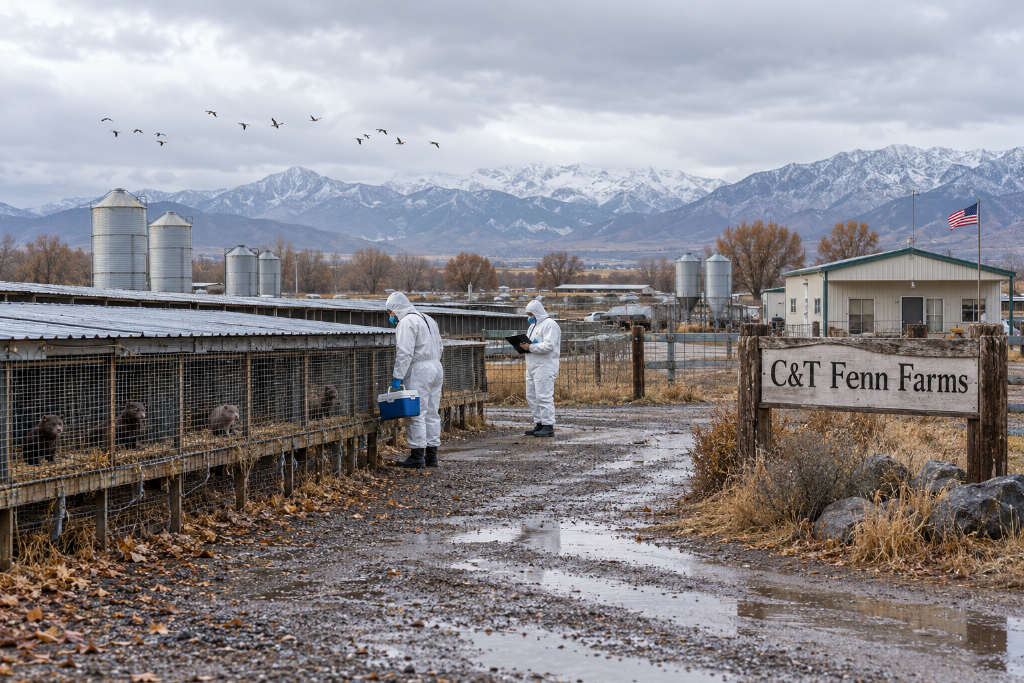
H5N1 bird flu has been spreading for more than two months at C&T Fenn Farms, a mink fur farm west of Provo, Utah, since authorities became aware of the outbreak around mid-August, according to a ProPublica investigation. The farm houses thousands of mink, and the virus has continued to circulate among the animals.
Follow-up reporting by The Guardian said state and federal authorities did not use the full-herd culling approach commonly applied in poultry outbreaks. Workers also were not placed under active monitoring under guidance from the U.S. Centers for Disease Control and Prevention, or CDC. Experts warned that fur farms could act as a bridge for cross-species transmission and raise pandemic risk for humans.
Mink farms seen as a possible site for viral evolution
Experts said mink are a concern because the structure of receptors in their respiratory tract is similar to that of humans. Mink have previously transmitted influenza, and they also infected some humans with COVID. If bird flu keeps circulating in densely packed mink populations, the chance of mutation or reassortment with seasonal human influenza could rise, potentially making the virus better able to infect the human upper respiratory tract.
Genetic sequencing showed the strain at the farm is related to the lineage circulating in U.S. dairy cattle. Mink are often fed raw livestock organs, including beef byproducts, but it is still unclear whether cattle feed was the route of introduction. Early samples reviewed by the U.S. Department of Agriculture, or USDA, did not show especially concerning mutations. Even so, experts said the virus is still evolving as it spreads among mink.
One influenza expert described the lack of culling and monitoring as "playing with fire." At the same time, the reports said there is still no evidence of human-to-human transmission and no confirmation that the outbreak has already caused a human pandemic. The risk remains a possible scenario raised by experts, not an established outcome.
No federal culling rule for infected mink
In the U.S., a single positive case in poultry can trigger a federal order to cull the entire flock, with compensation provided. No equivalent federal rule exists for infected mink. Utah state veterinarian Amanda Price asked USDA for help and was told the department does not regulate mink and has not approved a vaccine for them.
Finland and Spain have previously culled animals at fur farms. Utah has not moved aggressively in that direction. Industry representatives warned that culling would destroy the business. Price said the state has mostly been waiting and watching, while only verbally restricting the movement of mink, manure, and carcasses off the farm.
Farm owner Chad Fenn rejected the idea that the risk had been understated and said the issue was being overblown, adding that Europe had overreacted. He said workers wear masks in daily operations, while he does not. He also said he wants mink to be vaccinated, but there is no federal program in place.
Worker monitoring falls short of CDC guidance
Utah health officials had an agreement with agriculture authorities not to actively monitor workers unless there was evidence of human-to-human transmission, according to the report. That differs from CDC guidance, which calls for monitoring exposed people. State officials said the approach was meant to reduce resistance from farms, with operators expected to self-report instead.
ProPublica interviewed a worker at the farm who had red eyes, one of the common symptoms of bird flu in humans. The local county health department did not recommend testing. Fenn said the worker may simply have gotten dust in the eyes and that the symptom later went away. Experts said that without active monitoring and testing, it is nearly impossible to detect potential animal-to-human infections early.
State officials said there has been no sign that the outbreak has spread beyond the farm. Experts pushed back on that claim, saying that without active surveillance, authorities cannot confidently say there have been no cases.


