
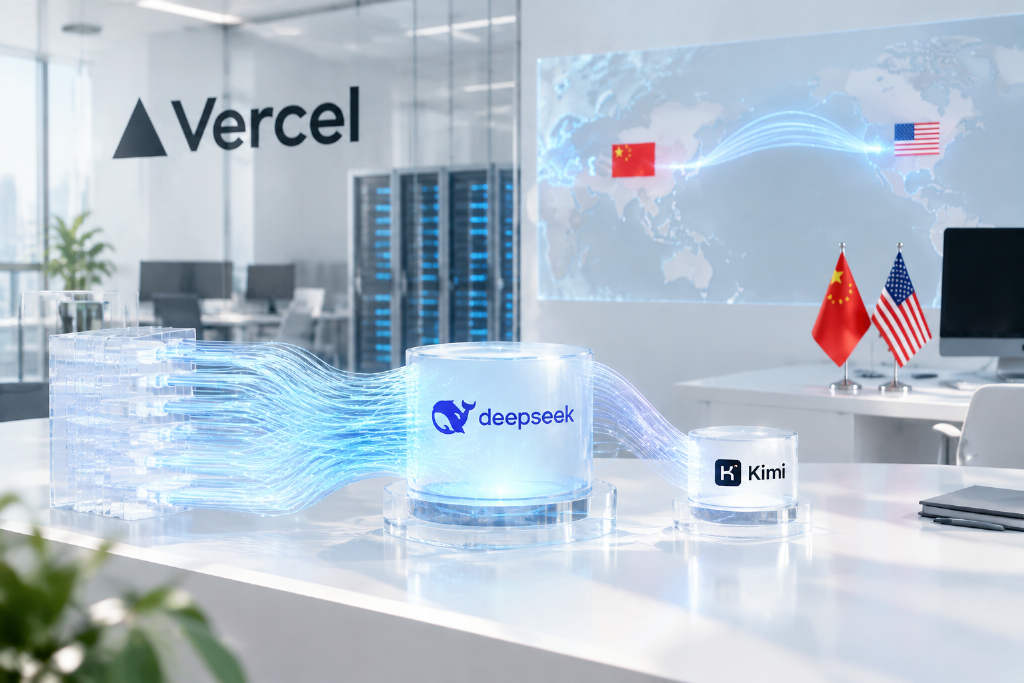
Vercel has released its latest AI Gateway usage report, showing that open-source models processed 71.5% of tokens on the platform in September, while accounting for only 23% of estimated usage costs based on public pricing. A month earlier, open-source models had represented about 56% of token volume.
DeepSeek led token volume while Kimi contributed more spending
Among individual providers, DeepSeek carried the largest share of traffic. Its models accounted for 58% of platform tokens, but only 6.6% of estimated costs. DeepSeek-V4.1-Flash alone processed nearly half of all tokens and made up just 2.6% of spending.
Moonshot AI’s Kimi showed the reverse pattern. It represented 3.6% of tokens, yet accounted for 13.2% of estimated costs. According to the report, lower-priced models absorbed a large share of requests, while higher-priced models such as Kimi K3 generated a larger portion of total spending.
Chinese models are creating business for U.S. inference providers
Vercel also pointed to a shift in who captures revenue around model usage. In September, nearly 70% of estimated call costs tied to Chinese models were linked to U.S. service providers. In December 2025, that figure was still below 10%.
DeepSeek illustrates that split. The company itself processed more than 80% of its model tokens, but calls handled by U.S. providers were billed at higher average rates, leaving roughly 40% of spending tied to U.S. companies. Those firms do not need to build their own models. By deploying DeepSeek’s open weights and selling compute and API access, they can charge customers directly.
Total AI usage costs rose about 13x from December 2025, while average token prices fell 47%
Vercel said total AI call costs on the platform in September were about 13 times higher than in December 2025, even as the average price per token fell 47%.
Among consistently active, high-usage paid teams, nearly one-third changed their most-used model vendor. Enterprises can access different models through a unified API instead of integrating with each provider separately. Even when using the same model, they can still choose among different inference service providers.
The result is a broader revenue fight across the stack. Model developers are no longer the only ones capturing usage income. Inference companies, along with platforms such as Vercel that control developer access, are also competing for that business.