
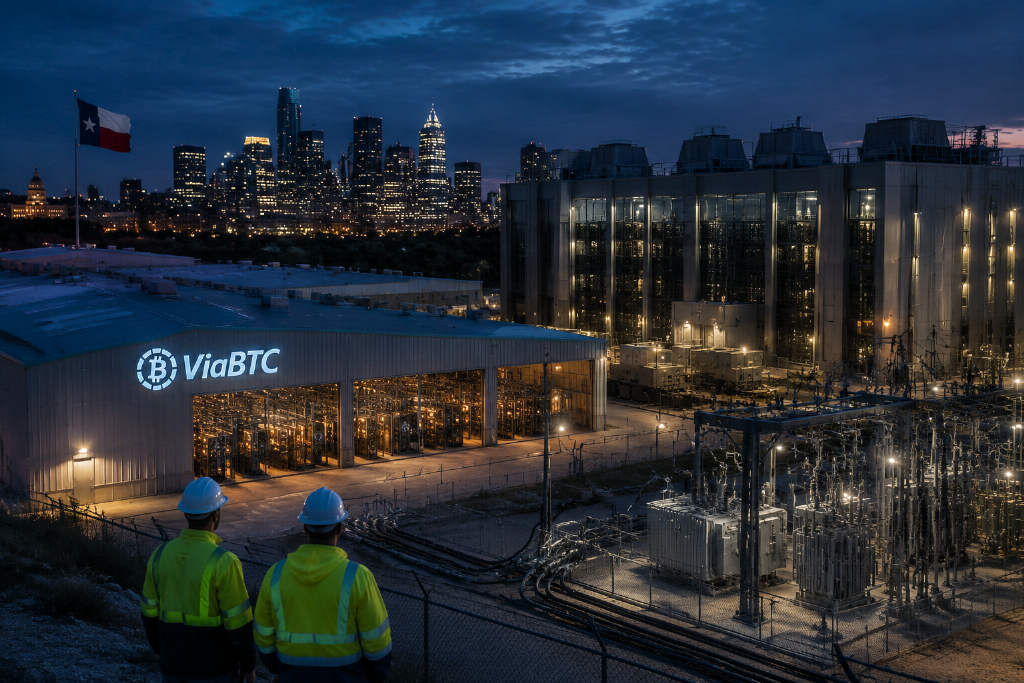
ViaBTC CEO Yang Haipo says Bitcoin mining has gone through a visible reset over the past year, with network hash rate and miner behavior both changing as some mining companies move capital and infrastructure toward AI and high-performance computing, or HPC.
In an article published by WuBlockchain, Yang wrote that the Bitcoin network’s total hash rate rose above 1.1 ZH/s in October 2025, then fell back, dropping to around 900 EH/s several times this year. Mining difficulty was cut by 11.16% in February and again by 10.09% in June, moves he described as rare in magnitude since 2021.
That backdrop has coincided with another shift drawing growing attention: a number of mining firms are redirecting their business focus toward AI and HPC.
What AI and Bitcoin mining are actually competing for
Yang argues that AI is not taking Bitcoin hash rate in a direct hardware sense. GPUs and Bitcoin ASICs are not interchangeable computing resources, he wrote. Using GPUs to mine Bitcoin is now almost uneconomic, while ASIC miners built for SHA-256 cannot be repurposed to run large AI models.
What the two industries are really competing for, in his view, is a layer above the machines themselves: chip manufacturing capacity, capital, land, electricity, and built-out data center infrastructure. Among those, the scarcest and most prized asset is increasingly the ability to secure large-scale power quickly and reliably.
Yang said two plots of land with the same footprint can carry very different value for an AI operator. A site that already has a substation, grid interconnection capacity, and fiber can be upgraded to handle AI workloads much faster. Another site may sit next to a power plant, but if it still needs to go through the full process of power access and infrastructure buildout, the wait could stretch into years.
That timing matters because AI expansion is highly time-sensitive, he wrote. AI chips and models iterate quickly, while large power facilities such as substations often take years to build. For a company trying to expand compute capacity fast, ready-to-use electrical capacity effectively means time.
Many miners, he said, already completed that time-intensive work years ago. They secured land, substations, and interconnection capacity before those assets became as sought-after as they are now. As AI companies become willing to pay more for the same infrastructure, the logic of mining firms pivoting becomes straightforward: what they are selling to AI is less the electricity itself than the already prepared access to it.
Why listed miners are reallocating sites, power, and capital
Yang cited recent company figures to illustrate that shift. Core Scientific posted a self-mining gross margin of negative 56% in the second quarter, while gross profit from its data center colocation business came in at nearly $80 million. TeraWulf, in the same period, generated about 71% of its total revenue from HPC leasing.
For Yang, those numbers show why a group of companies once centered on mining are now moving sites, power, and capital toward AI at a faster pace. Put together with the retreat in network hash rate, that has led many observers to a natural conclusion: AI is taking resources that might otherwise have gone to Bitcoin mining.
Where AI does not compete with mining in the same way
Yang says that picture changes if the focus shifts away from large data centers.
Over the years, ViaBTC has worked with many small and medium-sized miners, he wrote, including operators who connect a dozen or so Bitcoin miners to rooftop solar systems at their own factories. In that setup, normal industrial power demand comes first, surplus solar generation goes to the miners, and operations can scale up when excess power is available or shut down when it is not. The heat from the machines can also be recovered for factory hot water.
In cases like these, the solar installation was not built specifically for mining. Mining simply becomes an extra use case for electricity that would otherwise carry little value. The goal is not to run around the clock. It is to improve the value of surplus power that is already there.
If power left over after normal industrial or residential consumption earns little when sold back to the grid, or cannot be fully exported because of local transmission limits, Bitcoin miners can serve as a supplementary sink for that energy.
From the perspective of the power system, Yang wrote, mining machines are highly adjustable loads. They can run when surplus electricity is being produced and scale down or stop when that surplus shrinks. They do not require power to appear at fixed times every day, and they do not need a full high-availability power architecture just to keep a computing task running continuously.
He reduced the contrast to a simple distinction: AI needs power on demand, whenever it asks for it. This kind of mining runs when low-cost surplus electricity is available.
Yang added that AI can of course use solar or wind, and many operators are building such infrastructure. But if intermittent renewable power is going to support high-availability training or inference services, it usually has to be paired with storage, the grid, or another stable power source so that it can first be turned into continuous, usable supply.
That conversion has a cost. One kilowatt-hour of excess rooftop solar at noon and one kilowatt-hour of dispatchable power at night are physically the same, he wrote, but economically they are not.
From rooftop solar to utility-scale projects
Yang said this need to absorb idle or constrained electricity is not limited to households or small energy systems. He pointed to disclosures this year from energy group ENGIE, which said it is evaluating the deployment of either energy storage or Bitcoin mining facilities at its large Assú Sol solar project in Brazil because the local grid cannot always absorb all of the project’s photovoltaic output, leaving part of its generating capacity curtailed.
Whether it is a rooftop solar setup powering a dozen miners or a solar project measured in hundreds of megawatts considering Bitcoin mining, Yang said the underlying question is the same: what can be done with electricity that nobody needs at the moment and that cannot be delivered elsewhere.
That is why, in his telling, AI is more willing to pay for stable, high-availability electricity, while mining can accept power that is less ideal. Curtailed wind and solar, associated gas from oil fields, remote small hydropower, and power available during negative-price periods can be cheap enough to work for mining even if they are limited by stability, geography, or transmission constraints and are therefore less suitable for data centers that need continuous operation.
His conclusion is that AI will raise the value of high-quality sites, but it will not compete equally for every form of energy. Mining’s edge may increasingly lie closer to the energy source itself rather than inside standardized data center footprints.
Machines may change hands, and hash rate may change location
As large miners reduce self-mining, Yang expects not only sites to be freed up but also some mining rigs to gradually enter the secondary market. An older machine may no longer make sense in a data center with higher power prices. Sell it cheaply, move it to a location with low-cost hydropower, excess solar, or another inexpensive energy source, and the economics may work again.
He makes a distinction between cheaper machines and cheaper electricity. Whether a miner should stay online is still determined mainly by electricity price and energy efficiency. A lower secondhand machine price improves payback time and capital pressure instead.
For factories mining with surplus electricity, he wrote, the equipment may never run all day anyway. If the excess power cost is low enough, a cheaper used machine with weaker efficiency can still be the better fit because it requires less upfront capital and can tolerate lower utilization. In the end, machines from different generations may be rematched to different power-price bands.
Future hash rate growth may not come mainly from listed miners
Yang said institutionalization has been the dominant theme in mining over the past several years. Large mining firms raised money in capital markets, expanded aggressively, built data centers in the hundreds of megawatts, and brought a growing share of global hash rate into listed-company structures.
Now, he wrote, another path is becoming possible. Listed miners will remain important participants, but future growth in hash rate may not come mainly from them. Private operators, small and medium-sized miners, and energy projects that directly control low-cost power could regain more room to compete.
Drawing on ViaBTC’s decade of experience running a mining pool, Yang said the miner base has never consisted only of large institutions. There have always been many smaller operators working with different local energy conditions. They do not publish earnings reports or hold conference calls, so they rarely appear in public discussion. But as mining extends further into distributed solar, remote energy resources, and other fragmented pools of low-cost electricity, these miners, often absent from industry headlines, have never truly left the market.
He added that a more diverse and dispersed miner base actually increases the need for mature infrastructure. Large mining companies can build out their own operations, finance, and asset-management teams. Smaller miners need stable operations, transparent settlement, flexible payout structures, and low costs for onboarding and asset management. The job of a mining pool, he wrote, is to standardize as much of that complexity as possible so miners of different sizes can focus on their actual edge, such as finding the right machines and cheaper power.
Difficulty adjustment and the search for a new equilibrium
Yang also addressed the concern that a falling hash rate could leave the system out of balance.
If a group of miners shuts down at once, total network hash rate drops and block production slows in real time. At the next adjustment point, however, mining difficulty also falls. If other conditions are unchanged, the theoretical BTC output that the same machine can earn in a given period rises, and some miners that had fallen below shutdown economics may become profitable again.
Bitcoin does not prevent miners from exiting, he wrote, but the difficulty adjustment mechanism forces the market to recalculate the economics after hash rate changes.
The hash rate that comes back may belong to large mining farms with long-term access to cheap electricity, or to smaller miners using small hydropower, surplus solar, or other unusual energy sources. As machines leave and return, the system keeps searching for a new balance at a different combination of power prices, machine efficiency, and BTC price levels.
Yang stressed that difficulty adjustment addresses block timing and mining economics. It does not mean a drop in hash rate has no security implications. Total hash rate still matters for the cost of attacking the network. But he said it is also too simplistic to jump from a temporary decline in hash rate to the conclusion that the network is headed into a security crisis.
Yang sees the 2028 halving as the next clearer stress test
In his view, the fifth Bitcoin halving in 2028 will be the next more certain stress test for miners. No one can accurately predict how AI demand, BTC price, or regulation will evolve, he wrote. The one thing already written into the protocol is that the fixed BTC reward per block will be cut in half again.
The math is straightforward, Yang said. A fixed reward falling by half directly increases revenue pressure on miners unless BTC price, fees, and later difficulty adjustments can make up for the gap.
At that stage, competition may hinge less on scale alone or on who has the newest rigs, and more on broader cost discipline: who can secure cheaper and more flexible energy, who can source equipment at lower cost, and who can run with stronger cash flow and operational efficiency.
Bitcoin has already gone through four halvings, he noted, and over the past decade hash rate, price, and miner composition have all readjusted more than once. He said he is inclined to think the fifth one will not be different.
A resource reshuffle rather than an eviction
Yang’s bottom line is that AI is better understood as driving a reallocation of resources than as pushing Bitcoin mining out of the market altogether. Some high-quality power and site resources will go to AI because AI is currently willing to pay more for them. Mining machines, meanwhile, will keep looking for new owners and new sources of electricity.
On one side, mining companies are converting grid-connected sites measured in hundreds of megawatts to support AI workloads. On the other, a small factory with rooftop solar may still switch on a dozen miners at midday when excess electricity is available. AI will make the best sites more expensive and it will eliminate some of today’s mining models, he wrote. But mining retains a distinct ability: as long as there is electricity that is cheap enough and difficult for other industries to use efficiently, someone will rerun the economics.
Yang closed by pointing back to Bitcoin’s protocol design. The system was not built with AI in mind. It does not know who is shutting down, who is building solar, or where a used machine was shipped. It only looks at the past 2016 blocks and adjusts one parameter. The rest is left to the market and to miners themselves.
A system that does not know the price, does not know who is participating, and does not know what is happening outside still allows countless participants to complete another round of resource reallocation on their own, he wrote. That design has been running for 17 years, and in his view it can keep running much longer.