
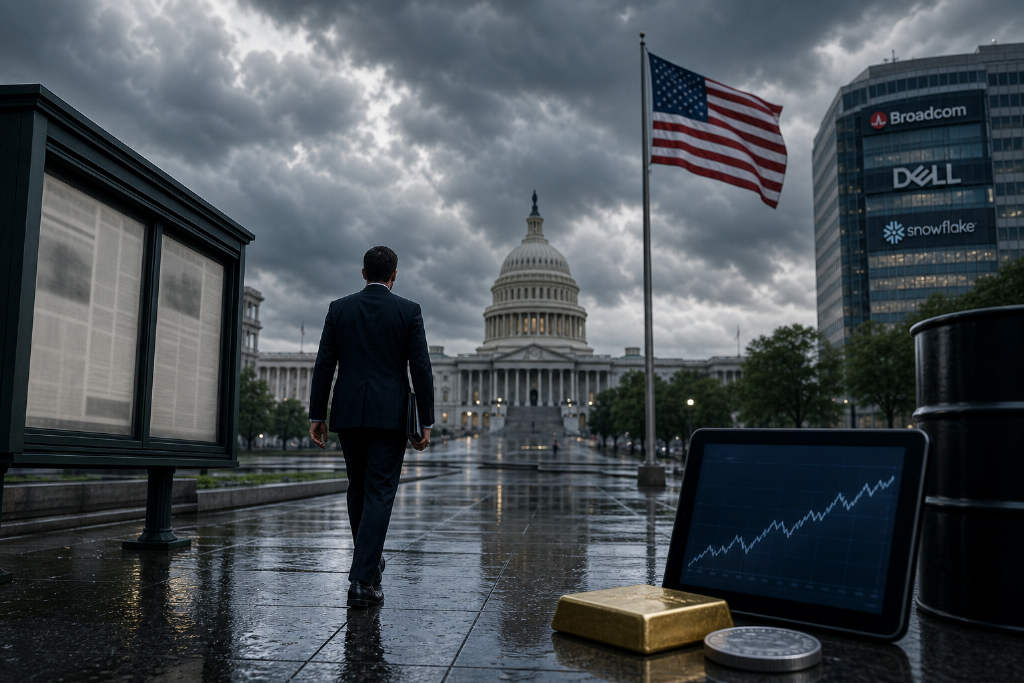
Federal Reserve Chair Waller’s first keynote speech since taking office at Jackson Hole pushed markets to reprice the odds of a September rate increase and knocked risk assets off balance heading into a week packed with macro data and AI earnings.
Waller said that while recent PCE and CPI readings had improved, underlying inflation had not yet shown a “meaningful improvement.” If inflation does not return to the 2% target clearly and quickly enough, he said, “the Federal Reserve still has work to do.” Markets read that as a fresh warning that a September hike remains on the table.
U.S. stocks closed lower on Friday. The Dow Jones Industrial Average slipped 0.02%, the S&P 500 fell 0.25%, and the Nasdaq Composite lost 0.52%. Pricing for a September hike rose from about 40% to 62.6%, while the 2-year Treasury yield climbed roughly 12 basis points to around 4.36%, near a recent high.
How institutions read the speech
China International Capital Corporation, or CICC, said Waller’s main goal was not to directly pre-announce a September rate hike but to rebuild the Fed’s anti-inflation credibility. In its view, the macro backdrop is still balanced between hiking and holding, but if upcoming jobs and inflation data do not shift enough, a September increase becomes a realistic option because of the Fed’s need to defend policy credibility.
Morgan Stanley took a different angle. The bank said Waller has long placed more weight on balance-sheet issues and that the Fed could launch more than $1.5 trillion in quantitative tightening next year, using “more balance-sheet runoff and fewer rate hikes” to contain inflation.
Dollar gains, gold breaks lower, oil jumps on geopolitics
The U.S. dollar found buyers again and at one point approached 99.7. Gold fell more than 3%, lost the $4,400 level, broke below its 200-day moving average, and hit a low of $4,396. Silver dropped more than 4% as well. The report tied that move to higher real yields and rising rate-hike expectations, which triggered rapid deleveraging in non-yielding assets.
Oil moved in the opposite direction as geopolitical tensions intensified over the weekend. WTI opened more than 2% higher, and Brent crude rose above $90 intraday before easing back.
U.S.-Iran tensions return to the foreground
According to the report, the U.S. military confirmed strikes on two rocket launchers on Iran’s Larak Island near the Strait of Hormuz, saying the launchers were preparing to deploy naval mines. It marked the first time since late July that Washington had publicly acknowledged military action against Iran.
Iran’s Revolutionary Guard vowed retaliation and said it had launched missiles at U.S. bases. The article also said Donald Trump had earlier declared “zero tolerance” for mine deployments, while Bessent was advancing what the report called “Operation Economic Orphan,” a plan to impose additional secondary sanctions on Iran every week, beginning with banks, and warning that “financial violence” could be used if necessary.
Trump also said he would fill the U.S. Strategic Petroleum Reserve with Venezuelan oil and claimed to have obtained “majority control” over reserves of more than 65 billion barrels, with the stated aim of pushing down long-term oil price expectations. In currency markets, the yen fell back below 160. Bessent said the move was “under control” and added that he expected the Bank of Japan to “do the right thing,” while saying Abenomics was near its end.
Nonfarm payrolls are the week’s biggest macro trigger
The next major test comes on Sept. 4 with the U.S. August nonfarm payrolls report. Market expectations in the article were for payroll growth of about 55,000 to 58,000 and an unemployment rate of around 4.1%. If jobs data comes in strong, expectations for a September hike could build further. If the report is weak, technology shares and gold could find room to rebound.
Hawkish repricing interrupts the AI compute rally
PANews said Waller’s hawkish turn interrupted the compute rally that had followed NVIDIA’s earnings. Semiconductor shares broadly gave back gains on Friday, while cloud and software stocks held up better on the argument that AI spending is moving from training hype to monetized deployment.
The Philadelphia Semiconductor Index dropped more than 3%. NVIDIA fell 4.57%, AMD lost about 2.3%, and ARM dropped more than 6%. Richly valued hardware names were hit first as higher-rate expectations returned.
Cloud and software names outperform on the “AI landlord” trade
Barclays said AI model companies may direct $35 to $45 of every $100 in revenue to inference-compute spending paid to Amazon Web Services, Microsoft Azure, and Google Cloud. Of that amount, cloud vendors could keep about $10 to $20 in operating profit, implying operating margins of 35% to 45%. In that framework, the deeper AI commercialization runs, the more likely cloud providers are to become the infrastructure landlords of the cycle.
That view helped lift Amazon by nearly 4%, Microsoft by 1.68%, Alphabet Class A by about 1.74%, Meta by more than 1%, and Apple by about 1.63%. In software, Elastic surged more than 19% after earnings. Workday rose nearly 6%, ServiceNow gained more than 4%, Salesforce added more than 1%, and Veeva fell nearly 2%.
The article said Elastic became one of the strongest names in AI application software after posting revenue and net income above expectations. RBC Capital and TD Cowen were cited as firms that raised price targets. Even so, the report said software remains split between companies backed by solid results and those trading mostly on narrative.
Single-stock watch: Tesla, SpaceX, NIO, Dell, Broadcom
Tesla
Tesla fell nearly 2%. The company said it will hold a launch event for its steering-wheel-free and pedal-free autonomous vehicle, Cybercab, in Austin, Texas, on Sept. 3, with plans to gradually add the vehicle to its Robotaxi fleet. The report said the production timeline still matters for Tesla’s valuation, but the stock was dragged lower in the short term by weakness across large-cap tech.
SpaceX
SpaceX gained 0.45%. The report said the company plans to launch its first AI data-center satellites equipped with NVIDIA Vera Rubin GPU architecture in the fourth quarter of 2027. Evercore assigned an “outperform” rating and a $230 price target. At the same time, institutions warned that meaningful revenue contribution may not arrive until fiscal 2029 and that orbital heat dissipation, radiation damage, collision risk, and regulatory approvals remain hard constraints on commercialization.
The same section said OpenAI then announced it would stop providing AI model services to Cursor, the coding tool under SpaceX, starting Nov. 12, directly accusing Elon Musk of repeated breaches of agreement. The dispute between the two technology groups escalated again.
NIO
NIO rose 0.23% ahead of second-quarter results due before the U.S. market opens on Sept. 1. The report said investors are focused on second-quarter deliveries, gross-margin recovery, and the company’s multi-brand strategy, especially whether Onvo and Firefly can lift volume without cutting into profitability. It added that the margin outlook could affect sentiment across Chinese EV names, including Xpeng, Li Auto, BYD-linked supply chains, and battery makers.
Dell and Broadcom
Dell fell 3.39% before results scheduled after the U.S. close on Sept. 1, with traders watching AI server orders, margins, and delivery timing. Broadcom lost 0.74% and is set to report after the close on Sept. 2. The article called it the most important AI hardware event of the week, with markets focused on AI semiconductor revenue, custom-chip orders, and AI networking demand.
Week ahead: index changes, G20 meetings, and a dense earnings calendar
Monday, Aug. 31
At 9:20, 33 Chinese stocks including Zhipu are formally added to the MSCI indexes. The article said the rebalance could trigger passive allocation flows and short-term position adjustments. As one of the higher-profile new additions in emerging markets, Zhipu may affect trading in AI, semiconductors, pharmaceuticals, and new materials.
The G20 finance ministers and central bank governors meeting runs through Sept. 1. Topics include global inflation, exchange-rate volatility, debt risks, financial stability, and sanctions on Iran. The report said U.S. Treasury Secretary Bessent may push for broader alignment on secondary sanctions, which could affect oil, the dollar, Treasuries, and emerging-market currencies. Any hint of currency coordination could also move the yen, USD/JPY, and long-dated Treasuries.
Zhipu, Black Sesame Intelligence, Mobvista Technology, and Horizon Robotics are also set to report results. PANews said Hong Kong-listed AI and intelligent-driving supply chains are entering a concentrated test period, with close attention on Zhipu’s ARR, API call volume, token pricing, and commercial delivery, and on Horizon’s smart-driving chip shipments and advanced driver-assistance penetration.
Tuesday, Sept. 1
Tim Cook is scheduled to step down as Apple CEO, with John Ternus taking over. Cook will become executive chairman. The market is watching whether Apple accelerates hardware innovation and AI device deployment under the new leadership, especially around a foldable iPhone, on-device AI, a new Siri, and smart displays.
A broad round of price increases in electronic components and materials also takes effect. The article listed price adjustments for some Qualcomm products, RF products from Maxscend, MLCC pricing from Taiyo Yuden, Mitsubishi cutting tools, and a 20% to 25% increase for CCL and prepreg from Nan Ya Plastics. PANews said the changes reflect rising upstream raw-material, capacity, and supply-chain cost pressure. If downstream buyers absorb the increases, earnings expectations for related companies may improve; if not, hardware margins could come under pressure.
The G20 technology ministers’ meeting runs from Sept. 1 to Sept. 2. Elon Musk, Jensen Huang, and Sam Altman were listed as attendees. The agenda includes global AI governance, digital-economy rules, and the U.S.-backed light-touch AI regulatory framework referred to in the article as the “Carolina Principles.”
Japan is also set to auction 10-year and 30-year government bonds on Sept. 1 and Sept. 3. With the yen below 160 and long-end U.S. yields elevated, investors are watching whether local demand for Japanese sovereign debt pulls capital away from overseas markets.
Also on Sept. 1, NIO reports before the U.S. open, Baidu’s dual primary listing in Hong Kong and the U.S. becomes effective, and Shein and Mech-Mind Robotics formally list in Hong Kong.
Wednesday, Sept. 2
Dell, Credo Technology, MongoDB, and Palo Alto Networks are due to report. The report framed Dell as a test of visibility in AI server orders and margin quality; Credo as a check on active-cable demand in AI data centers; MongoDB as a read on enterprise database cloud migration; and Palo Alto as a measure of cybersecurity spending under AI-driven threat conditions.
At 22:30, the U.S. will release EIA crude oil inventories and Strategic Petroleum Reserve stockpile data. With U.S.-Iran tensions rising and risks around the Strait of Hormuz back in focus, those numbers carry more weight this week.
The Reserve Bank of New Zealand will announce its rate decision and policy statement, with markets watching whether it hikes by 25 basis points to 2.75%. The Bank of Canada will also announce a rate decision and hold a press conference. The article said markets broadly expect no change, leaving the policy rate at 2.25%.
SEMICON Taiwan also opens and runs through Sept. 4, with a focus on advanced packaging, HBM, semiconductor equipment, and materials.
Thursday, Sept. 3
At 02:00, the Federal Reserve will publish the Beige Book, offering on-the-ground detail on employment, consumption, credit, real estate, and inflation.
Broadcom reports after the U.S. close, alongside Hewlett Packard Enterprise, Snowflake, NetApp, FuelCell Energy, C3.ai, and ChargePoint. PANews described Broadcom as the week’s headline event in AI hardware, with attention centered on AI semiconductor revenue guidance, custom AI accelerator orders, AI networking demand, and customer concentration.
At 20:30, Federal Reserve Governor Christopher Waller will take part in an interview. The article said this is one of the last important appearances before the FOMC blackout period. If Waller echoes the hawkish tone from Jackson Hole, September hike odds could rise again. If he stresses labor-market risks, rate pricing could move the other way.
Tesla’s Cybercab event is also scheduled for Austin on the same day. The 2026 World Power Battery Conference will run through Sept. 4, with Tesla, CATL, and BYD among the participants and a power-battery industry development index due to be released.
Friday, Sept. 4
DocuSign, Lululemon, Zscaler, Ciena, UiPath, Planet Labs, and Ambarella are set to report. The article tied those results to cloud-security demand, optical-networking conditions, enterprise software spending, consumer resilience, and edge AI and in-vehicle vision chips.
At 20:30, the U.S. publishes August nonfarm payrolls, the unemployment rate, and average hourly earnings. PANews called it the single most important data release for global markets this week. Consensus in the article was for payroll growth of about 55,000 to 58,000 and an unemployment rate of 4.1%. Stronger-than-expected jobs and wage growth would reinforce September hike trades, lifting the dollar and short-end yields while pressuring the Nasdaq, gold, and long-duration growth names. A clearly weaker print would undercut the hawkish repricing triggered by Waller and could help Treasuries, gold, and technology stocks rebound.
Sunday, Sept. 6
The monthly meeting of seven OPEC+ countries will review implementation of the planned September production increase of 188,000 barrels per day and assess global oil supply and demand. If U.S.-Iran tensions remain elevated, the group’s language could directly affect the risk premium in Brent and WTI. Signals favoring production discipline or cautious supply increases could support oil prices, while looser guidance could limit gains in energy shares.