
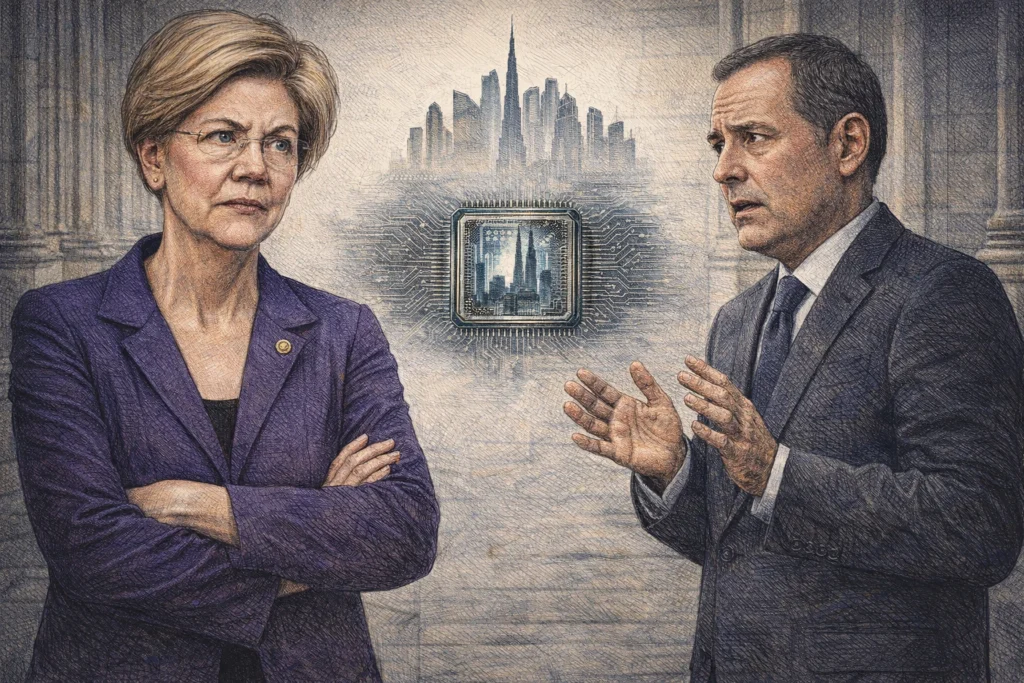
U.S. Senator Elizabeth Warren has sent a letter to Commerce Secretary Howard Lutnick asking why the Commerce Department relaxed artificial intelligence chip export restrictions for the United Arab Emirates, while questioning whether the move conflicts with foreign money tied to World Liberty Financial, or WLFI, a crypto project linked to the Trump family.
CNBC reported on Aug. 5 that Warren directly argued in the letter that the department’s softer stance toward the UAE came at a time that was “too coincidental” with two major UAE-linked investments connected to WLFI. That timing, she said, raised questions about whether the president’s crypto business interests were influencing federal decision-making.
Two UAE-linked deals drew Warren’s attention
Warren focused on two transactions that tied UAE money to crypto business activity associated with the Trump family.
- In January, an entity backed by Abu Dhabi royal Sheikh Tahnoon bin Zayed Al Nahyan invested $500 million in World Liberty Financial.
- In a separate deal, UAE-linked firm MGX used World Liberty’s stablecoin, USD1, in a $2 billion purchase of an equity stake in crypto exchange Binance.
The Binance transaction was settled with USD1 rather than through the traditional U.S. dollar banking system. The report said that has added to concerns about stablecoins being used in large cross-border transactions between states.
Commerce moved the UAE into Country Group A:5
Before Warren sent the letter, the Commerce Department had already changed the UAE’s classification in July, moving it into “Country Group A:5.”
That category gives the UAE access to more goods that are exempt from export license restrictions, including some advanced AI chips. The department also said it would “favorably review” chip and server export license applications submitted by MGX.
Warren says crypto business interests may be affecting national security decisions
In the letter, Warren wrote: “The Commerce Department’s actions raise serious questions about whether the President’s cryptocurrency business interests are influencing the agency’s operations and our national security.”
The letter marks the latest step in a broader push by Democratic lawmakers who have been questioning the Trump administration’s ties to the crypto industry.
Back in June, Warren and other Democratic senators called for a hearing into whether the UAE’s $500 million investment in WLFI involved a quid pro quo. The report also said Trump’s pardon of former Binance CEO Changpeng Zhao, or CZ, has remained a target of criticism from Democratic lawmakers. Some legislators, according to the article, believe the timing of that pardon was connected to the USD1-based transaction between Binance and WLFI.
Scrutiny now spans crypto, diplomacy and export controls
The report noted that Warren has long taken a hard line on crypto and previously described the industry as “shadow banking.” In this case, though, her criticism is not centered on the technology itself. The issue she raised is whether crypto investment is being used as a channel linking political relationships and foreign policy.
From UAE money flowing into WLFI, to the USD1 settlement in the Binance deal, to the Commerce Department’s decision to loosen chip export restrictions for the UAE, the chain of events has placed cryptocurrency, diplomacy and semiconductor export controls into the same political debate.