


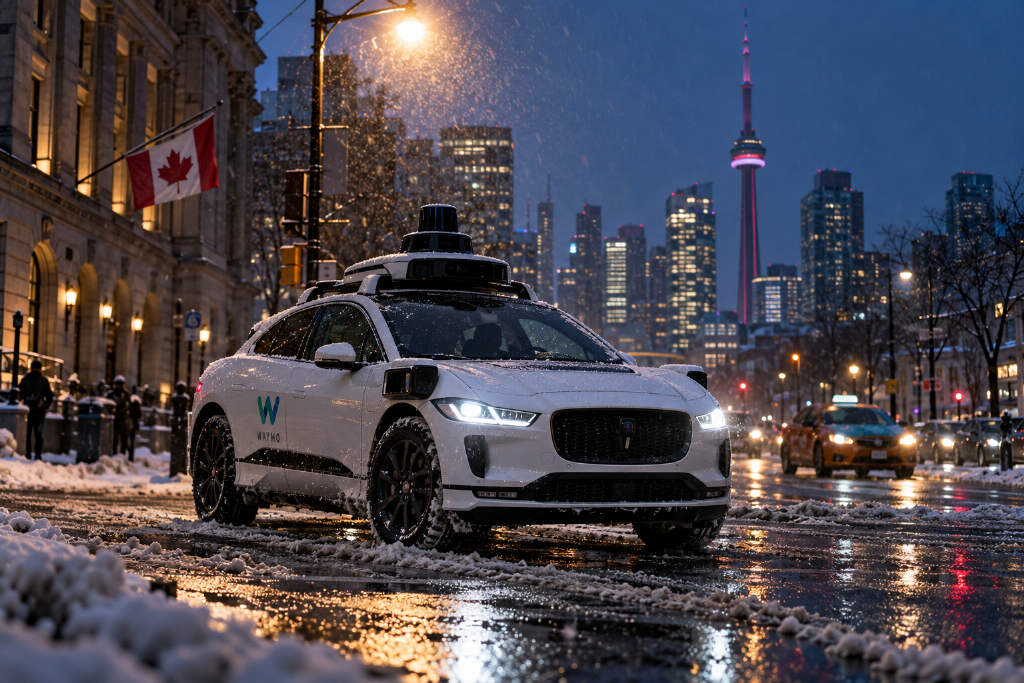
Waymo is aiming to launch driverless passenger service in Toronto as early as 2028, but the company still faces two clear hurdles before that can happen: Ontario’s current rules only allow testing, not paid rides, and Waymo has yet to complete a full winter of commercial service in a snowy city.
In an official blog post dated Oct. 16, Waymo said its vehicles would begin appearing on Toronto streets in the coming days. At this stage, the cars will be manually driven and will not carry passengers. People interested in using the service can register on the company’s website.
What the first Toronto vehicles will do
Waymo said the first phase will focus on building high-definition maps through manual driving. Those maps identify lane-level details and traffic signal locations so the system can determine exactly where the vehicle is. After that, trained autonomous vehicle specialists will test the cars from the driver’s seat before any passenger operations begin.
The Globe and Mail reported that the first batch of test vehicles numbers in the dozens.
Toronto-based Element Fleet Management will handle fleet operations, including charging, maintenance, cleaning, and vehicle condition management. Waymo will oversee validation of the autonomous driving system and the ride-hailing app. The two companies said on June 15 that their partnership began in San Diego, with Toronto set as the next stop.
Waymo said it plans to add "hundreds of jobs" with partners including Element, covering fleet maintenance, validation driving, customer support, and operations.
By Waymo’s own figures, the company has logged more than 400 million kilometers of fully autonomous driving. In cities where it operates, crashes involving serious injuries or worse are 95% lower than those involving human drivers.
Ontario law does not yet allow paid service
Under current rules, Waymo cannot legally offer paid passenger service in Ontario.
Ontario’s pilot regulation under the Highway Traffic Act, O. Reg. 306/15, began in 2016. Section 5 states that vehicles may be used only for "testing purposes." A 2019 amendment opened the door to driverless testing, provided the company can monitor the vehicle at all times, take control when needed, and bring it to a safe stop.
The regulation contains no provision for paid passenger operations. Section 18 also states that the pilot framework will be revoked on Oct. 13, 2027, which is earlier than Waymo’s 2028 target.
The Canadian Press reported that Waymo said the provincial government had approved its participation in the pilot. Under the regulation, however, that approval covers testing rather than commercial service.
Dakota Brasier, spokesperson for Ontario Transportation Minister Prabmeet Sarkaria, said in an email that the province would move in phases, with safety and job creation taking priority. The province is asking for a "credible jobs plan" that sets out expected roles and a hiring timeline.
Safety and labor concerns are already in focus
Toronto Mayor Olivia Chow said on Oct. 16 that her top concern is public safety and that the highest standards should apply. She also noted that the legal authority to allow these vehicles on the road sits with the province, not the city.
In April, her press secretary told CBC: "If Waymo will cause people to lose jobs, suppress the wages of other workers, or create more precarious work in the city, the mayor will not strongly support Waymo. Waymo must prove that these things will not happen."
Laura Miller, Uber Canada’s head of policy, estimated that paid driverless passenger service in Ontario is at least two years away. She called on the province to set safety standards and to "prepare for the impact on workers."
Marc-André Way, president of the Canadian Taxi Association, said, "It is possible that at some point some drivers will be replaced," but added that "no one should hit the panic button."
Toronto winter remains an open question
Whether Waymo can handle Toronto’s winter is still unknown.
Denver opened driverless passenger service in September and became Waymo’s first commercial city with real snowfall. The airport there averages about 47 inches of snow a year over 30 years, or roughly 119 centimeters. This winter will be Waymo’s first full season of paid operations in a snowy city.
Waymo said its vehicles are designed to pull over safely when weather worsens, and service will be suspended in severe conditions. Company spokesperson Amanda Galbraith told The Globe and Mail that Waymo has spent years testing in a range of icy and snowy environments and has already operated in subzero temperatures in multiple cities, including in frost and hail.
Sidney Givigi, a robotics professor at Queen’s University, said: "All sensors can potentially be covered by snow. That is a problem California does not have."
Adam Motaouakkil, co-founder of advocacy group Technologists for Democracy, said: "Waymo operates in sprawling cities. Those places do not have huge snowbanks, and they do not have streetcars."
Section 166 of Ontario’s Highway Traffic Act says that when a streetcar stops to let passengers on or off, vehicles behind it may not pass and must stop at least 2 meters behind the nearest door until passengers have boarded or reached the curb.
A Hacker News commenter who said they had worked on lidar perception also argued that snowflakes can scatter lidar signals, while lane markings covered by slush often lead drivers to follow the tracks left by the vehicle ahead.
Outside the US, Waymo is still in testing or preparation mode
Toronto is not an exception. In cities outside the United States, Waymo is still either testing or preparing for launch.
- London only began tests with safety operators in April, and the UK approval process for passenger service is not complete.
- Singapore and Toronto are both targeting 2028.
- Munich began mapping this fall and is aiming for the end of 2027.
Whether Waymo can meet its Toronto timeline now depends on two things already in plain view: changes to Ontario’s regulatory framework and proof that its system can operate through the city’s winter conditions.