


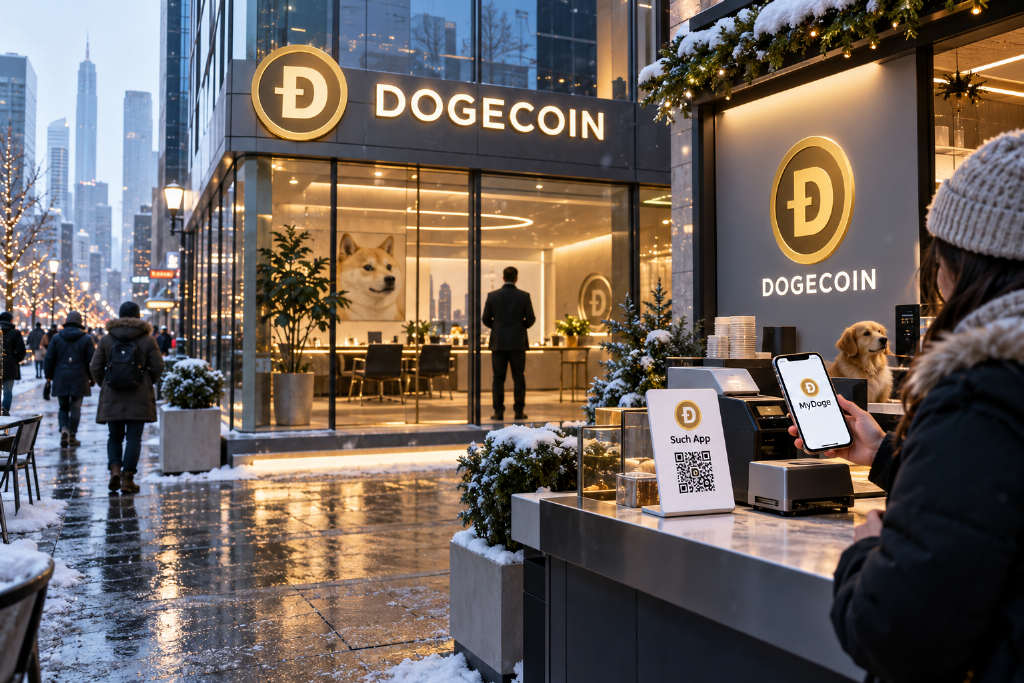
Dogecoin Labs launches with backing from the Dogecoin Foundation
Dogecoin Labs has been formally established with support from the Dogecoin Foundation. The new entity is led by DogeOS founder Jordan Jefferson as CEO and brings together the MyDoge wallet, the DogeOS application platform and the Such App payments product. Its stated goal is to expand DOGE use across payments, commerce, DeFi and gaming.
According to the project details, MyDoge has more than 500,000 users. DogeOS launched its EVM-compatible public testnet on Sept. 30, and Such App offers merchant invoicing and in-person QR code payments. Dogecoin Labs will operate as an independent organization, while the Dogecoin Foundation will continue to oversee ecosystem management and open-source development.
Circle shareholder sues Trump and World Liberty Financial
Circle shareholder Benjamin Greenberg has filed suit in federal court in Washington against U.S. President Donald Trump and World Liberty Financial, a crypto project co-founded with participation from Trump’s family. The complaint alleges that Trump illegally profited from two UAE-linked transactions in violation of the U.S. Constitution’s Foreign Emoluments Clause and harmed Circle shareholders through unfair competition.
The two transactions cited in the case are a $500 million acquisition of a 49% stake in World Liberty by an investment entity backed by members of the UAE royal family, and a $2 billion investment in Binance by Abu Dhabi fund MGX using the USD1 stablecoin. The plaintiff is asking the court to block the alleged unconstitutional conduct, recover the alleged illegal gains and award damages.
Circle said the lawsuit was brought by an individual shareholder and that the company was not involved. World Liberty denied the allegations and said its business complies with U.S. laws and regulations.
Zcash targets NU7 activation around Nov. 5
Zcash developers have agreed on activation block height 3,543,405 for the NU7 upgrade, which is expected to go live around Nov. 5. The change would reduce block times from 75 seconds to 25 seconds.
The upgrade would also temporarily remove 60% of fees from circulation on each block, with those funds set to be returned to miners starting around February 2031. The existing mining reward halving schedule will remain unchanged. Sprout, the network’s original privacy system, will be fully shut down, and any assets not migrated by then will no longer be spendable.
As of 08:00 UTC on Oct. 21, the activation height proposal had not yet been merged into the deployment specification and still needed to be included in node software before it could take effect.
OpenSea opens app downloads to the public
OpenSea co-founder and CEO Devin Finzer said the OpenSea app is now publicly available for download.
The app combines three core functions. It aggregates trader social graphs and trading activity from platforms including fomo, pump and Farcaster, allowing users to follow on-chain actions in a live feed and claim their own profile. It also supports wallet creation or import with Apple Pay funding, cross-wallet asset tracking under a single account, and one-click trading for tokens, meme coins, NFT art and trading cards. Trade execution is powered by cross-chain liquidity and real-time pricing.
Finzer said the current release is a foundational aggregation phase. More precise trading signal customization and on-chain performance profiles are planned for later releases.
Qubic reports wallet compromise affecting 1,404 addresses
Layer 1 network Qubic said attackers exploited insufficient randomness in some wallet seeds between 23:42 UTC on Oct. 17 and 01:26 UTC on Oct. 18, compromising 1,404 wallets and stealing about 2.94 trillion QU. Qubic said the issue came from the seed generation mechanism rather than the Qubic protocol itself.
The network halted transactions at block height 85,371,949. Qubic said 87.1% of the stolen funds remained on the network and had been frozen, while 12.9% was transferred to MEXC, where the related accounts were also frozen. Other exchanges have suspended QUBIC deposits and withdrawals. The project said the seed generation issue was fixed in version 4.26.4, and the next steps will be decided by a Computor quorum under network rules.
An analysis from the GoPlus Chinese community said the official Qubic wallet used Math.random() to generate wallet seeds. Under Apple’s JavaScriptCore engine, the underlying pseudorandom number generator had only 32 bits of seed entropy. That meant an attacker could enumerate roughly 4.3 billion possibilities offline, derive private keys and addresses, compare them with funded on-chain addresses and then steal assets.
The affected scope includes wallets whose seeds were generated before Oct. 18, 2026 through the official Qubic client on iPhone, iPad browsers or Mac Safari, as well as wallets generated before July 2025 through the Qubic iOS app. Public research and tools related to the weakness appeared in September 2026. Qubic said it replaced the method with crypto.getRandomValues in Web Wallet v4.26.4.
Aave founder says Aavenomics 3.0 will include buybacks, staking and burns
Aave founder Stani said during a third-quarter livestream that Aavenomics 3.0 will include AAVE buybacks, staking and token burns.
He also said AAVE buybacks have been paused since April 19, the day after the rsETH exploit. Since then, the DAO has committed 25,000 ETH to DeFi United to cover losses and arranged a credit line of up to 30,000 ETH from Mantle. Before the pause, a forum proposal had suggested cutting the annual buyback budget from about $50 million to $30 million.
Uniswap rolls out Aggregator Hooks on three chains
Uniswap Labs said Aggregator Hooks are now live on Ethereum, Base and Robinhood Chain. The feature connects liquidity from external platforms to Uniswap v4 and is designed to help users find better execution routes.
Fluid, Curve and PancakeSwap are the first outside liquidity sources to be integrated. The feature is available through the Uniswap web app and API, with support for more blockchains planned later.
Aggregator Hooks are built on Uniswap v4’s Hooks framework. They package external liquidity as Uniswap v4 liquidity pools, then let Uniswap compare its own pricing with outside venues and choose the best route.
Starknet vote backs research into an independent quantum-resistant Layer 1
Starknet (STRK) holders used more than 93.5% of voting power to support a research proposal exploring whether Starknet should move from being an Ethereum Layer 2 to an independent quantum-resistant Layer 1 network.
StarkWare plans to publish a draft white paper in November. The vote only authorizes research into the transition and does not mean a final transformation plan has been approved. Any next step would still require additional governance approval.
GMX plans tokenomics changes for Oct. 28
The GMX governance forum published proposal GMLabs-003, under which the decentralized derivatives platform plans to implement two tokenomics changes on Oct. 28.
After GT token buybacks are completed, all remaining protocol revenue from the Solana business will be used to buy back GMX, and the purchased tokens will be added to the staking rewards pool. On Arbitrum and Avalanche, GMX and esGMX staking positions will be subject to a 180-day unstaking wait period, covering both existing and new positions. On-chain staking rewards have not yet resumed. The changes are expected to take effect on Oct. 28.
Aerodrome and Velodrome complete merger
Aerodrome, a leading decentralized exchange in the Base ecosystem, and Velodrome, a leading DEX on OP Mainnet, have formally merged and launched a unified on-chain spot trading platform called Aero.
According to the project team, Aerodrome accounted for 58% of Base DEX trading volume in the third quarter of this year, while Velodrome accounted for 60% on OP Mainnet.
The merger also unifies tokenomics. Existing AERO will convert to the new AERO on a 1:1 basis, VELO will convert at a 1:0.044 ratio, and locked veAERO and veVELO positions will be converted into sAERO. The new platform will also introduce the Metaswaps cross-chain trading feature, the Slipstream V3 dynamic fee mechanism and a predictive liquidity incentive allocation mechanism.