
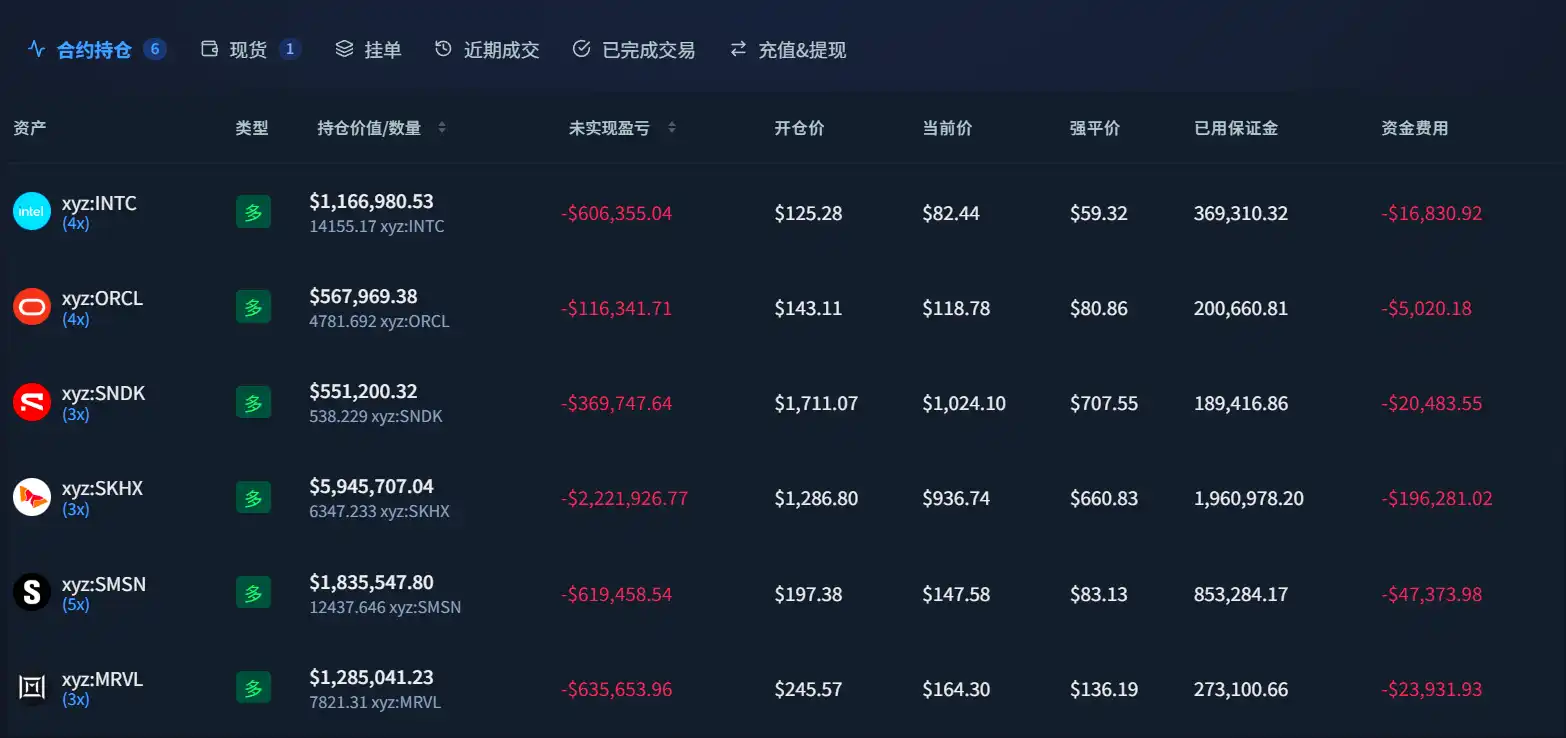
BlockBeats reported on July 30, citing Hyperinsight monitoring data, that a whale address beginning with 0x053f had accumulated positions in SanDisk, Marvell, SK Hynix, Intel, Samsung Electronics and Oracle.
The six-stock basket has now turned into a heavy drawdown trade. Four of the names have fallen more than 50% from their stage highs, while the other two have pulled back by more than 40%.
A rebound bet that kept expanding
The position started as a wager on a rebound in technology stocks. The whale began entering in late May, then kept broadening the trade while buying into weakness. Marvell was added in early June, followed by long positions in SK Hynix, Intel, Samsung Electronics and Oracle, until the account was spread across all six names.
The rebound never came, and prices kept sliding. At the latest reading, SanDisk was down 56.8% from its stage high. Oracle, SK Hynix and Marvell were down 52.6%, 52.5% and 51.8%, respectively. Intel and Samsung Electronics had also retreated 43.1% and 41.9%. All six names were in deep drawdown.
Unrealized losses reach $4.544 million
Among them, the earliest SanDisk long was once the best-performing position in the group. After entering in late May, the whale at one point had a sizable paper gain there. But the position was increased as the stock pulled back, wiping out earlier gains and turning the trade into a large loss.
After another broad sell-off in tech stocks overnight and into the morning, the whale’s six long positions had expanded to an unrealized loss of $4.544 million at the time of publication, with total position value at about $11.3 million. SK Hynix was the biggest source of loss, accounting for roughly $2.218 million in unrealized losses on a single position.
Returns on Intel, Samsung Electronics and SanDisk had all fallen below -120%. Marvell’s return had also dropped to -98.8%, meaning the margin put into that trade had been fully consumed.
The whale was still adding
What began as a rebound trade turned into a sequence of averaging down across falling names. In the process, the whale built what BlockBeats described as a “halved basket.” Despite the size of the unrealized loss, the buying had not stopped. As of 8:00 today, the whale was still adding to SK Hynix, according to the report.