
Breaking into the market around Texas Instruments’ C2000 is proving to be far more difficult than matching a chip on paper. An article by EEWorld said TI’s university program, launched in 1996, helps explain why. By bringing DSP products into university labs and classrooms, TI familiarized generations of engineers with its chips, development tools and software environment before they entered the workforce.
That long-cycle investment, with no obvious short-term payoff, helped build what later rivals now find hardest to attack: ecosystem depth. The report said TI’s edge is not limited to chip performance. It also comes from years of accumulated work in architecture, methodology and application support. C2000 has been used for a long time in areas such as digital power and motor control, and TI has built extensive development resources around those use cases.
Even so, the market is no longer sealed off. Customer priorities differ. Some focus on real-time performance, some on cost and power consumption, and others care more about ease of development, supply reliability and technical support. No single vendor can satisfy every requirement at once, and that has opened the door to a growing number of Chinese entrants.
An experienced chip industry expert told EEWorld, 「From the perspective of C2000, the most important change in the development of domestic chips is that the market is finally seeing more choices. In the past, TI built a deep advantage in real-time control through product performance and its development ecosystem. Now Chinese vendors are entering from different directions, trying to find breakthroughs in compatibility, cost, architecture and application fit.」
Three routes taken by China’s “C2000 challengers”
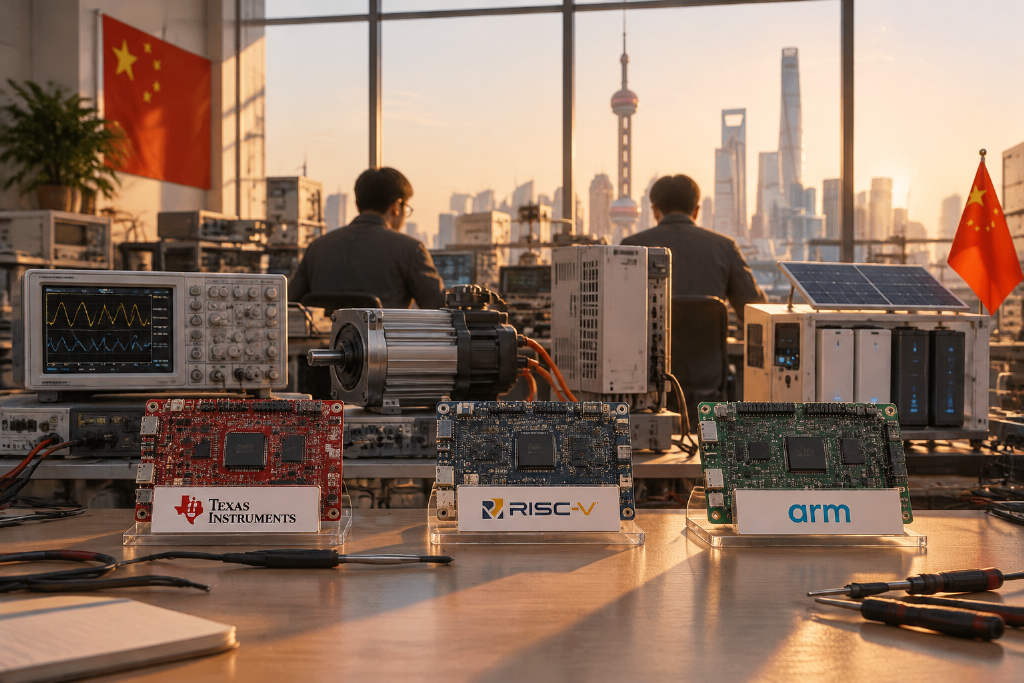
The same expert said China’s local chipmakers still face “a tough battle” before they can truly establish themselves. Even the label “China’s C2000” reflects TI’s standing in the segment. According to the article, domestic vendors are broadly following three strategies.
Compatibility: lower the switching cost first
The first is the compatibility route. Companies including Hunan Jinxin and Guliang Micro are trying to start from TI’s existing products and reduce migration costs as much as possible. For customers already using C2000, the transition becomes much easier if a new chip can fit into the existing software development flow and even reuse part of the code.
The appeal is straightforward. Customers do not have to rebuild everything from scratch, and domestic chips gain a chance to enter the market through applications that already exist. But the report stressed that compatibility does not mean direct replacement. Instruction sets, peripherals, real-time performance and software behavior all need to be verified. If code or binary reuse is involved, intellectual property and licensing issues also have to be considered.
RISC-V: openness creates room for customization
The second route is RISC-V. Zhongke Haoxin moved into the field relatively early. Gejian and Jiangxinchuang are also looking for opportunities in related markets, and newer participants have joined as well.
The attraction of RISC-V lies in its openness. Vendors can design cores around the needs of real-time control and have more room to adjust instruction sets and processor configurations. But the core is only the beginning. Whether customers can actually use the product depends on the rest of the stack, including compilers, peripherals, algorithm libraries and development tools. The article said some companies have already made progress with specific customers and applications, though broad adoption remains some distance away.
Arm: entering through a mature ecosystem
The third route is Arm. Companies on this path include Naxin Micro, Yichuang Micro, Nationstech and GigaDevice. The Arm ecosystem is relatively mature, developers are more familiar with it, and software resources are more abundant. For customers trying to lower the development barrier, that makes it a practical option.
Still, a mature Arm ecosystem does not automatically deliver C2000-class control capability. The report said real-time response speed, peripheral configuration and algorithm execution efficiency still depend on the specific product.
The expert told EEWorld that most domestic vendors are still in the stage of moving from zero to one. Some have opened the door with customers, while others have gained a foothold in specific fields. Each route has its own logic: compatibility aims to shorten the switching cycle, RISC-V emphasizes architectural autonomy and flexibility, and Arm leans on an existing ecosystem.
There is room in the market, but not every company needs to copy TI
In the expert’s view, the market is large enough and customer demand is diverse enough for different vendors to find their own space. At present, photovoltaic, energy storage and some equipment aimed at overseas markets have become key areas of focus for domestic suppliers. These markets are relatively sensitive to cost, and some customers are willing to try new chip solutions.
The article argued that Chinese vendors do not need to replicate the full product lineup and ecosystem of foreign companies at the outset, nor do they need to confront them head-on in every application. Finding the right market, gaining a foothold there first, and then gradually expanding products and customer coverage is also a workable path.
Customers are buying more than a datasheet
EEWorld wrote that a mature industrial ecosystem does not need every company crowded into the same lane, but it also should not be left to only a handful of players. Too few vendors limit customer choice and can drain vitality from the market. Too many vendors, if they offer nearly identical products without sustained investment, may also struggle to survive. A healthy market needs companies with different technical routes and different product positioning.
A technical expert quoted by EEWorld said engineers do not choose a chip only by looking at clock speed, memory capacity and peripheral count. They also need to know whether development, debugging and mass production can be completed quickly. Resources that look minor on paper can save a great deal of effort in practice.
That is especially true in power control. Engineers are not dealing with a simple programming exercise. Sampling timing, control algorithms, power devices, PCB layout and electromagnetic interference can all affect final performance. Meeting chip-level parameters does not mean the whole system will run smoothly.
For domestic Chinese chips, the question is whether vendors can meet performance requirements while also finding an architecture and implementation path that suits them better. Customers are not looking only at price. Long-term stability, continuous supply and timely technical support when problems arise are all important in procurement decisions. Even if a chip passes initial testing, it still has to prove itself over time in real applications.
Sustained investment remains the hard constraint
If domestic vendors can already design chips that meet demand, why is market penetration still so difficult? The article said C2000’s own development history offers a useful reference. Beyond technology and ecosystem, there is another unavoidable factor: whether a company can keep investing.
Chip development itself requires substantial funding. Even without something as ambitious as a university program, companies still need to maintain software tools, improve reference designs, support customer development and take responsibility for long-term supply after a product is launched. All of that costs money.
Yet the current market picture remains tight. Some domestic vendors have already won customer accounts, but the scale of the related business is still limited. For companies that need to keep funding R&D, sales in the tens of millions of yuan are difficult to turn into a fully self-sustaining business.
That creates a practical loop. Products need continued R&D and technical support to win more customers, but R&D and service need revenue to support them. For domestic vendors that have not yet reached scale, the math is difficult. The article said financial strength and operating capability matter as much as technology in this kind of competition. If a company focuses only on short-term orders and fails to build stable R&D processes, product management systems and customer service capabilities, it will struggle to stay competitive over time.
At the same time, competition inside China’s semiconductor industry is intensifying. More companies are entering the MCU and real-time control markets. Product differences may narrow, and price competition may become more severe.
Who stays in the market will be decided over time
Looking back at TI, its advantage is not just that one chip was done well. Its current market position was built over many years through product planning, development tools, customer support and long-term supply capability.
The article said domestic vendors still have a long road ahead. Some companies are using capital to accelerate expansion, while others are growing step by step around specific customers and applications. Each model has strengths and weaknesses. The key is whether a company can find an operating approach that fits its own situation and keep following it.
There is, however, a more encouraging side. The market has already opened some new opportunities for domestic chip companies. Different architectures can coexist, and products with different positioning can still find customers. Customer onboarding is only the beginning. Long-term stable operation is the real test. Over the next few years, the gap between domestic vendors may gradually widen. The companies that keep winning customer recognition, and that run into fewer problems in product quality and supply capability, will have a better chance of staying in the market.
As the expert told EEWorld at the end of the article, 「What comes next is endurance. Everyone is waiting for an opening.」



