
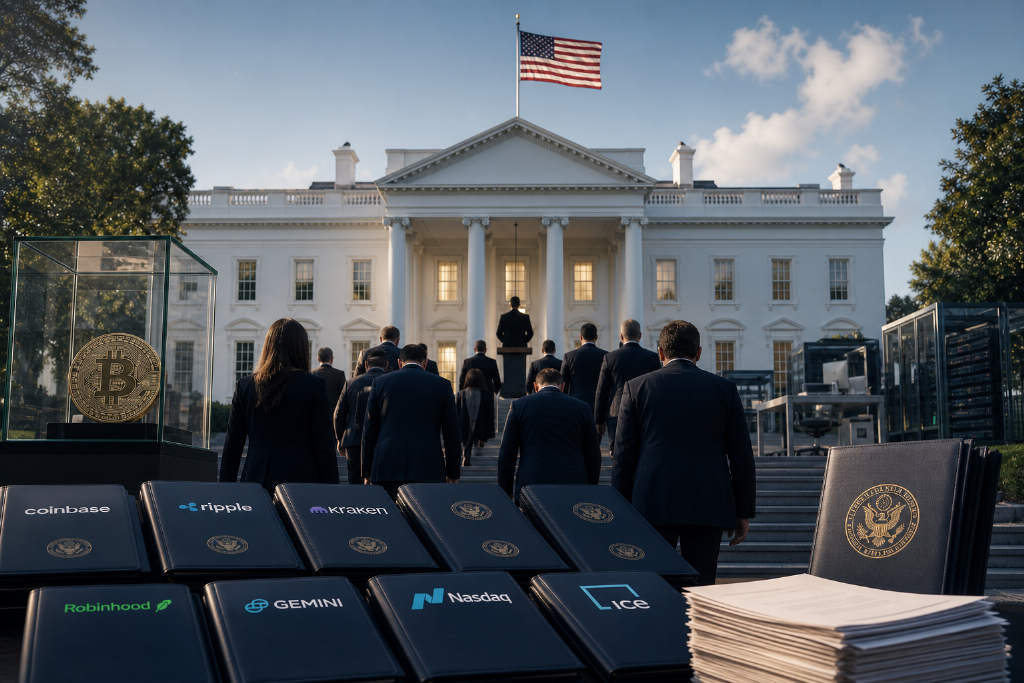
U.S. crypto policy is now being pulled toward one date: Sept. 15. At a White House summit on Aug. 19, President Donald Trump met with executives from Coinbase, Ripple, Kraken, Robinhood, Gemini, Nasdaq and Intercontinental Exchange (ICE), with SEC Chair Paul Atkins and CFTC Chair Michael Selig also in the room. One day earlier, the SEC had rolled out a new crypto fundraising proposal. Less than 24 hours after the summit, the CFTC chief said that if Congress cannot move the CLARITY Act, the agency will write its own market-structure rules.

Trump used the summit to press three messages
The meeting took place in the Roosevelt Room, where crypto and Wall Street executives sat across from top regulators. Trump opened by saying the previous administration had pushed innovation overseas and that his administration had ended the crypto war "once and for all." He then moved to three specific points.
First, Trump urged Congress to pass what he called a fair version of the CLARITY Act. The report says the House approved the bill in July 2025 by a 294-134 vote, and the Senate Banking Committee advanced it in May 2026, but a full Senate vote remains stuck in September. Trump said the legislation would help ensure the U.S. stays ahead of China.
Second, Trump said the U.S. could buy more Bitcoin. Asked whether the government would purchase "large" amounts of Bitcoin and other crypto assets, he replied: "This has been discussed. It takes a lot of pressure off the dollar. It’s very good for the dollar." He did not provide any figures or timeline. According to the report, the current strategic Bitcoin reserve and digital asset stockpile are mainly built from law-enforcement seizures.
Third, Trump named Hyperliquid directly and said the CFTC is working to bring it into the U.S. in a fully compliant and lawful way. "I know Mike is working very hard to bring Hyperliquid into the United States in a fully compliant, legal way," he said. Hyperliquid currently blocks U.S. users. The report says it holds roughly 60% to 80% of the decentralized perpetuals market.
SEC laid out Plan A, while CFTC signaled a Plan B
The policy groundwork had already been set on Aug. 18, when the SEC released its proposed Regulation Crypto Assets framework. It creates two registration exemptions.
- Early-stage projects could raise up to $5 million in aggregate over four years with principle-based narrative disclosure.
- Larger projects could raise as much as $75 million in any 12-month period, but would need to file financial statements and comply with ongoing reporting obligations.
The proposal also includes an investment contract safe harbor. Under the approach described in the report, if an issuer can show that core managerial efforts have ceased, the crypto asset could fall outside SEC jurisdiction. Atkins said: "Our proposal will give the crypto entrepreneurs in this room certainty, so they can use digital assets to raise capital here in the United States."

If the SEC proposal was framed as an opening within existing law, Selig’s remarks on Aug. 20 at the first meeting of the CFTC’s innovation advisory committee were more blunt. He said that for years, "anti-crypto armies, doomsdayers, and decreationists" had stifled innovation. He added that the CFTC is "turning a new page" and acting as an innovator in mapping out finance’s new frontier.
His clearest signal concerned what happens if Congress does not act by Sept. 15. Selig said the CFTC would leave room for a CLARITY vote, but if lawmakers cannot get a fair version to the president’s desk, he will direct agency staff to move quickly on new rules.
Those rules, according to the report, could allow registered exchanges and some currently unregistered crypto platforms to offer leverage or margin trading under CFTC supervision. The agency would also work with on-chain protocol developers to explore compliant operating models for decentralized finance platforms. The report notes that Selig is currently the CFTC’s only sitting commissioner, giving him unusually concentrated room to steer rulemaking.
Hyperliquid drew the strongest market response, but approval is still not in hand
After Trump named Hyperliquid, the market reaction was immediate. HYPE climbed from about $62 to as high as $72, then eased back to the $69-$70 range. Its 24-hour gain was put at roughly 19% to 20%, while trading volume topped $1.3 billion.
Hyperliquid Strategies, the Nasdaq-listed company trading under PURR and described in the report as holding HYPE as a core strategy, rose 30.42% in a single session. Traditional derivatives exchange operators moved the other way: Cboe fell 3.5% and CME slipped 1.7%.
Still, Trump’s remarks do not amount to regulatory approval. Hyperliquid continues to restrict access for U.S. users, and its operating company is headquartered in Singapore. Coinbase said the same day that it would integrate Hyperliquid perpetual contracts into Base App, but the report describes that as an interface partnership rather than proof that Hyperliquid itself can legally operate in the U.S.

One possible structure mentioned in the report would place a licensed U.S. broker at the front end to handle KYC and customer funds, while Hyperliquid continues to serve as the underlying trading venue. Whether that kind of hybrid model — compliant at the front end, decentralized at the back end — could pass CFTC review remains unresolved.
The biggest hurdle may be ethics language, not the crypto text
All roads now lead to Sept. 15. Senate Majority Leader John Thune filed a cloture motion on Aug. 8, and the Senate will need 60 votes that day to begin debate.
But the report says the central obstacle to the CLARITY Act is not the crypto language itself. It is the ethics language. Democratic senators want the bill to restrict federal officials, including the president, from profiting from crypto businesses.
That dispute comes against the backdrop of Trump’s 2025 disclosure that his family received more than $1.4 billion in income from crypto-related businesses. Family-linked projects have also drawn repeated conflict-of-interest questions. Lawmakers from both parties submitted a counterproposal to the White House in late July, but as of early August there had been no public response, according to the report.
Coinbase CEO Brian Armstrong said at the summit: "The most important next step is the Sept. 15 CLARITY Act vote." He said he wants the measure to win more than 60 votes so that the progress made in recent months becomes durable for decades.
Selig drew a sharper line between legislation and agency rulemaking. He said congressional action is "the most reliable way to prevent future Gary Gensler-style regulatory abuse." His message was plain: if Congress fails, the CFTC can still act, but agency rules could be reversed by the next administration. Legislation would make the direction much harder to undo.
