
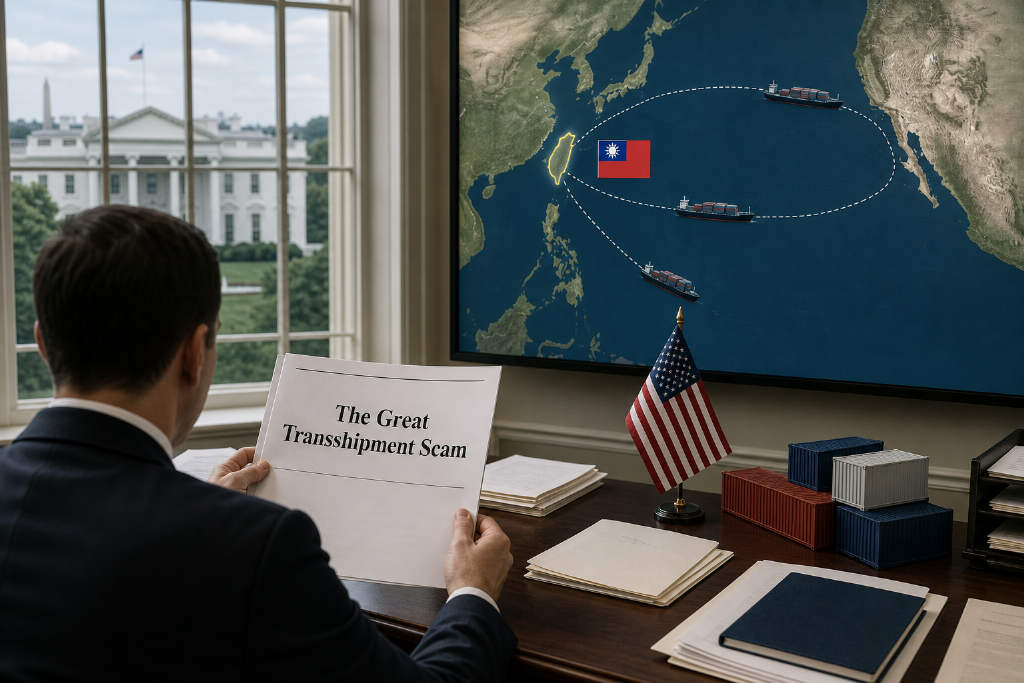
The White House Office of Trade and Manufacturing Policy (OTMP) released a 25-page report on Aug. 13 titled The Great Transshipment Scam, alleging that China reroutes goods through more than 40 countries to avoid U.S. tariffs. The report put the annual scale of that activity at between $40 billion and $303 billion.
Taiwan was listed in Tier 1, together with Japan, South Korea, Canada, the European Union, India, Israel, and Mexico. The report also stated in plain terms that the five estimates cited in the document cannot be added together and cannot be directly compared.
Taiwan placed in the first tier
The report was issued by the office led by Peter Navarro, a trade adviser to Donald Trump. It said the force behind transshipment is tariff arbitrage: if a product faces a higher tariff when exported from one country to the United States than it would from another, that gap creates a profit opportunity.
OTMP divided the more than 40 countries into three tiers. Tier 1, labeled “Diversified Scale Leaders,” includes Canada, the European Union, India, Israel, Japan, Mexico, South Korea, and Taiwan. The report said this group handles large absolute volumes of China-linked goods, but also has diversified industrial bases and serves as a major platform for exports to the United States. In that framing, transshipment risk is embedded within large flows of lawful trade.
Tier 2 was labeled “Scale Leaders with Significant China Integration.” Its members are Brazil, Indonesia, Malaysia, Thailand, Turkey, and Vietnam. The report said Vietnam, Thailand, Malaysia, and Indonesia have become deeply embedded in China-centered manufacturing networks and now serve as major platforms for electronics, machinery, plastics, footwear, apparel, and components.
Tier 3, the largest group by number of countries, was described as “Small Opportunistic Targets.” The report said these locations tend to rely on low-cost labor, free zones, bonded warehousing, or weak enforcement capacity. It cited Cambodia for low-cost labor and export processing zones; Laos and Myanmar for border corridors near China; Panama and Costa Rica for maritime shipping and re-export platforms; Azerbaijan and Georgia for rail and inland port transshipment; and Jordan for preferential trade access and niche assembly capabilities.
Five estimates, a 7.5-fold gap
The report’s headline range of $40 billion to $303 billion comes from five separate estimates presented side by side.
- Goldman Sachs: about $40 billion, covering only pure rerouting transshipment.
- White House Council of Economic Advisers (CEA): $34.2 billion to $89.6 billion, with the report using a midpoint of $60 billion.
- Exiger: about $75 billion, based on product-level and freight-flow analysis.
- Office of Trade and Economic Analysis (OTEA): a $109 billion trade-diversion baseline covering 459 HS6 product categories, plus a separate estimate of about $67 billion transshipped through major hubs in 2025.
- Altana: $303 billion, described as an upper-bound facility-level exposure measure.
The report said the estimates rely on different datasets, methodologies, product filters, and definitions of transshipment. For that reason, it said they should not be added together or directly compared. Using the top-end $303 billion figure as the sole conclusion, or using the low-end $40 billion figure the same way, would both depart from the report’s own framing.
Economic impact under a midpoint scenario
Using a $75 billion midpoint scenario, the report estimated an annual U.S. GDP reduction of $113 billion to $150 billion, displacement of 450,000 jobs, and a federal tax revenue loss of $19 billion to $26 billion.
It added that the 450,000 figure is a model-based estimate rather than an observed unemployment count, and is intended to show the scale of exposure. Lost tariff revenue was estimated at $10 billion to more than $100 billion, depending on whether the tariff differential is set at 25%, 35%, or 45%.
AI enforcement system outlined
On enforcement, the report said reciprocal trade agreements already include provisions aimed at preventing benefits from spilling over to third countries. Executive Order 14411 was also cited as strengthening customs enforcement through importer liability, bonds, domestic assets, equity disclosure, related-party review, and penalties.
The report also described an AI system called “Detective Border.” It is designed to connect freight data, routing records, product classifications, ownership links, capacity indicators, anomaly detection, and computer vision to help U.S. Customs and Border Protection distinguish legitimate nearshoring and foreign direct investment from simple pass-through trade.
The report stopped short of making a final policy judgment. It said it is still too early to assess the net effect of the administration’s tariff and anti-transshipment measures because trade and customs data arrive with a lag, and several enforcement provisions are still being implemented.
How the report framed Taiwan
Taiwan’s inclusion in the report does not, by itself, amount to a direct finding of wrongdoing in the text. The document placed Taiwan in Tier 1, a category defined as large and diversified export platforms where any transshipment risk sits within substantial volumes of legitimate trade. That wording differs from Tier 2, which the report used for economies it described as significantly integrated with China.