


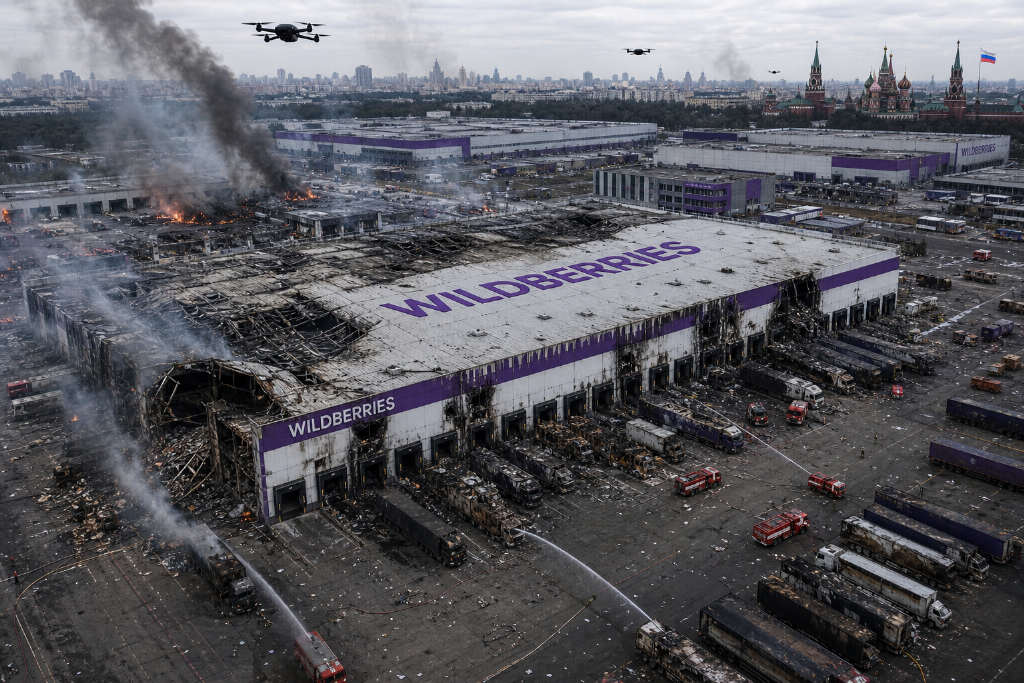
Wildberries, Russia’s largest e-commerce platform, has come under repeated drone attack over the past month, with the damage now reaching a large portion of its logistics network. The source material says about one-third of the company’s warehouse capacity has been hit, while cargo losses are estimated at $5.9 billion.
Wildberries holds a major place in Russia’s online retail market. The report says it accounts for 45% of the sector and processes 7 million orders a day. Over the last month, a large share of its warehouse network was damaged or destroyed, turning parts of that infrastructure into ruins and leaving billions of dollars in goods lost.
At least 21 attacks since mid-July
Since mid-July, Ukraine has carried out at least 21 drone attacks on Wildberries, according to the article. More than 1.5 million square meters of warehouse space were burned, equal to more than one-quarter of the company’s total storage area. Publicly compiled strike records cited in the piece also show that at least nine employees were killed in explosions over the span of a month.
The timeline in the report describes a campaign aimed at logistics nodes rather than scattered facilities.
- July 18: A 230,000-square-meter warehouse in Elektrostal, Moscow region, was completely destroyed, leaving one person dead and 37 injured. On the same day, a warehouse in Kotovsk, Tambov region, was reported to have seven deaths.
- July 22: A 150,000-square-meter warehouse in Krasnodar was completely destroyed.
- July 24: The Shushary warehouse in St. Petersburg stopped operating.
- Aug. 5: A 194,500-square-meter warehouse in Aleksin, Tula region, was completely destroyed.
- Aug. 11: A new park in Voronezh was completely destroyed. The article says the site opened in November 2025 and could store 90 million items.
- Aug. 16: A 200,000-square-meter warehouse in Koledino, Moscow region, was completely destroyed.
TechTimes reported that Ukraine’s HUR cyber unit breached Wildberries’ payment system twice between Aug. 10 and Aug. 15. The article says those intrusions were paired with a coordinated assault involving about 600 drones, temporarily knocking out seven of the company’s 10 main logistics hubs.
From English teacher to founder of a retail giant
Wildberries founder Tatyana Kim comes from a Korean family in Russia and previously worked as an English teacher. She started the business in 2004 with her former husband, Vladislav Bakalchuk, initially selling products from European clothing catalogs. The company later grew into a retail platform with nearly 95,000 pickup points across the country.
Kim once described the company’s early idea this way: 「The idea came from my own need, and it turned out to be needed by hundreds of thousands of people. If a product or service makes your life easier, you are moving in the right direction.」
After Western brands pulled back from Russia following Vladimir Putin’s order to invade Ukraine, Wildberries strengthened its position. According to financial results for RWB Group after the merger of Wildberries and Russ, 2025 revenue reached 6.1 trillion rubles, or about $75 billion, and net profit came to 175 billion rubles, or about $2.15 billion. Analysis cited from The Moscow Times says Wildberries is expected to hold 45% of Russia’s online retail market in 2026, compared with 32% for rival Ozon. Its user base covers two-thirds of Russia’s adult population, and it operates more than 200 warehouses nationwide with total storage space of about 5.5 million square meters.
Strikes extended to Ozon
Early on Aug. 22, the attacks reached Ozon, Russia’s second-largest e-commerce platform. Euromaidan Press reported that a Ukrainian-made FP-1 drone hit an Ozon warehouse in Chapayevsk, Samara region, and triggered a fire. The article says this was the first confirmed Ukrainian strike on an Ozon facility.
Drone manufacturer Fire Point said the warehouse was one of Ozon’s largest and handled more than 215,000 orders a day. Ozon confirmed that people were injured, more than 500 employees were evacuated, and deliveries and orders had been rerouted to other facilities. Samara Governor Vyacheslav Fedorishchev said several people were hospitalized. Unlike the case made around Wildberries, Fire Point did not claim that this Ozon warehouse was involved in military supply shipments.
Loss estimates for cargo, rebuilding, and sellers
Data Insight estimated that Wildberries has now lost about one-third of its warehouse space and $5.9 billion worth of goods, equal to roughly 480 billion rubles. Analyst Sergei Semko said, 「The biggest warehouses are almost empty already.」
Forbes Russia estimated seller losses at 214.9 billion to 279.6 billion rubles, or about $2.64 billion to $3.44 billion. Warehouse reconstruction costs were put at 105 billion to 223 billion rubles, equal to about $1.29 billion to $2.6 billion.
Insurance exclusions and bank pressure
The report says about 80% of warehouse buildings and inventory were never insured. A key factor is that Wildberries introduced terms that took effect on July 11 and explicitly excluded drone attacks from compensation coverage.
Kim said publicly: 「The terrorist attacks on our warehouses constitute force majeure... these losses are not compensable under the law.」 She urged affected sellers to seek help through official channels and government relief programs.
Insurer Ingosstrakh then raised premiums for drone attack coverage by 3.3 times. Financial stress began to spread as well. On July 25, VTB shares fell 2.5% as the market started to worry about Wildberries’ debt repayment capacity. The article says Russia’s central bank later asked major lenders including Sberbank and VTB to provide debt restructuring plans. As of Aug. 10, Sberbank had received about 2,000 loan restructuring requests. More than 400,000 sellers on the platform still have little path to compensation, according to the report.
How Ukraine framed the targets
Volodymyr Zelensky defined the targets as logistics centers involved in supplying the Russian military with drone parts, navigation devices, and other military hardware. Kyiv’s position, as described in the article, is that Wildberries accounts for about 10% of Russia’s total retail turnover and also supplies the Russian military, making it a legitimate military target.
Ukrainian presidential adviser Podolyak was quoted more bluntly. The attacks were intended to 「disrupt military supplies, create public dissatisfaction, and trigger knock-on effects in Russia’s economy by putting pressure on major banks such as VTB and Sberbank.」 In that framing, the warehouses were not the only focus. The financial system and public morale were also part of the intended pressure.
The article also lists changes in some sales figures. By late July, sales of military-related goods in Russia had fallen, with body armor down 24%, quadcopter accessories down 36%, and night-vision devices down 20% to 40%. The source text cuts off before giving fuller data on platform advertising volumes.