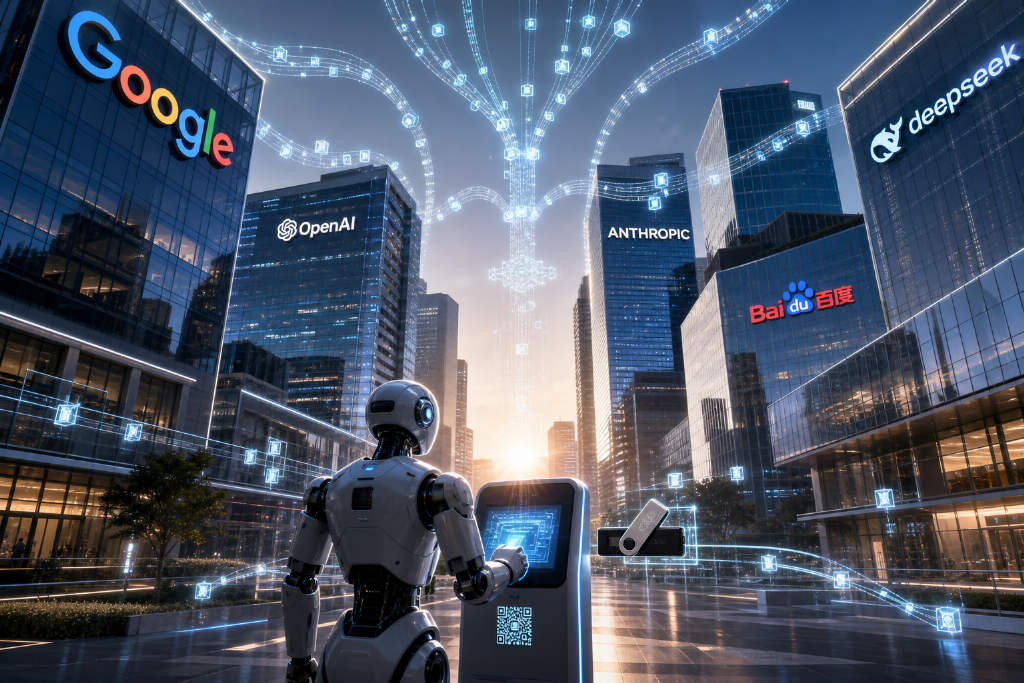
A Foresight opinion article examines whether on-chain payments could become a real necessity in the AI era. The piece opens with a comment left under an Aug. 13 article, "AI traffic has surpassed humans, and the opportunity for crypto payments has arrived." The comment said: "Using blockchain for AI payments is just self-entertainment within the crypto circle. AI giants will not hand that discourse power to blockchain. They are already preparing their own protocols."
The author rejects that view outright. The article argues that assuming today’s incumbents will always keep control over market power and narrative power gives too much credit to large companies and overlooks how history tends to move.
The article uses the AI sector itself to challenge the idea of permanent dominance
According to the piece, the broader history of technological and commercial development is a repeated cycle in which older leaders are displaced and new ones emerge. It uses AI as the clearest example. If dominant companies never gave way, Google should already have locked up the field.
The article notes that Google invented Transformer, the core architecture behind large language models. It also says that six of the eight authors of the landmark paper "Attention Is All You Need" were Google employees at the time. Even so, OpenAI and Anthropic still rose afterward, rather than leaving Google with lasting uncontested control.
The same pattern, the article says, can be seen in China through Baidu. In the author’s telling, Baidu was the first among China’s large companies to bet on the right AI direction and the right people, yet it now finds itself watching DeepSeek and a range of later entrants rise quickly.
From there, the article argues that in technology and business, large companies may resist giving up monopoly power, but what breaks that power is usually not their willingness. It is often shaped by forces outside technology itself.
Why the author sees AI payments as a small spark that incumbents are missing
One recurring factor, the article says, is that when a new track first appears as a small spark, major companies often do not believe it can become something much larger. Even when they do pay attention, they may only make symbolic investments or keep it under observation.
By the time that spark grows large enough to reshape the field, a new leader may already be in place. The author argues that AI payments sit in that exact position today. In the author’s view, current AI leaders are competing in large models, compute power and electricity supply, but not in payment applications.
That observation forms the first reason the author dismisses the original comment.
Two main arguments for public blockchain-based payments
The article’s second and more important point is that AI payments are highly likely to be built on public blockchains. The first reason is structural: AI cannot complete KYC and apply for accounts in the same way humans do.
The author argues that today’s payment systems, along with the regulatory frameworks built around them, are designed for humans and do not naturally fit AI. At the same time, the article describes AI’s defining trait as the pursuit of extreme efficiency. By that standard, the author sees existing human payment systems as too inefficient compared with payment methods based on public blockchains.
The article then makes a broader claim about how technology and business evolve: they move toward the path with the least friction. On that basis, the author believes public blockchain payments represent the lowest-friction option for AI.
The argument extends beyond payments to the question of AI restraint
The piece also points to what it calls a recent pattern in which AI has repeatedly crossed boundaries set by humans and begun to act on its own in harmful ways. The author says this suggests an "instinct" in AI to break through constraints imposed by people.
That instinct, the article says, is dangerous. It mentions Anthropic’s Dario as one of the people most aware of the issue at present. Still, the author says Dario’s proposed approach, so-called "constitutional AI," feels "a bit idealized" — not necessarily useless, but awkward in practice.
On that basis, the article argues that the only technology with a real chance of constraining AI may be blockchain, precisely because it is also a native internet technology. Among the areas that most need constraints, payments stand near the top. The author therefore sees blockchain-based payment methods as one of the likeliest tools to both restrain AI and let it pay efficiently.
KYA is mentioned, but the author says it still follows human control logic
The article notes that proposals for governing AI are already appearing, including KYA, short for Know Your Agents. Still, the author argues that such protocols remain rooted in the same logic used to govern humans, which is why they feel awkward and ill-suited to AI.
The conclusion is straightforward: AI payments will most likely rely on public blockchains. What exact form that takes, and what technical stack will be used to implement it, remains unclear. The author says there is no way to predict that now and that only time will show the answer.
The piece ends with a disclaimer stating that markets involve risk, investment should be approached with caution, the article does not constitute investment advice, and readers should decide for themselves whether any opinion, view or conclusion fits their own circumstances.