


Wiwynn (6669), an AI server manufacturer in Taiwan, failed to see the ex-rights rebound some investors had been looking for after a large stock dividend distribution. The company handed out about TWD 19.83 in stock dividend per share, a ratio that worked out to nearly two extra shares for every one share held. On Sept. 1, the day before the ex-rights adjustment, the stock hit the daily limit and climbed to TWD 7,800, setting a new record high.
That momentum did not carry over. The stock opened ex-rights at TWD 2,615 on Sept. 2, and then fell for two consecutive sessions, leaving it in discount to the ex-rights price. On the third trading day, shares rose 3.64% to TWD 2,565, but still remained below TWD 2,615.
Odd-lot treatment became the center of the dispute
The sharpest reaction focused on how odd lots created by the stock dividend were handled. Because the distribution amounted to about 1,983 shares for every 1,000 shares held, or about 1.98279 shares per share, many investors with smaller positions ended up with fractional holdings that could not be assembled into whole trading units.
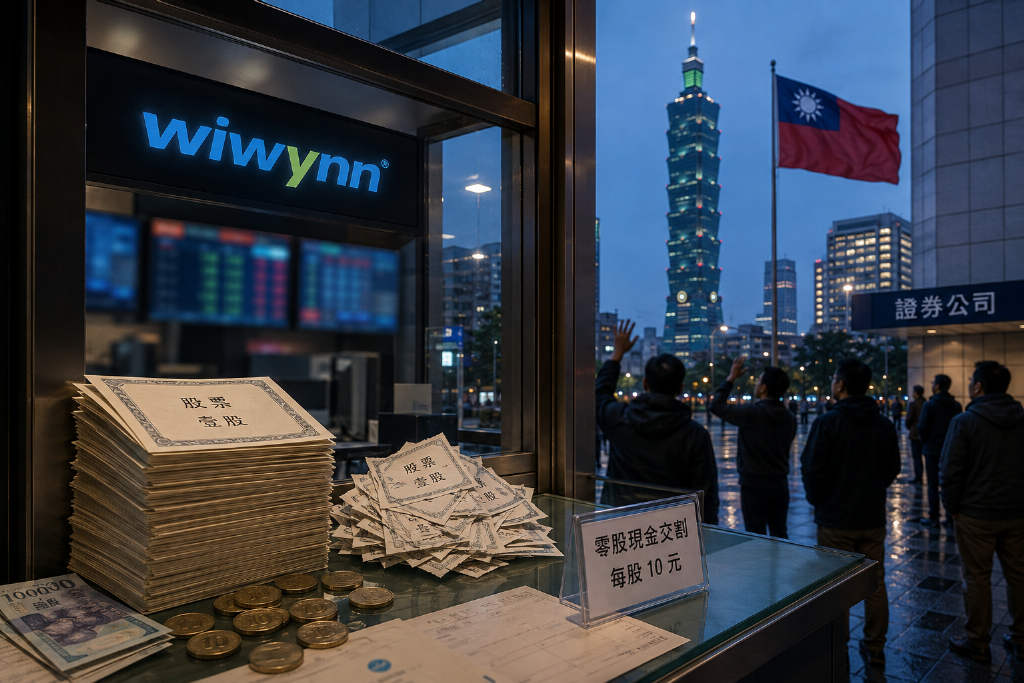
Under current operating rules, if shareholders do not find a way within five days from the book-closure date to combine those holdings into one full share, the remaining odd lots are settled in cash at the stock's par value of TWD 10 per share under the Company Act, with the chairman authorized to arrange for designated subscribers to buy those shares at par.
The rule has been in place for years, but it triggered an unusually strong response in Wiwynn's case because the stock was trading in the TWD 2,000 range after the adjustment. Some investors wrote in Facebook groups that this was "cutting retail investors like chives," while others called for a "Wiwynn self-help group."
Critics argued that an asset worth thousands of Taiwan dollars in market terms could be removed at TWD 10 a share simply because the fractional amount could not be rounded into a whole lot, and then passed on to designated buyers at par. In their view, that amounted to a structural disadvantage for minority shareholders and a benefit for selected parties.
Shares fell after the adjustment and stayed below the reference price
The share-price weakness added to the frustration among investors who had bought ahead of the ex-rights date. Before the adjustment, the market had already priced in expectations tied to AI server growth and the unusually large stock dividend. On the first ex-rights trading day, Wiwynn briefly jumped to the daily upper limit at TWD 2,875 in early trade. Selling pressure then picked up, the stock turned lower on heavy volume, and the decline continued the next day.
ABMedia said the stock dividend, while large at 1,982.79 shares per 1,000 shares, was still a capital adjustment in substance. A sharp expansion in share capital would dilute future earnings per share, and the market now has to rework valuation based on post-adjustment EPS. Until profit growth catches up with the larger capital base, the market has remained cautious about chasing the stock higher.
Chen Chung-ming pointed to profit-taking pressure
Investor commentator Chen Chung-ming, known by the nickname "The Undefeated Guru," said the stock had already been pushed to TWD 7,800 before the ex-rights date by enthusiasm around the generous distribution. After the adjustment, shareholders had not yet received the new shares, but their entitlement was already locked in, and their existing shares could still be sold freely.
He said: "After the ex-rights adjustment, your one lot becomes 2.983 lots. Wouldn't you be tempted to sell one lot first? You can still receive another 1.983 lots later." In his view, that shift in mindset explains why older shares may be sold first after the ex-rights date, creating an initial wave of profit-taking pressure.
Chen also warned that when the new shares are formally deposited into custody accounts about a month later, the market could face a second wave of real selling pressure as those shares become available.
On strategy, Chen said, "Wiwynn's business is still good, but the price-to-earnings ratio is high. I'd rather buy the parent, Wistron (3231)." He suggested that ordinary investors do not need to chase a high-valuation stock through volatile trading, and said exposure through parent company Wistron could offer both AI-related upside and a better valuation margin.