


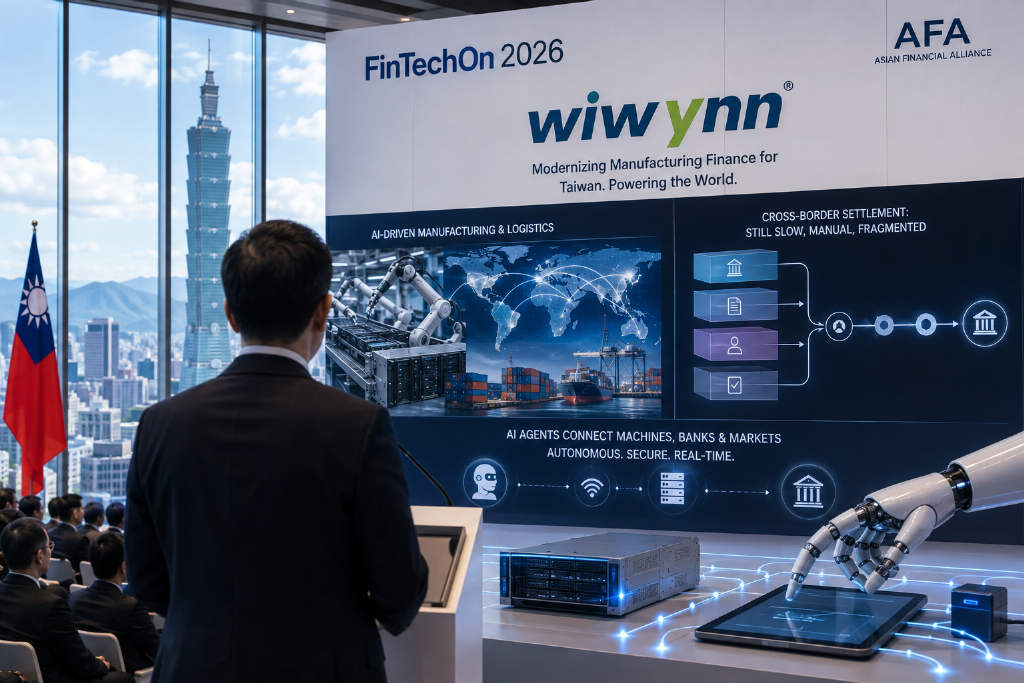
Wiwynn Chair and Chief Strategy Officer Hung Li-Ning said at the FinTechOn 2026 & AFA Summit that financial infrastructure needs urgent upgrades, based on what she described as real-world conditions across global hardware manufacturing and supply chains. She said AI has already pushed component tracking and capacity scheduling in manufacturing and cross-border logistics into near real-time information flows measured in milliseconds, while cross-border fund settlement and credit transfer still remain constrained by layered review structures.
Settlement still lags supply-chain data flows
Hung said machine-led ordering and payments will reshape market models as Autonomous AI Agents move closer to commercial deployment. If working capital continues to be delayed by slow settlement processes, manufacturing operations will face clear friction. For that reason, she said Financial Technology, or FinTech, needs to be embedded across physical manufacturing systems.
She pointed to the global manufacturing chain for servers and computing equipment, which spans multiple countries and markets and operates across complex exchange-rate systems and local regulatory frameworks. Logistics and production scheduling can already reflect market demand in real time, she said, but cross-border capital allocation often still requires sequential reviews by multiple intermediary banks, leaving the movement of funds far slower than the movement of data.
According to Hung, that settlement friction directly leaves working capital idle for multinational companies and adds time costs, making a shift toward real-time and parallel clearing rails increasingly necessary.
Autonomous AI agents could change ordering, logistics, and payments
Hung said autonomous AI agents with independent decision-making logic are already changing traditional commercial transaction flows. In the next stage, she said, these systems are expected to be used broadly for demand forecasting, placing procurement orders with suppliers, booking logistics capacity, and carrying out payment and settlement functions.
Those transactions, she said, would be completed automatically within milliseconds. That would require financial infrastructure with the high-frequency processing capacity to match what she called machine transaction speed. She also said the transition is expected not only to change how businesses interact with each other, but also to help create an autonomous financial services market worth trillions of dollars.
Asia’s hardware edge raises pressure to upgrade financial rails
Hung said the future AI economy cannot be built by hardware manufacturers or financial institutions working separately. Instead, she said it will depend on deep integration across manufacturing, software technology, and financial rails. She added that Asia already holds a core strategic position in semiconductor assembly, server manufacturing, and the supply of computing components.
To remain competitive in a highly automated machine economy, Hung said, the industry’s next task is to build digital financial infrastructure that is resilient and compatible across borders, while integrating manufacturing, technology, and finance to address what she described as a new digital economy market measured in trillions of dollars.