
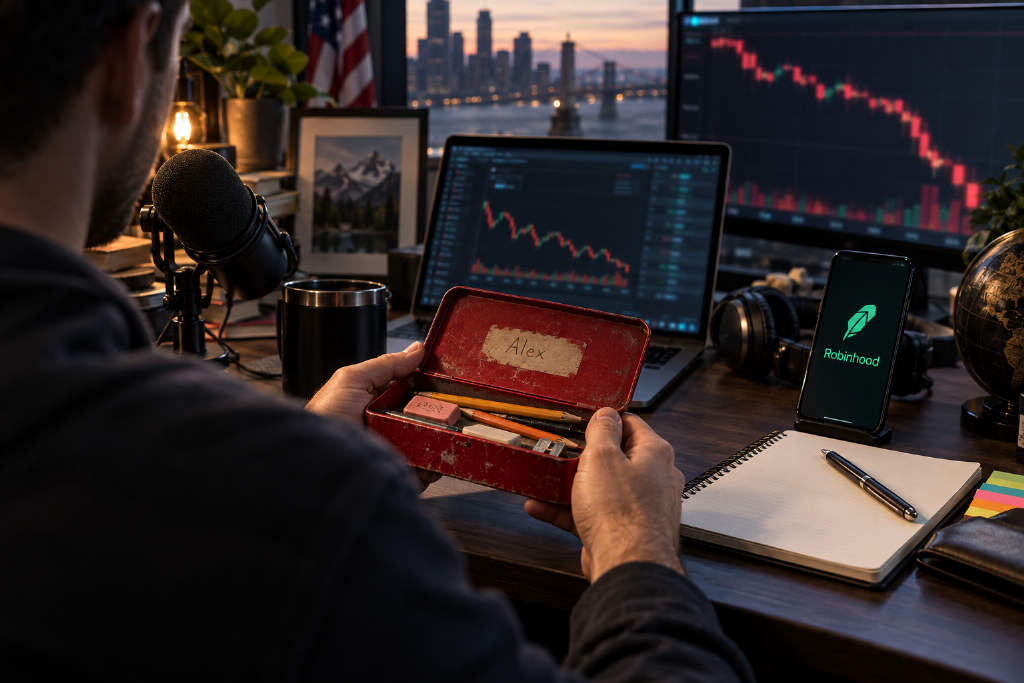
Source: HODLong Podcast, Episode 69
Compiled by: Mable
Ogle says he still has a small red box at his mother’s house, with his name written on it in a child’s handwriting. Inside are pencils and erasers. When he was 6, he noticed that the school store opened only briefly in the morning, leaving students unable to buy supplies later in the day. So he used the $2 of pocket money his mother gave him to buy several packs wholesale, put them in the box, took them to class, and sold them one by one to classmates, “for quite a bit more,” as he put it.
More than 30 years later, sitting down to record this podcast, he had just lost several million dollars in 15 minutes two days earlier.
Robinhood summit upended his LIT thesis in minutes
The day before the recording, Robinhood held its annual summit. When Chief Executive Officer Vlad Tenev began talking about perpetual futures, Ogle said he almost jumped out of his seat. His largest position was built around that exact setup.
He had expected 15 million day traders to pour into Lighter, sending the LIT token sharply higher. In his mind, this was the scenario he had been waiting six months for.
But Tenev never mentioned Lighter on stage. The press release that went live at the same time made the structure clear: Robinhood’s perpetual futures product would go through Bitstamp, the exchange Robinhood acquired last year. LIT did not collapse immediately. It simply stopped going up, and then the market began to process what had happened. Price started sliding lower.
“Ten to fifteen minutes,” Ogle said. Then he paused. “Several million was gone.”
He said his LIT long had been based on two reasons, split evenly in importance.
- First, Lighter’s founder and Robinhood CEO Vlad Tenev had known each other since university. In Ogle’s telling, each also held a board seat at the other’s company.
- Second, the same founder also sat on the Commodity Futures Trading Commission’s innovation advisory committee.
Once Robinhood did not channel activity to Lighter, the first leg of that thesis broke. “The reason I allowed myself to keep an oversized position was falsified,” he said.
So he cut the position by exactly half.
He was careful to say this was not panic. In his framing, if two reasons had justified the trade and one disappeared, then the position should be reduced by half as well. “Two reasons left me with one. So half the position remained.”
Do not stay on the train just because you already boarded it
Most people, he argued, do not cut risk when something like this happens. They do something else: announce that they are now “part of the community,” join the Telegram group, keep posting bullish messages on X, and wait to get back to breakeven.
Ogle used one of the analogies he kept reaching for throughout the conversation. You buy a train ticket from New York to Chicago. One hour into the trip, the conductor tells you the train is actually going to Miami.
“You can’t stay on just because you’re already on the train. Who wants to go to Miami?” he said.
Getting off is annoying. You waste an hour and have to buy another ticket. None of that changes the conclusion. If the destination is wrong, get off. He laughed and added, “Not me.”
He gave another example from a recent discussion with a friend about the same token. The friend’s view was simple: if you are up, you should take profit; if you are down, you should hold until you get back to even. Ogle said that logic makes no sense. Whether you are up or down should not decide whether you sell. The only real question is this: if you were sitting in cash right now, would you still buy the token?
If yes, hold it. If no, sell it, regardless of whether the trade is green or red. “So what if you’re down? Every trade is an opportunity cost. What else could that same money be doing?”
Cut size until you can sleep
He then moved to position sizing. A trader splits capital equally across five tokens. One of them surges. Before long, 80% of total net worth sits in a single coin. Almost nobody would choose that allocation at the start, but many people drift into it and then find themselves unable to sleep. A 1% move in the token feels like 50% is moving through their whole body.
At that point, Ogle invoked a line often attributed to J.P. Morgan. A nervous trader asks Morgan how he manages to sleep with such a large position. The answer: “Cut the position down to where you can sleep.”
That, for Ogle, is a practical rule, not a slogan.
He actively looks for reasons his thesis could be wrong
One of the more counterintuitive habits he described was his constant search for exits. “I am actively looking for reasons to invalidate my own view,” he said.
When he was long LIT, he preferred reading posts from Hyperliquid believers arguing why Lighter would die rather than reading messages designed to strengthen his conviction. The aim was not confirmation. It was disproof.
He brought up Ondo as another example. He once held the token, then exited for a very direct reason: the only part of the story he truly cared about was the founder, and once that person was gone, he sold everything. Ondo went higher afterward and he did not regret it. “My reason for being there no longer existed.”
In theory, he said, an investment can have six reasons behind it, and losing one or two may not matter. In crypto, though, where competition is intense, there is usually only one thing that really makes you place the bet. The rest tends to be interchangeable.
From switching schools 11 times to day trading bitcoin on BTC-e
Before finishing high school, Ogle had attended 11 schools. His father, in Ogle’s words, was “honestly a criminal, but a very good businessman who chose the wrong line of work.” Money at home came and went depending on whether his father was in prison or out of it.
That upbringing gave him an unusually concrete feel for buying and selling from an early age. He watched cash being counted on the floor. He watched things get bought and sold. He also learned that all of it could disappear at any moment.
“The only two things holding me back were my last name and money. Some people are born with a respectable last name and a lot of money. I had the bad version of both,” he said.
At 7, he began trading baseball cards. An aunt bought him a pricing guide every month, and he copied the listed prices onto the cards in pen. In college, he traded penny stocks in the pink sheets market, which he called “the stock-market version of dog coins.” The first one was a Canadian company that burned MP3 files onto CDs for people at shopping malls. By his second year of college, he was trading options and futures. In 2013, he was day trading bitcoin on BTC-e.
He later started three companies and exited all three. The first exit came when he was 22. He arrived in California with less than $1,000 and became a millionaire within six months.
After his first big wins, he gave almost all the money away
After making serious money for the first time, Ogle said he donated almost all of it. It had come too quickly, too easily, and did not feel fair. He did almost the same thing after his second exit.
Even after becoming wealthy, he said he deliberately lived as if he only had 5% of what he actually had. “Struggle is my fuel. It makes me feel alive.”
He called money an “unnecessary evil,” while also admitting that it determines where people live and how long they live, which means the game does not simply stop.
After failed building efforts, he set himself another test this year
For the past several years, Ogle said he had been trying to build things. First came Glue, which took three and a half years. Then came America.fun, where he worked as an advisor. In his own telling, both failed. People assume founders always make money, he said, but he lost several million dollars, and worse than that, he lost time.
He is convinced that building and trading require different mental systems and are hard to do at the same time.
After traveling for two or three months earlier this year, he gave himself a new challenge. He took what he called a “symbolic” amount of money, a little over six figures and visible on-chain, and asked whether he could still turn a small pile into a big one.
Before placing trades, he shut himself away from noise for several weeks and read white papers for eight to 12 hours a day for multiple weeks. “If you don’t even understand what game you’re playing, you can’t make a decent decision,” he said.
In this cycle, he focused on projects that buy back and burn their own tokens
After that period of reading, Ogle came to a broad conclusion: crypto was finally moving closer to traditional finance, and real money was going to enter the space.
He argued that in the past, this industry did not need to make money. “Some chains were valued at $2 billion and doing $16 a day in fee revenue. Their core skill wasn’t making money. It was fundraising.” He believes that era is ending.
The next question, then, is whether the money projects earn can flow back to token holders.
He said he once argued with the CEO of XRP at a conference over exactly this point. Ripple can sign large deals and make a great deal of money, he said, but that has nothing to do with the XRP token itself, even if taxi drivers around the world think their XRP should rise because of it.
So in this cycle, he looked for one type of project: those that use revenue to buy back their token in the market and then burn it permanently. Supply shrinks. Each unit matters more. In his view, that is the closest token holders get to something resembling a dividend.
Some people tell him good companies do not buy back their own stock. His answer is that they are talking about stocks, which represent ownership. Tokens do not. Mixing the two frameworks means the speaker has not thought the issue through.
Lighter, LayerZero, Ethena and Pons all came from that same framework
That screen led him to Lighter, a perpetual futures exchange that uses all of its fees to buy back and burn its token.
Before February, he had barely noticed the name. Once he dug into the founder’s background, including ties to Robinhood and the CFTC seat, he entered with size around $1.18.
He then did something he acknowledged was a little obsessive. The position had first been opened on Hyperliquid, but the more he thought about it, the less sense it made to him. He was betting on Lighter to win while paying fees to its competitor. So he moved the entire position over. The trade was so large that he pushed price down 20% and then back up 20%, losing about $500,000 to slippage alone.
When asked why he did not simply buy Hyperliquid, which was already the obvious leader, he answered with another analogy. A cookie company’s competitors are not just other cookie companies. They are chips, apples, and every other thing a consumer might spend the next dollar on.
By his rough math, doubling Hyperliquid would require about $280 million in net buying. Doubling Lighter would require about $3 million. “Which is easier to find, $3 million of buying or $280 million?” he said. Hyperliquid, in his view, was better suited to a steadier portfolio allocation. His goal here was to turn small money into large money.
The same logic also surfaced LayerZero, where most of the revenue from new business goes to buying back and burning ZRO; Ethena, where he said the on-chain value of its digital asset trust product was mispriced by roughly 6x; and Pons, the biggest token launch platform on Robinhood’s new chain, which began burning supply on day one and which he had publicly mentioned when it was valued at $450,000.
By autumn, he said, the publicly verifiable gains from that six-figure starting capital had reached $15 million to $20 million.
Then the Robinhood summit happened.
His view of a moat: not technology, but relationships
At one point, the host asked how he thought about moats. If launchpads can be copied by almost anyone, what protects Pons?
Ogle’s answer was not technical defensibility. It was people.
When he advises projects, he said, one of the first three questions is almost always, “What is your moat?” The answer is almost always “none.” If there is no built-in moat, then the moat becomes relationships.
He pointed to Bonk. Bonk did not work because the dog was cute, he said. It worked because from birth it assembled a coalition of roughly 20 Solana protocols that all agreed to integrate it, and each got a slice of supply. Orca, he said, received roughly 1% to 1.5%. When everyone has a stake, everyone has an incentive to keep it alive.
Pons, in his telling, rose by stepping into the gap left by a previous launchpad that made mistakes. The whole strategy came down to one word: speed. Bring in whales. Sign partnerships. Lock in the deal before somebody else does. “If you don’t lock that partnership, someone else takes it. The person who can lock it wins.”
He called perp DEX early, but his own product arrived too soon
Ogle said he had been saying for years that perp DEXs were the future. He was just early. Hyperliquid succeeded, in his view, not because of some detail in the order book but because it finally made trading feel like normal software.
After Serum in the FTX era, on-chain perpetual futures venues were difficult to use. Every click lagged. Every action triggered another wallet confirmation.
The hard part for him is that Glue, the company he spent three and a half years building, was aimed at exactly that set of frictions: cross-chain use, approvals, and smoothing away the annoying parts. “That part hurts,” he said. Then he repeated it. “It really hurts.”
He keeps testing whether his success came from skill or luck
Asked what he is really chasing now that he has more than enough money, Ogle did not say wealth. He said certainty.
He is not sure how much of his success came from skill and how much came from luck. If it was luck, he does not want it. “If I won the lottery, I would donate 100% of it. I couldn’t feel proud of a life built on picked-up money,” he said.
Even after eight or nine major wins, he still goes through periods where he feels washed up and sets himself another challenge, like the one he set this year. The host compared it to a 40-year-old man suddenly deciding to run a marathon. Ogle laughed and agreed.
He said this year had already answered his question about trading. Starting in February, while it was still a bear market, he had still done well. He added, “I know how to pronounce EMA. I have no idea what it means. I’m a value investor, not a technician.”
Building is harder to reverse than trading, and Safermoon came three to four years too early
Building, though, has been less forgiving.
Ogle said he has slowly realized that he was closer to users in his early 20s. Back then he ate instant noodles; now he eats expensive dinners. Today, when he builds, he can slip into thinking about what he wants users to think rather than what they actually think.
He said that in 2020 he built Safermoon on BNB Smart Chain, a one-click token launch platform that arrived three to four years before pump.fun. But he did not know how to raise capital, and the project could not survive long enough for the market to catch up.
The host observed that if a trader is early, the trader can admit the mistake, exit, and re-enter later. Ogle agreed. Founders who are early are already tied to investors, partners, and the story they sold to the market. Turning around is much harder.
Whales can hedge, but the sell button is always there
Near the end, he addressed a common question around Pons: were some large holders trapped because their positions were too big to exit?
His answer was no. A whale can open an equal-sized short in perpetual futures and make the book delta neutral, removing directional exposure. Or that holder can work with a professional trading desk to structure a collar that locks both the upside and the downside.
Still, he warned that if you hold the same token as a whale, you should remember the whale can hit the sell button at any time. Or a hacker can hit it after an account is compromised.
FOMO showed him how easily trading can become performance
The tone changed when he turned to FOMO, a social trading application. Friends had been pushing him for months to sign up, and he finally did. The app makes purchases and profits public. Within a week, he had moved into the top 10.
He realized he was enjoying that visibility. “See that, you bastards? Let me show you who can actually trade,” he recalled thinking.
He brought up Unipcs, who had previously been crowned by the market as the “Bonk guy,” even though Ogle said he held more Bonk at a lower cost basis. That had always bothered him. This time, his Pons cost basis was 10 times lower than Unipcs’s. As it began to look like Unipcs might become the “Pons guy” as well, Ogle transferred in more from an external wallet and took the top Pons spot on FOMO by exactly one token.
Unipcs then bought two more and reclaimed first place. Ogle responded by putting in another $5,000.
At that point in the story, he stopped.
“That was completely ego,” he said. Someone who dresses like a homeless man, hides his face, and deliberately conceals all his wallets had found himself making trades purely to be seen. His reaction in the moment was: what the hell are you doing?
The host compared the dynamic to the panopticon described in Discipline and Punish: a structure where the guard at the center can see every cell. FOMO, he said, functions like that. Maybe social media already turned the world into one. Ogle’s response was blunt. He appreciates the creator rebates, but “these apps definitely made me a slightly worse trader.”
The four rules he wanted listeners to remember
At the close, Ogle said that if listeners finished the episode feeling they had learned a lot but could not remember any of it, then they had learned nothing.
Every time he finishes a white paper, he forces himself to summarize it in a paragraph. If he cannot, he reads it again. If he still cannot, then maybe the white paper itself is bad, he said. After that, he sets a reminder for two weeks later and revisits the idea.
The principles he wanted people to keep were plain:
- If you boarded the wrong train, get off.
- If you were in cash right now, would you still buy it?
- Cut your position down until you can sleep.
- Keep looking for reasons your thesis is wrong.
Those are the tools good traders actually use, he said. “None of them is inside information. It’s about thinking the right way.”
The host then mentioned an old line from before DeFi Summer: top traders keep a copy of the Diamond Sutra on their desk. The point, he said, is to look at each situation as if for the first time, without preconception, and only at what is in front of you now. In the end, trading is a practice of the mind.
Ogle nodded. Most of the time, he said, when people curse the whale who slammed the market, the person who really hurt them was themselves. They knew they were in profit. They knew they could take the money. They did not, because they were greedy.
“Most of the time, your counterparty is yourself.”