
Funding is moving quickly in the world model sector.
According to IT Juzi, among world model startups founded in 2026, the median time from official launch to securing a first financing round was just two months. That was not an isolated case. It was the median across 39 sample companies.
To examine who is writing those early checks, IT Juzi looked at 79 world model companies founded between 2024 and 2026 that had already raised capital, then traced their first-round investor lists. The sample excluded large technology companies, automakers, embodied robotics hardware companies, and AI video or image generation platforms, with the aim of keeping the focus on startups whose core business is world models.
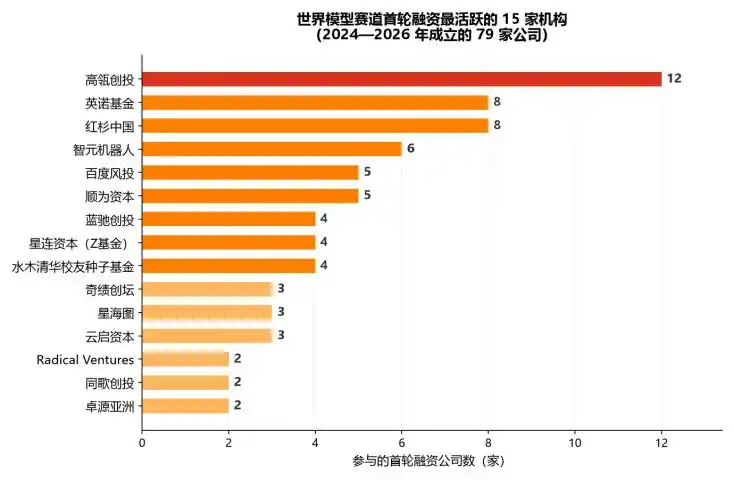
Hillhouse, Sequoia China and Inno Angel ranked near the top
When investors were ranked by the number of companies they backed in first-round financings, Hillhouse Ventures, Sequoia China and Inno Angel took the top three spots. One of the more notable names in the upper tier was AgiBot, a robotics company that placed in the top five as an industrial investor.
The chart cited in the report used IT Juzi MCP data and a sample of 79 companies.
After matching the top 10 investors with the years they invested and the startups they backed, the report highlighted several patterns.
Top investors often showed up in the same rounds
First, the leading firms were not spreading their bets independently. Their portfolios overlapped heavily.
IT Juzi said the top 10 investors made 59 investments across 30 world model startups. Of those 30 companies, 17 were backed by more than two institutions, putting the overlap rate at 57%. Another seven companies drew support from at least three investors. Liqing Intelligence stood out the most: seven top-10 institutions appeared in its first-round investor list.
Hillhouse and Sequoia China escalated in 2026
Second, Hillhouse Ventures and Sequoia China were in close competition in 2026.
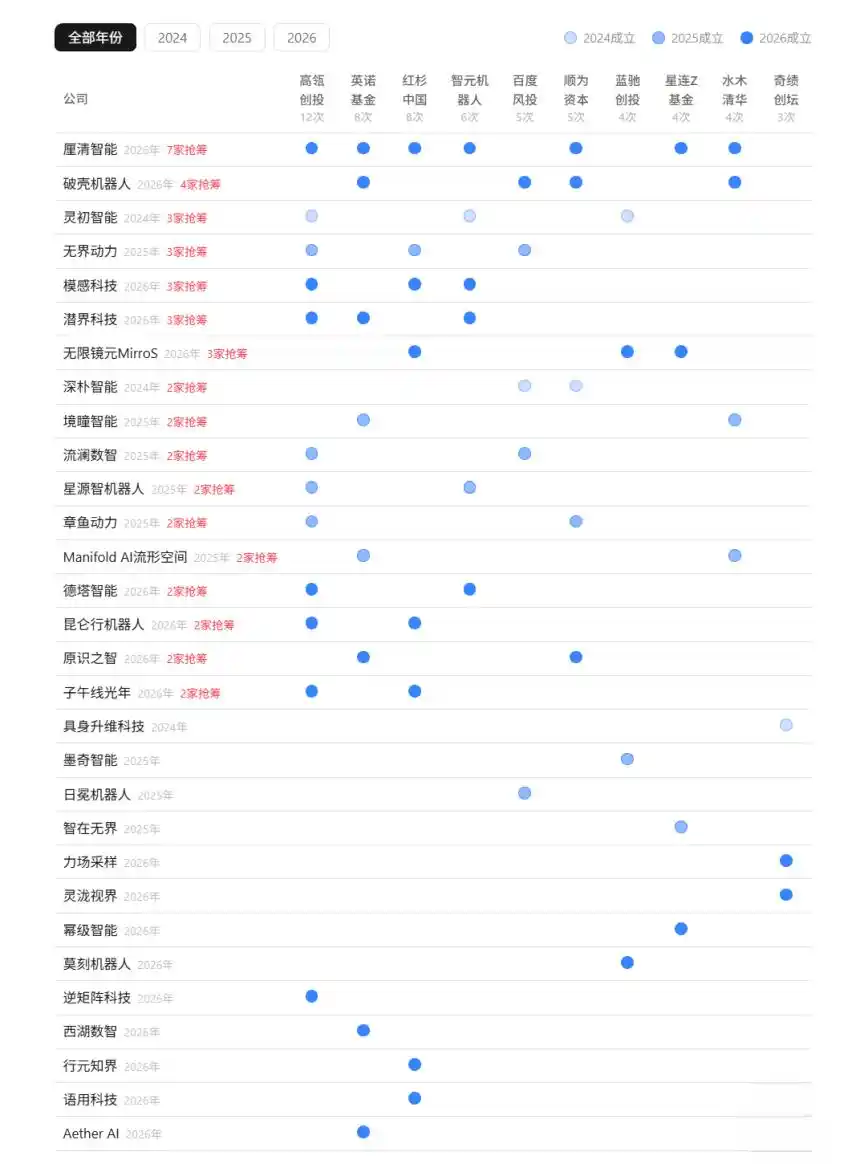
Hillhouse Ventures led the full investor ranking with 12 investments, and its pace increased year by year: one company in 2024, four in 2025 and seven in 2026. Sequoia China came later. It backed only one company, Infinity Dynamics, in 2025, then jumped to seven deals in 2026, matching Hillhouse.
The two firms also overlapped on the same companies in the same year. Liqing Intelligence, Meridian Lightyear, Kunlunxing Robotics and Mogan Technology all appeared on both firms' lists. IT Juzi said that points to a high degree of alignment in how the two firms identify top projects, while also raising the bar for startups seeking to be seen as category leaders.
2026 became the year of concentrated entry
Third, the report said top institutions only reached a broader consensus on the world model sector in 2026 and started entering in groups.
Among the top 10 investors, Hillhouse Ventures was the only one that invested continuously from 2024 through 2026. Some others entered in 2025, including Inno Angel and Xinglian Capital. A larger number only started making concentrated first-round investments in 2026. In IT Juzi's reading, that was the year capital formed a clearer bullish consensus around the segment.
Four signals from the first-round investor base
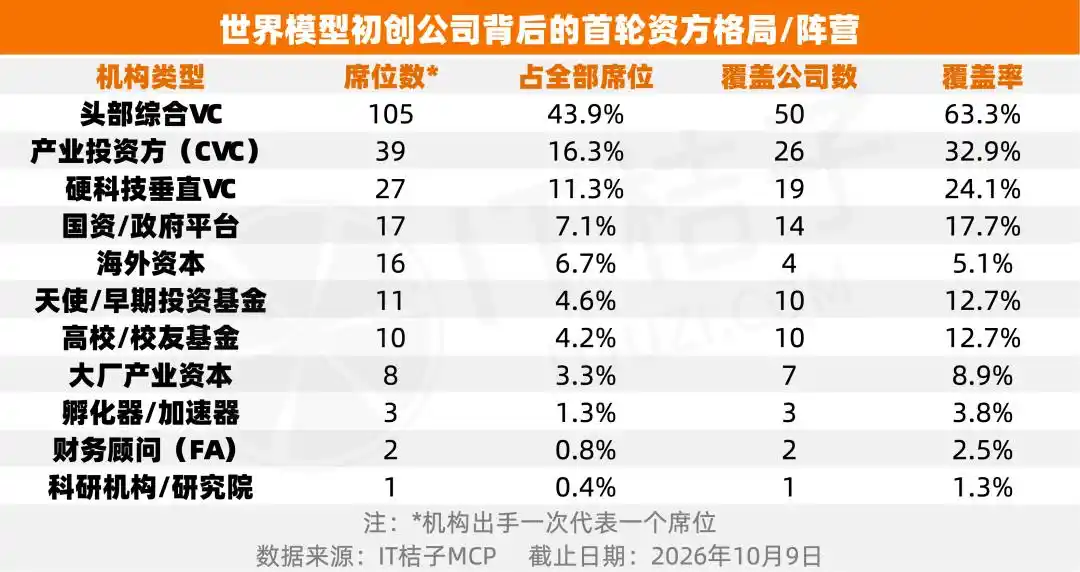
Looking at all 79 companies, the report drew four broader conclusions from the composition of first-round investors.
Leading generalist VCs held most of the early tickets
First, about two-thirds of those first-round spots were controlled by top venture firms.
Out of 79 startups, 50 had participation from leading generalist VC institutions in their first financing round, for a first-round coverage rate of 63.3%. On that basis, the report said nearly two-thirds of the first tickets into the world model sector were led by top VC capital, with industrial investors, hard-tech focused vertical VCs and state-backed capital acting more as complements.
University-affiliated funds also showed up in 10 first-round deals. Tsinghua Alumni Seed Fund backed four companies including Liuxing Space. Peking University Yanyuan Venture Capital invested in Reverse Matrix Technology and ZhiZai Wujie. Fudan Sci-Tech Innovation Fund participated in Linglong Vision, and Westlake University invested in and incubated Westlake Digital Intelligence.
Robotics companies are using investments to build an ecosystem
Second, robotics companies investing in world model startups are trying to shape an industrial ecosystem.
Industrial investors appeared in the first-round financing lists of 26 world model companies, excluding broad corporate venture capital arms from companies such as BAT, according to the report.
AgiBot was the most aggressive industrial investor in this group, backing six world model startups. Those included Lingchu Intelligence in 2024, Xingyuanzhi Robot in 2025, and Liqing Intelligence, Delta Intelligence, Mogan Technology and Qianjie Technology in 2026.
Xinghaitu invested in three companies including Liulan Digital Intelligence. Horizon and Lingchu Intelligence each backed two world model companies. Leju Robotics, Galaxy Era and Li Auto made smaller numbers of investments. The report said industrial capital now covers much of the upper tier of the robotics supply chain.
IT Juzi added that most of those robotics companies are still startups themselves and may still rely on financing to sustain operations, but they are actively moving into upstream world model technology in an attempt to build ecosystem barriers. World model companies provide what the report described as an embodied brain, as well as perception and decision-making capabilities that embodied intelligence companies urgently need. With technical routes still unsettled, taking equity stakes directly in seed rounds has become one way to secure optionality.
Once industrial capital is already showing up in first-round financings, the alliance between technology providers and application-side players has effectively moved to day one of a startup's life, the report said.
Only a small group kept writing repeat checks
Third, the report found that a limited number of institutions kept betting repeatedly, while many others appeared only once.
IT Juzi data showed that only 38 institutions appeared more than twice in first-round deals in the world model segment. The other 120 participating institutions made only one investment across the full sample.
That split suggests top investors are making sustained bets, while long-tail institutions are mostly entering for exposure. The report described this as a typical pattern for a sector moving from an early frontier into a consensus phase. Money is available; what remains scarce is certainty built through repeated institutional validation.
Syndication in first rounds is rising fast
Fourth, the market is still accelerating its dealmaking pace.
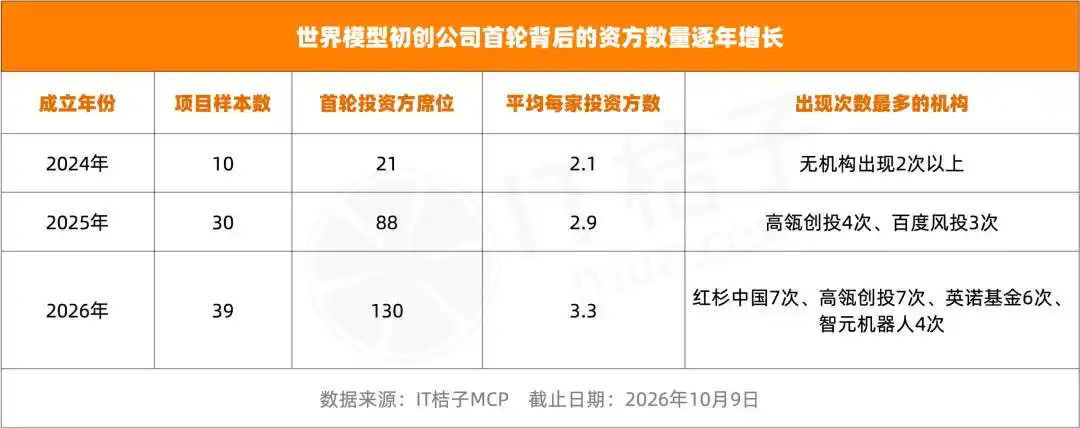
According to IT Juzi, the average number of investors in a world model company's first financing round rose from 2.1 in 2024 to 2.9 in 2025 and 3.3 in 2026.
At the same time, no institution made two repeat investments in the sector in 2024. That began to change in 2025, and by 2026 firms such as Hillhouse Ventures, Sequoia China, Inno Angel and AgiBot were investing at a high frequency.
In IT Juzi's view, that acceleration curve shows that as the sector heats up, first rounds become more crowded and the window for winning allocation gets shorter. As the amount needed for an early financing round increases, investors are more likely to share risk, which in turn raises the odds of multi-investor syndicates.
First-round investor lists are shaping valuation anchors
The report argues that the capital map around world model startups is starting to come into focus. For founders, the list of investors in a first round is not random. Choosing one institution over another can also mean choosing a valuation anchor.
The article was originally published on the WeChat account IT Juzi (ID: itjuzi521) and written by Wu Meimei. MarsBit republished the report.