
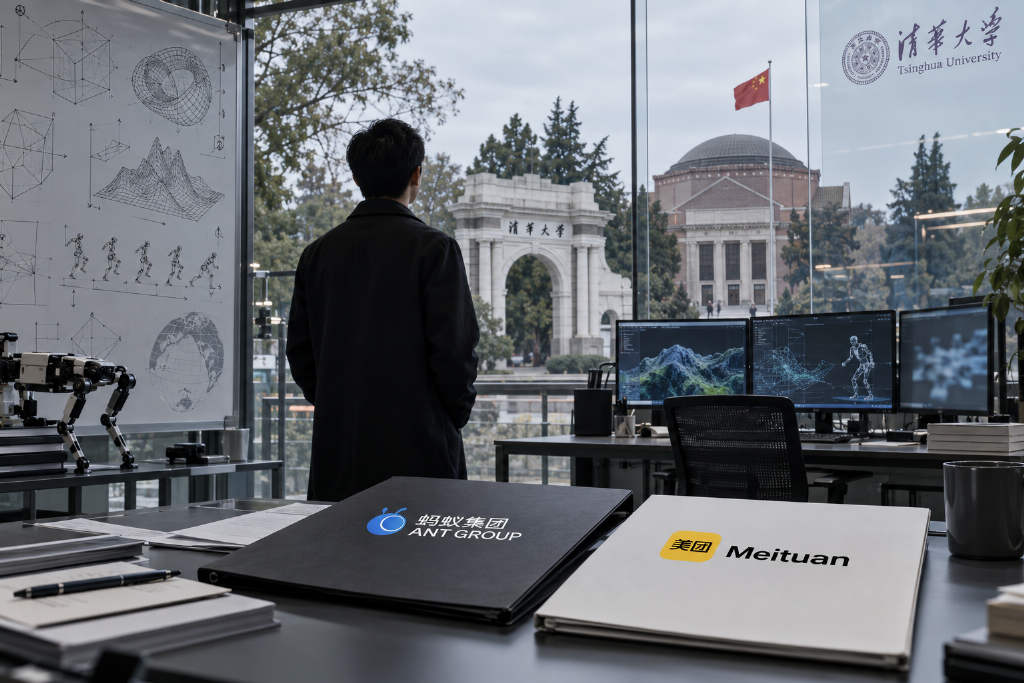
Top researchers are still flowing into the world-model field.

QbitAI reported that Wu Haixu, who received Tsinghua University’s Special Scholarship in 2022, has quietly started a world-model venture this year. The company is called Wuyuan Technology. It has completed three funding rounds so far and reached a valuation of $600 million, with investors including Ant Group, Meituan, Fortune Capital and Xinglian.
Startup focus: world models with physical modeling capabilities
People close to Wuyuan Technology said Wu chose to enter the market through world models equipped with physical modeling capabilities. The same people said the approach, to some extent, follows the technical path behind GeoPT.
In February, GeoPT, a paper with Wu as first author, drew strong attention in technical circles. The work proposed a new pretraining paradigm for dynamical lifting. Through Synthetic Dynamics, it lifts static geometry into a dynamic space, allowing a model to acquire physical intuition from unlabeled data by learning how particle trajectories evolve.
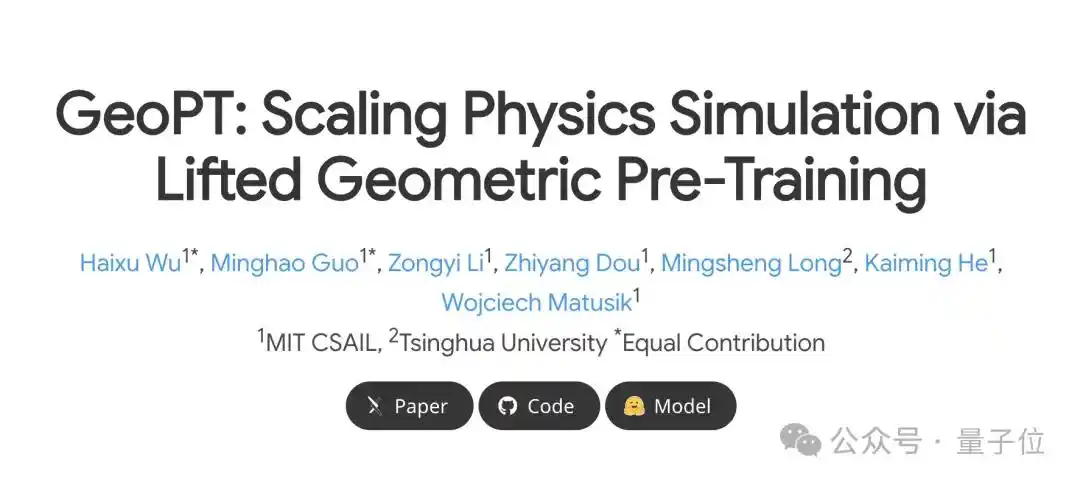
The paper’s author list also included Long Mingsheng, a tenured associate professor at Tsinghua University’s School of Software, Kaiming He at MIT, and MIT professor Wojciech Matusik. Long was Wu’s PhD advisor, while Matusik led the group where Wu has been doing postdoctoral work.
Academic path
Wu entered Tsinghua University’s School of Software in 2016 as an undergraduate majoring in software engineering. Starting the following year, he also pursued a second degree in pure mathematics and applied mathematics at Tsinghua’s Department of Mathematical Sciences.
In the summer of 2019, he joined Harvard University’s Visual Computing Group as a visiting student, working under professor Hanspeter Pfister.
After finishing his undergraduate studies, Wu continued at Tsinghua University’s School of Software for graduate research under Long Mingsheng. Long’s group started with transfer learning and later shifted its focus to time-series foundation models, spatiotemporal forecasting, AI for Science and large weather models.
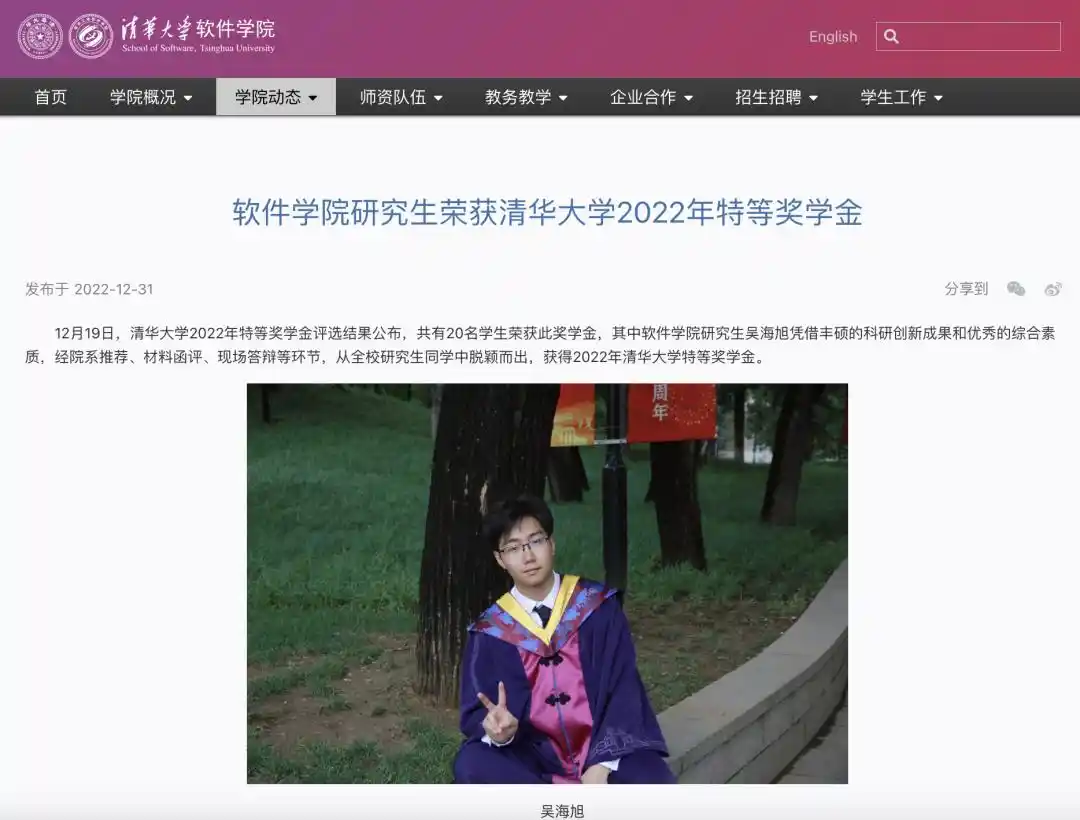
In 2022, Wu received Tsinghua’s Special Scholarship. The original report noted that Moonshot AI’s Yang Zhilin, OpenAI’s Chen Lijie, Google’s Yao Shunyu, Sand.ai’s Cao Yue and LiberAI’s Liu Songming were also previous recipients of the award.
From Autoformer to GeoPT
At the time of his scholarship defense, Wu had already published seven papers in CCF-A conferences or journals including ICML, NeurIPS and IEEE TPAMI. Six of those papers listed him as first author or co-first author.
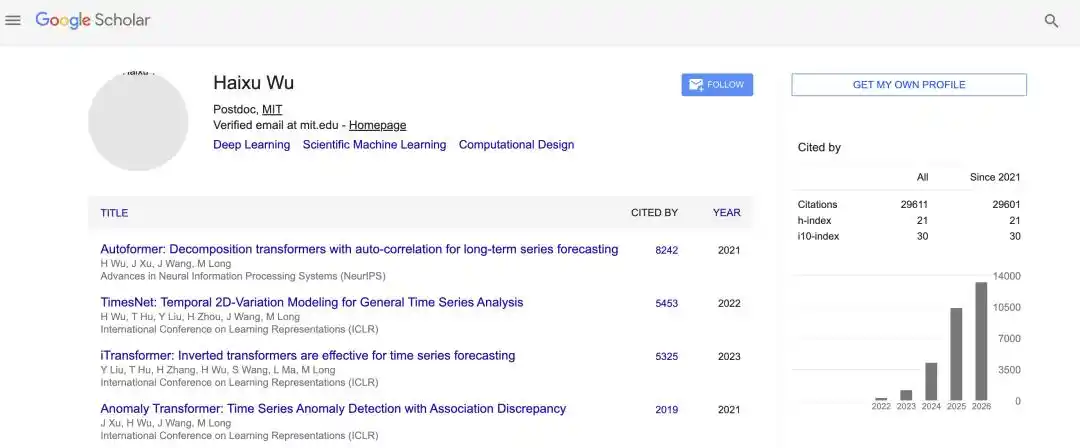
His core result at the time was Autoformer. The original report described it as the first work to systematically integrate sequence decomposition with an improved attention mechanism, calling it a milestone model in long-sequence time-series forecasting, or LSTF.
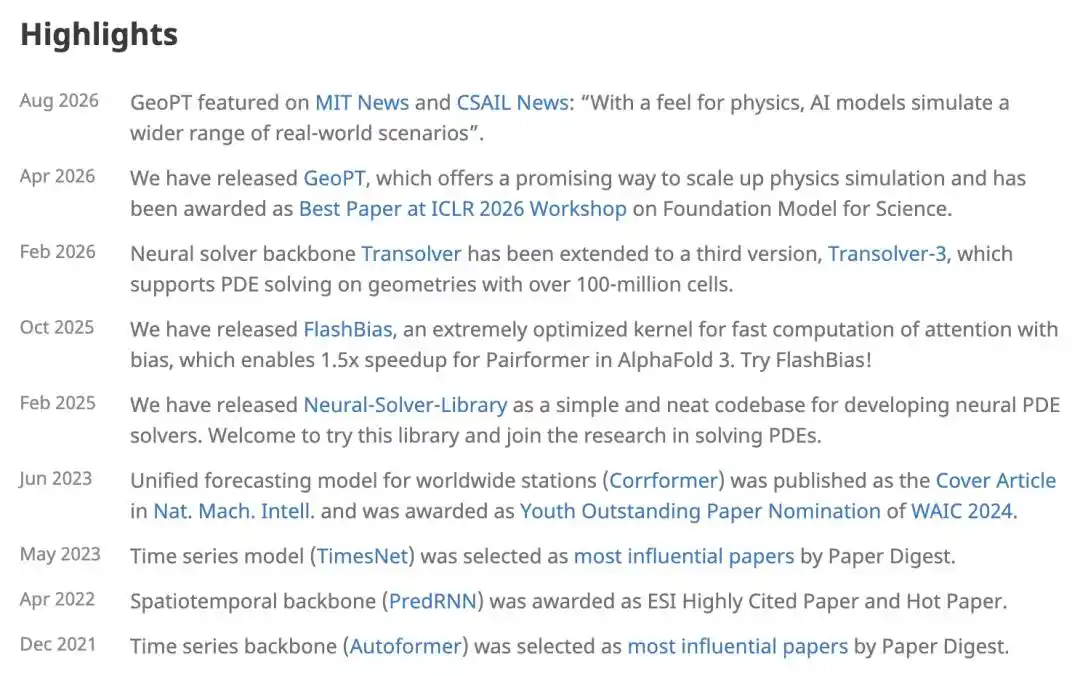
After Autoformer, Wu went on to publish work including PredRNN, Corrformer, Neural-Solver-Library and FlashBias.
Starting in 2025, Wu moved to MIT CSAIL for postdoctoral research. GeoPT became one of the representative works from that period.
Research focus and public citation data
During that period, Wu’s postdoctoral advisor, Wojciech Matusik, was described in the report as a well-known scholar in computational design and manufacturing. His research spans computer graphics, computational fabrication and robotics, with a focus on connecting the digital world and physical manufacturing through algorithms.
Wu’s current personal homepage says his research centers on deep learning and scientific machine learning, with the goal of building scalable principles for physical systems. His work focuses on physical systems and dynamical systems across three main directions:
- Scalable backbone networks based on physical principles: Autoformer, Corrformer, Transolver
- End-to-end physical foundation models: TimesNet, Unisolver, GeoPT
- Domain-aware scientific learning systems: Flowformer, Transolver++, FlashBias
Wu’s Google Scholar citation count currently stands at 29,611.
References and byline
The referenced links include Wu’s personal homepage, his Google Scholar profile, Wojciech Matusik’s page and a related page from Tsinghua University’s School of Software.
The article was first published by the WeChat account QbitAI, with Heng Yu credited as the author.