
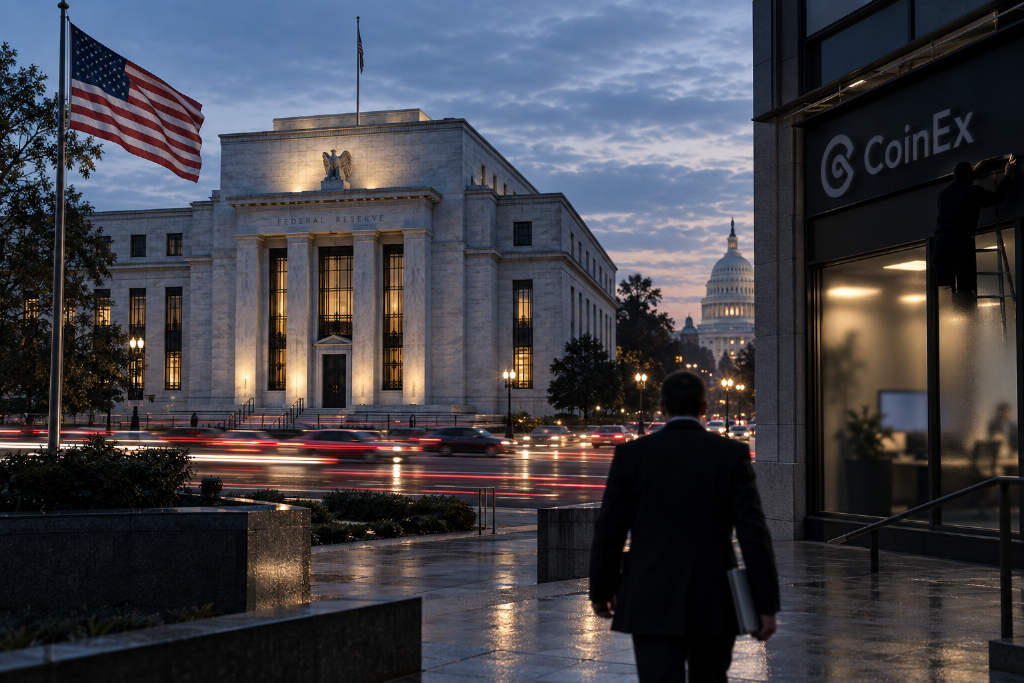
WuBlockchain’s weekly Top 10 centered on U.S. rates, crypto legislation, tokenized securities pilots, exchange shutdowns, and new moves by banks and large financial institutions in stablecoins, custody and on-chain trading.
1. Fed raises rates by 25 basis points to 3.75%–4.00%
The Federal Open Market Committee voted 12-0 to raise the target range for the federal funds rate by 25 basis points to 3.75%–4.00%, while continuing its policy of maintaining ample reserve balances in the banking system.
The FOMC said U.S. economic activity has continued to expand at a solid pace, domestic spending has shown resilience, productivity growth has been strong, capital investment has remained elevated, job gains have broadly kept pace with labor force growth, and the unemployment rate has changed little. Inflation, it said, remains elevated, and the rate increase is intended to help return inflation to the 2% target in a timelier way.
Wall Street Journal reporter Nick Timiraos said 16 of 18 participants expect at least one more rate hike in 2026, while only a small minority see rates below 4% by the end of 2027.
A Grayscale report said the 25-basis-point increase to 3.75%–4.00% looks more like a mid-cycle adjustment than a broader policy turn and is unlikely to trigger a major shift in crypto markets. It added that one or two expected hikes in 2026 are also unlikely to change capital allocation. The report cited a one-off rate hike under Alan Greenspan in March 1997, saying the Nasdaq bull market was not materially affected. It also noted that stablecoin issuers such as Circle and Tether could earn more as rates rise, while higher yields on tokenized bonds and money market funds could draw more capital on-chain, leaving the impact uneven across crypto assets.
2. CLARITY Act fails to advance in the U.S. Senate
The CLARITY Act did not move forward in the U.S. Senate. The bill failed to secure the 60 votes needed to invoke cloture, and support did not even reach 50 votes.
Before the vote, Senate Republicans had released a revised text of the crypto market structure bill. The package included an ethics proposal approved by Trump, along with changes to the Blockchain Regulatory Certainty Act, or BRCA, stablecoin yield provisions, and the so-called “Ag provision.” Republicans described it as their “last, best, and final” offer to Democrats ahead of Tuesday’s cloture vote.
The revisions narrowed the BRCA language to the Bank Secrecy Act and civil enforcement, removing protections for criminal cases, including prosecutions under Section 1960. The ethics proposal would require covered individuals to divest “substantial” crypto holdings or place them in a blind trust, and it would allow state attorneys general to enforce the rules. The stablecoin yield section added a “circuit breaker” mechanism under which federal regulators could step in if there were signs of large-scale migration of community bank deposits into stablecoins, with Treasury Secretary Scott Bessent as the final decision-maker. The “Ag provision” added restrictions tied to vertical integration, affiliated transactions, and conflicts of interest involving digital commodity exchanges, brokers and dealers. It also made clear that state consumer protection laws would still apply, that developer protections would not create an exemption from derivatives law, and that prediction markets would not be affected.
3. SEC approves temporary “Innovation Exemption” for tokenized stock pilots
The U.S. Securities and Exchange Commission said it has formally approved a temporary conditional exemptive framework, called the “Innovation Exemption,” allowing limited pilot trading of tokenized National Market System stocks on specific on-chain venues known as Tokenized Securities Venues, or TSVs.
The exemption gives TSVs temporary regulatory relief so that, when they offer tokenized stock trading through permissioned automated market makers and liquidity pools, they are not automatically treated as “exchanges” under the Securities Exchange Act of 1934. It also provides guidance for liquidity providers using proprietary capital to support market making.
SEC Chair Paul Atkins said qualifying TSVs may be exempted from the definition of “exchange,” while some liquidity providers may be exempted from the definition of “dealer,” for the purpose of trading tokenized NMS stocks. He laid out four main conditions:
- TSVs must be U.S. entities and comply with OFAC sanctions rules.
- Trading must be permissioned, with access limited to participants that meet entry standards.
- Synthetic stocks are not allowed. Tokenized shares must be issued by the issuer or its representative, or tokenized by an unaffiliated third party, and they must give holders the same dividend, voting and other rights as traditional shares.
- Issuers must have the right to object to and block trading of their securities on a TSV.
The SEC said federal anti-fraud and anti-manipulation rules remain fully in force. The exemption is temporary, and the agency will seek public comment while considering whether to write longer-term rules.
AMC Chairman and CEO Adam Aron said he supports the SEC decision on tokenized stocks made under Chair Paul Atkins. Aron said the SEC has set a five-year trial period for tokenized stocks and made clear that investor protection is essential, synthetic tokenized stocks are not allowed, and the tokens must carry full voting and dividend rights. He also said stock issuers should retain the right to object to trading of their securities on tokenized securities venues. Aron called on Robinhood to follow the same standards in overseas markets, including investor protections, a ban on synthetic tokens and issuer objection rights.
4. WSJ says Lagarde intervened in Binance’s EU licensing effort
The Wall Street Journal reported that European Central Bank President Christine Lagarde personally intervened to stop Binance from gaining a foothold in the European Union.
Binance had applied through Greece’s financial regulator for a license that could cover the EU market. Greek officials had at one point told Binance the application was complete. The company had prepared a press release titled “major milestone,” CEO Richard Teng planned to travel to Athens for a photo with the Greek prime minister, and the local team was preparing to sign an office lease. The plan did not move ahead. The Wall Street Journal said Lagarde personally stepped into the process.
According to the report, Lagarde’s intervention was driven by two considerations: waiting to see whether the European Securities and Markets Authority, or ESMA, might take over crypto licensing approvals across the EU, and concern that Binance’s expansion would strengthen the dominance of dollar stablecoins in Europe and affect the development of the digital euro.
5. UK FCA says banks can keep crypto payment restrictions
The UK Financial Conduct Authority said that even after the new cryptoasset regulatory framework takes effect on Oct. 25, 2027, commercial banks will not be forced to remove payment restrictions aimed at crypto exchanges. Nine of the UK’s 10 largest retail banks currently use blocks or limits, according to the update.
The FCA also released regulatory guidance and said authorization applications will open on Sept. 30, 2026, covering stablecoin issuance, trading platforms, custody and staking. It plans to consult in October on updates to the guidance.
6. CoinEx to shut down exchange operations after nearly nine years
CoinEx said it will end nearly nine years of exchange operations and begin an orderly wind-down. The company cited a prolonged crypto market downturn, shrinking industry trading volume and liquidity, and rising regulatory and compliance costs.
The platform will phase out futures, wealth management, lending and spot trading, and will close withdrawals on Dec. 22.
Founder Yang Haipo said CoinEx’s reserve ratio is above 100%, that all user assets are fully reserved, and that the company will buy back CET. He also said ViaBTC operations will not be affected.
CoinEx had previously drawn attention over reports involving Iran-related fund flows, but it denied cooperating with sanctioned entities.
7. NYSE plans 24/7 on-chain trading through an ATS platform
Avalanche said in a post that the New York Stock Exchange plans to enable round-the-clock on-chain trading through an alternative trading system, or ATS, platform now under development.
Michael Blaugrund, an executive at Intercontinental Exchange and the NYSE, said Avalanche met multiple requirements during the platform review process and that the two sides are working closely together.
8. Column launches bank-native stablecoin infrastructure
Column, the bank founded by Plaid co-founder William Hockey, launched bank-native stablecoin infrastructure that directly integrates USDC and USDT into a bank’s core system.
Under the setup, stablecoin addresses and bank accounts sit on the same ledger, allowing 24/7 instant conversion between stablecoins and U.S. dollars while connecting to ACH, Fedwire, FedNow, RTP and SWIFT.
Plaid is a major U.S. provider of bank account connectivity and financial data APIs, serving thousands of financial applications.
9. Circle launches Arc mainnet and mints 10 billion ARC tokens
Circle (NYSE: CRCL) said Arc, an open Layer 1 blockchain built for financial markets, real-time money movement and agentic economic activity, has gone live on public mainnet.
Arc is natively integrated with Circle’s full-stack platform, including USDC, which has more than $74 billion in circulation. Circle said more than 100 applications and more than 100 institutions and ecosystem builders were live on day one.
The genesis validator cohort includes BlackRock, DTCC, Galaxy, ICE, Mastercard, MoneyGram, SBI Group, Standard Chartered, Sumitomo Corporation, Visa and Worldpay, now Global Payments.
Arc uses USDC for gas, offers sub-second deterministic finality, and supports optional privacy, post-quantum signatures and designs aimed at AI agents.
Circle said it completed the genesis mint of ARC in the U.S. this week, with an initial supply of 10 billion tokens, but added that the mint does not amount to a commitment to a public offering of ARC. The network plans to explore a transition from proof-of-authority to proof-of-stake in 2027.
10. Deutsche Bank to launch crypto custody service
Deutsche Bank AG, Germany’s largest commercial bank, said it will formally launch a crypto custody service.
Pending final regulatory approval, the service is expected to go live later this year and will allow institutional and corporate clients to custody and transfer Bitcoin, Ether and selected stablecoins within the bank’s compliance framework. The bank said it plans to expand the offering later to tokenized financial instruments.
Gerald Podobnik, co-head of corporate banking at Deutsche Bank, said digital assets are an important complement to the traditional financial system rather than a replacement. The first phase of the service will be rolled out to domestic clients in Germany.
The offering is aimed mainly at asset managers, hedge funds, custody intermediaries, sovereign wealth funds and corporate clients engaged in blockchain-related business.
Key funding deals of the week
WuBlockchain also listed several financing events from the week:
- Velocity raised $48 million in Series A funding, with participation from Visa, Circle and Ripple.
- Fin com announced a $20 million seed round.
- Kaiko secured fresh funding led by S&P Global, bringing the round size to $110 million.
- Tare, a private credit platform on Avalanche, raised $13.25 million, with participation from the Aave CEO and a Tether co-founder.
- Stablecoin payments company dtcpay received a strategic investment from SBI, bringing its Series A total to $25 million.
- Tether became the main precious metals financing party for Goldcom in a deal worth about $1.5 billion.
More industry fundraising events are available at crypto-fundraising.info.