

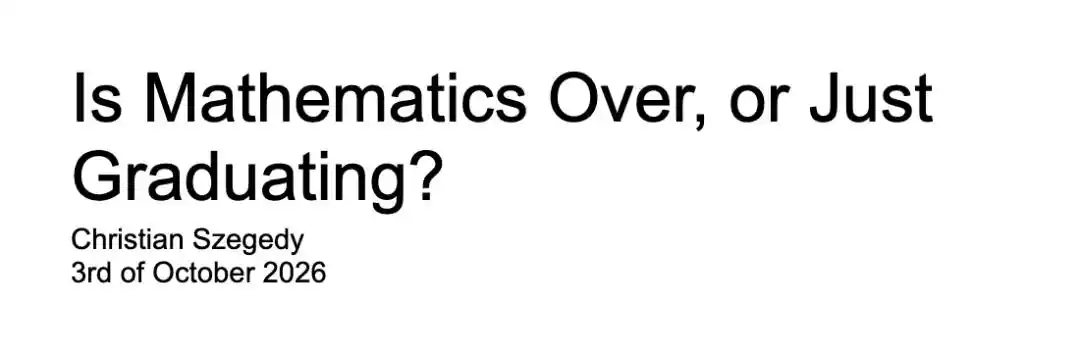
Christian Szegedy, a co-founder of xAI, has published a long essay on X titled Where Is Mathematics Going?, arguing that the two-thousand-year “heroic age” of mathematics is drawing to a close. In his framing, mathematicians are explorers climbing through a wild, unmapped jungle by hand, while AI is an aircraft that has already planted flags on mountain tops no one had reached before. What comes next, he says, is not the end of mathematics but the start of a new phase: mapping the whole continent.

His central claim is blunt. Mathematics is “graduating.” Instead of remaining a quiet corner of academia, it is set to become a full industry and the underlying infrastructure for scientific and technological progress.
A bet he says he has been making for a decade
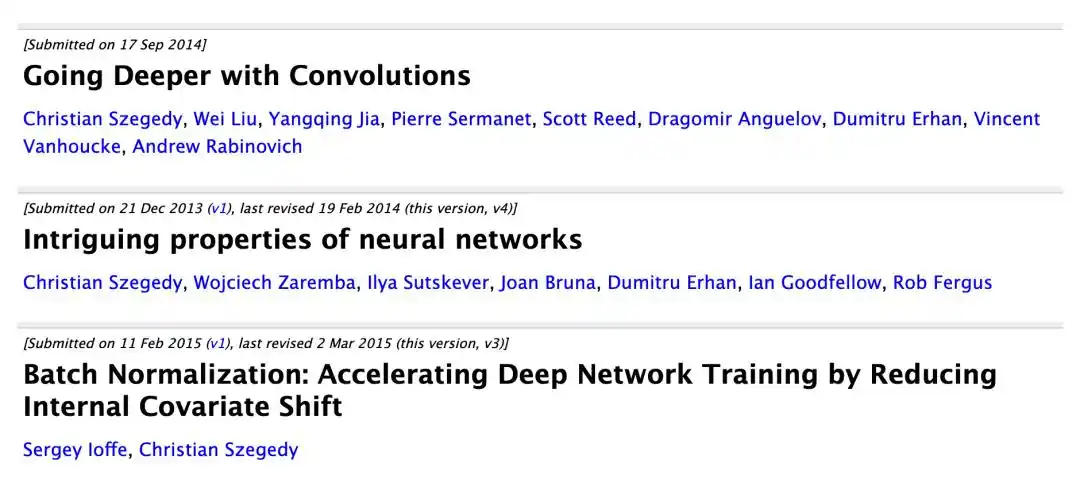
Szegedy traces the argument back through his own life. As a teenager, he studied in a mathematics track at one of Hungary’s top schools, with 8 hours of math classes each week and much of his youth spent on competition problems. He later earned a PhD in applied mathematics from the University of Bonn and then spent more than a decade at Google.
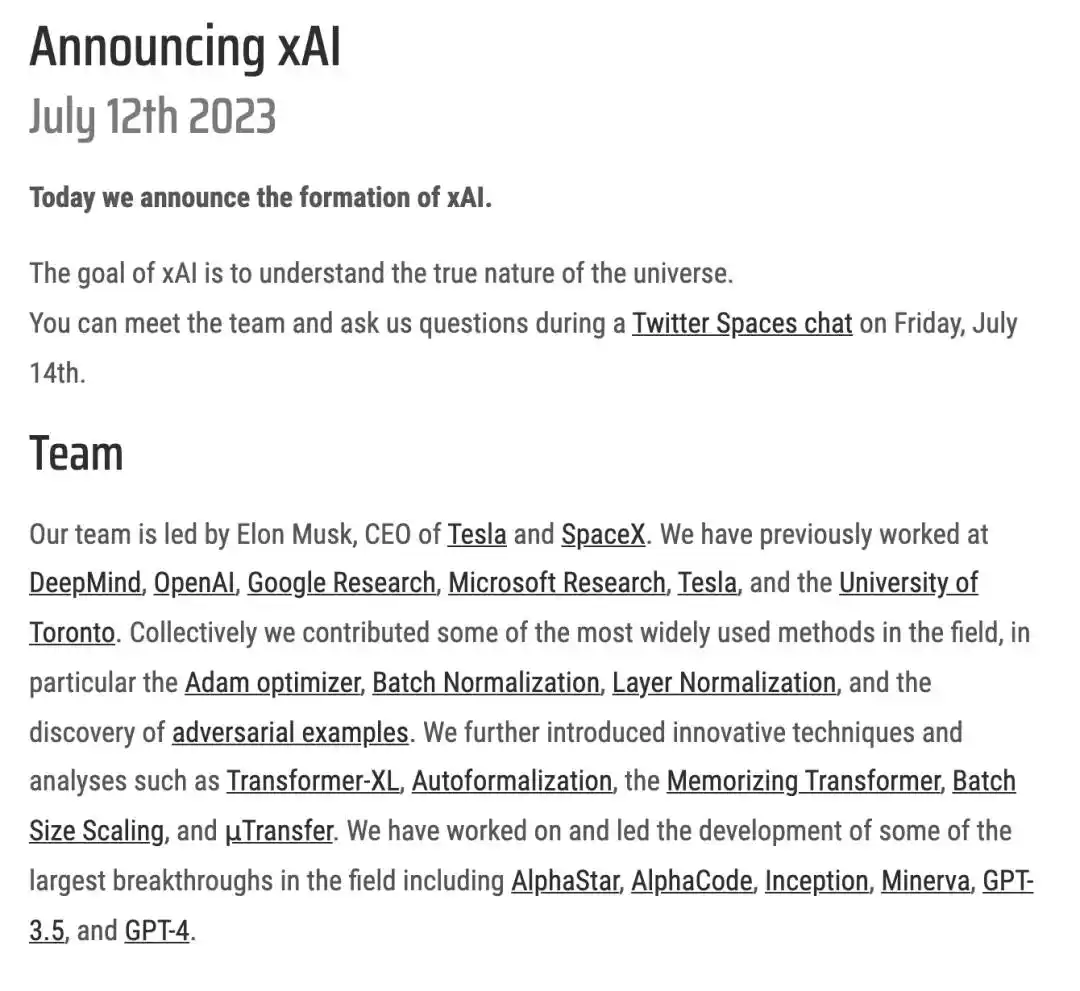
His name is attached to several milestones in deep learning. He was first author on the Inception paper, a landmark architecture in image recognition. He was also first author on the early paper showing that neural networks can be fooled by adversarial examples. Batch normalization, now standard textbook material, was proposed by him and his colleagues. In 2023, he became one of xAI’s 12 founding members.
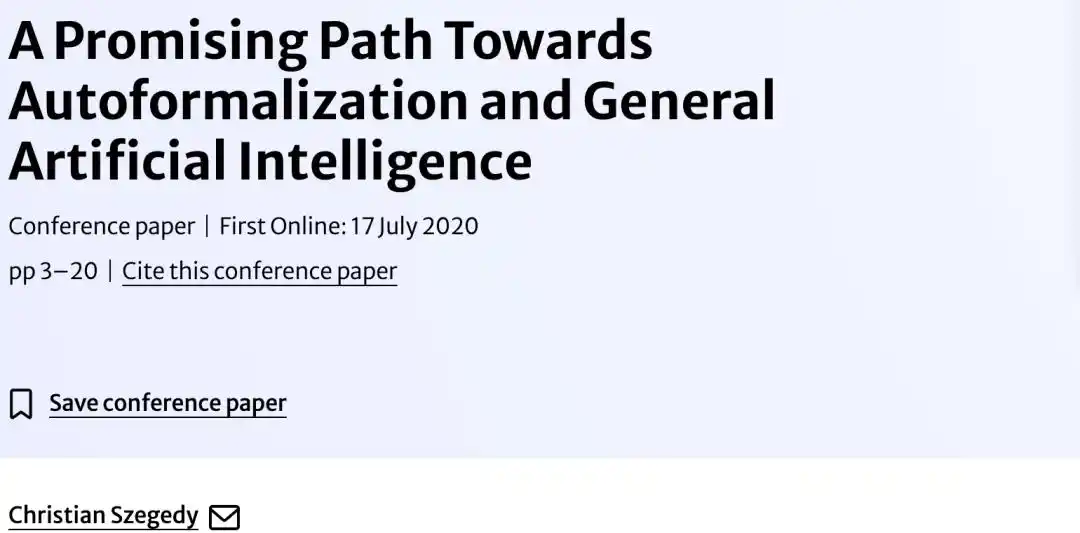
Still, mathematics has remained the thread running through his career. In 2019, he published a position paper arguing for automatic formalization as the path toward superhuman mathematicians. By automatic formalization, he means having AI translate human-written mathematics into proofs that machines can verify line by line.
At the time, he set 2029 as the target. In 2024, he moved that schedule forward by 3 years. AI skeptic Gary Marcus replied that he was not nearly as optimistic. In February of the same year, Szegedy also discussed a wager on X with figures including Keras creator François Chollet, betting that a superhuman AI mathematician would appear before June 2026.
The 2026 timeline he cites
In Szegedy’s account, 2026 became the year that forecast started to materialize.
- In May, OpenAI overturned the 80-year-old unit distance conjecture.
- In July, an Anthropic researcher used Claude Fable 5 to disprove the Jacobi conjecture, first proposed in 1939.
- On Sept. 4, Anthropic’s internal model completed a full proof of Fermat’s Last Theorem in the Lean theorem prover in 11 days.
- On Sept. 8, OpenAI said 10,000 agents ran for 88 hours and cracked the Millennium Prize problem on the Navier-Stokes equation.
- On Sept. 21, OpenAI said its internal model had solved more than 100 long-unsolved mathematical problems.
All of that, he notes, happened before the 2029 date in his original forecast.
Two thousand years as an explorer’s story
The essay begins with his own high school graduation. Szegedy writes that the first two hours after his final exams were the freest moments of his life. Then the emptiness arrived. There were no more competitions, no one teaching him, and no one who cared. “For the first time, I did not know who I was without it,” he wrote.
He says many mathematicians are about to face something similar.
In his metaphor, pure mathematics is like exploring a wilderness with no map, harsher even than the Darién Gap between Panama and Colombia. A beginner can get lost in days, catch malaria, or be eaten by wild animals. Explorers do three things there: draw maps, find minerals, and build tools.
The most admired figures are the ones who climb a mountain after everyone else has failed and sketch the summit. Whoever reaches such a peak first is treated almost like a god. He points to the Langlands program as that kind of achievement. Toolmakers can also become famous, but they do not receive the same aura. And when someone finds a “mineral” useful to ordinary people, such as the discovery that elliptic curves can be used in cryptography, most number theorists, he says, do not care much beyond putting it into a grant application.
The rocks everyone wants to conquer are conjectures. Often they are not that interesting in themselves, but they serve as test sites for climbing tools. What keeps explorers in the jungle is something else: not maps, not money, but the rare moment when an ignored rock turns into a mountain and the whole terrain opens beneath your feet.
Szegedy quotes Stephen Wolfram, the creator of Mathematica, who has described pure mathematics as the greatest intellectual edifice built by human civilization. In Szegedy’s telling, that edifice was assembled over more than two millennia by solitary climbers, one stone and one summit at a time.
Then the aircraft arrived
That is where AI enters the story.
Szegedy writes that the Wright brothers’ first flight lasted only 12 seconds and covered less distance than the wingspan of a large modern airliner. That, he says, is roughly where AI in mathematics stood until recently. These aircraft were primitive, able to fly only a few hundred meters and only a few meters above the ground. They were expensive and useful in only a small number of cases.
Over the past few months, though, he says they have changed. They can now fly into the Darién Gap without crashing. “We have even landed on a few rocks that no one had ever climbed before,” he wrote, referring to solved conjectures.
He then offers a parable. Some people, he says, will argue that these rocks are not very interesting, that mathematicians climb them only to sharpen tools for the real mountains, and that aircraft cannot reach those heights. Szegedy calls that a static-thinking fallacy. Today’s aircraft are primitive compared with what they will be in a few months, let alone in a few years.
“Don’t bet against the aircraft”
Once aircraft become cheap, he argues, the whole jungle changes. Private planes will be everywhere. Anyone who can pay will be able to charter one and land on any rock. Humans will invent satellites, survey the mineral wealth of the entire jungle, and then extract it.
He expects the process to be messy. Today’s explorers will be horrified, nostalgic for the old days, and angry that large companies are ruining the jungle they loved. “They are right,” he wrote, “but that changes nothing; large companies will find unimaginable wealth there.”
Rock climbing itself will not disappear, in his view. More amateur explorers will fly to the rocks they like, buy ready-made gear from a tool shop, and climb with friends. People with less physical ability will use aircraft to search for grander mountains, or look down on the whole range from a height above any peak.
“The old atmosphere and thrill will disappear forever,” he wrote. “Mathematics will be more glorious, more useful, and more ordinary than in the old age of heroic exploration.”
The first sentence of the final section of his essay reads: “Don’t bet against the aircraft.”
He argues that people who say AI will not generate conjectures, build theories, or explain things are describing the models of last spring. Within months, he says, those descriptions stop holding. Anyone who ties their identity to “AI cannot do X” is building on sand.
Universities, journals, and tenure committees may look similar for a few more years, he says, but what they reward will change at a basic level. The old heroism of climbing mountains no one else could climb will matter less. In its place, he sees three other skills becoming central: choosing which terrain is worth exploring, directing fleets of aircraft, and explaining discoveries to the world.
He also concedes that, for many people inside the system, this will feel like a demotion, and some will resist.
“Mathematics is about to graduate”
In the final paragraph, Szegedy writes: “Mathematics is about to graduate. It will grow into a full industry, become the true infrastructure of all scientific and technological progress, become the foundation on which every other field stands, and no longer remain a quiet corner of academia. The age of the solitary climber is ending, and the age of mapping the whole continent is beginning. As for me, I can’t wait to board a supersonic aircraft and see those vast mountain ranges.”

Stanford mathematician Jared Duker Lichtman, whom Szegedy mentioned by name, reposted the essay and wrote that he had been waiting for this moment since graduate school in 2019. He added that disruption without replacement leaves a vacuum, but a clear picture of the future can bring new life. The next step, he said, is already clear: translate all known mathematics into formal code.
Not everyone is willing to accept that “graduation certificate.” Five days before Szegedy’s post, Wolfram published a 7,000-plus-word essay saying he was “getting a bit tired” of claims that humans would no longer be needed to do mathematics. In Wolfram’s view, the goals of mathematics “almost by definition” must come from outside the system, specifically from us.
He also cited his own experience with automatic formalization. AI told him that “the proof went through,” but what it had proved was not the thing he wanted proved. His conclusion was that pure mathematics will never be finished.
Imperial College mathematician Kevin Buzzard described the field through the “five stages of grief”: denial, anger, bargaining, depression. He wrote that the first four stages all have plenty of representatives. Buzzard also said Fields Medalist Scholze has publicly stated that he will not use AI and is willing to “fight to the death” over that position.
Buzzard included the case of a PhD student whose research was stuck on a lemma. ChatGPT proved it in one shot. The student then began to question what the work meant at all.

“We must know. We will know.”
Szegedy says he knows that grief well. On the day he graduated from high school, he also felt that he had lost part of his life. But in the essay he writes that the grief is real, only not permanent.
In 1930, David Hilbert left behind a line in Königsberg that was later engraved on his tombstone: “We must know. We will know.” Buzzard quotes the same line at the end of his own essay.
In Szegedy’s account, mathematics is destined to become the first foundational discipline industrialized by AI. It can be checked line by line by machines. It does not require experiments. Right is right, wrong is wrong. That is why, in his telling, the first hard targets AI has bitten into — the Millennium Prize problem, the Jacobi conjecture, and Fermat’s Last Theorem — all sit inside mathematics.
The result, as he sees it, is that mathematics is shifting from a craft practiced by a small number of geniuses into the foundation beneath the broader technology industry. On the road toward superintelligence, it is the first continent to be surveyed.
Sources and attribution
The account above is based on Szegedy’s essay and related public discussion on X. The MarsBit article cited a Google Docs publication link and public X posts as reference material. MarsBit also noted that the piece came from the WeChat public account Xinzhiyuan (ID: AI_era), written by ASI Qishilu and edited by Moses.