
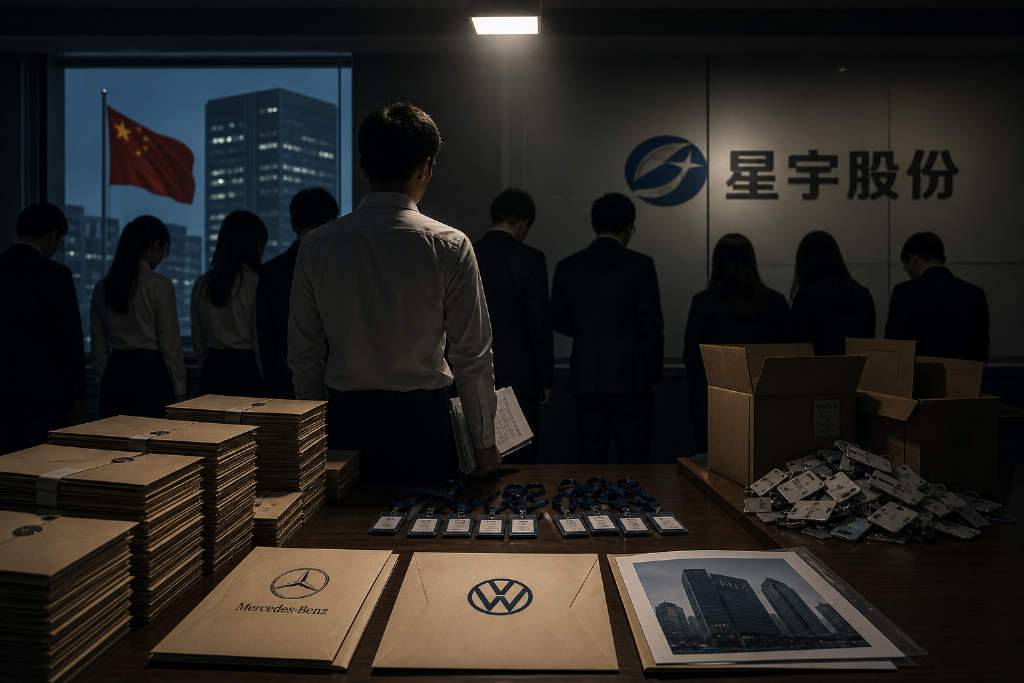
440 Hired, 107 Cut Within Weeks
Xingyu Co., a major Chinese automotive lighting manufacturer listed on the Shanghai Stock Exchange under ticker 601799, brought in 440 fresh graduates in July for R&D and technical roles. The cohort included graduates from China's elite 985-tier universities and holders of master's degrees. The company promised a one-month production-line internship followed by a transfer to technical positions — all while pushing ahead with its listing ambitions. On July 29, Xingyu filed for an HKEX listing to revive its "A+H" dual-listing plan; by August 14, it had completed the China Securities Regulatory Commission's overseas listing filing.
Just over a month after onboarding, some of the new hires were called into individual meetings with HR. Two options sat on the table: sign a voluntary departure form and collect half a month's pay, or get reassigned to the production line to tighten screws. Those affected later described the process as "humiliation-style layoffs." In total, 107 graduates had their labor contracts terminated.
Bypassing the System — Four Fronts at Once
The 107 dismissed workers made an unusual choice. They skipped arbitration, skipped litigation, and did not bother with the local trade union — which, like most Chinese unions, is state-led and widely seen as too slow to deliver results. Their reasoning: Xingyu's market and customer base had long extended beyond China, so their fight did not need to stay domestic either.
Step one was evidence collection. Recordings, labor contracts, and transcripts of HR conversations were compiled into a comprehensive PDF complaint package.
Step two hit four channels simultaneously: China's labor inspection authorities, the HKEX's ESG complaint mechanism, EU supply-chain compliance complaint channels, and the supplier whistleblower systems operated by Mercedes-Benz, BMW, and Volkswagen.
Step three packed the most punch. The same PDF went straight to Xingyu's clients, brokerage analysts, and investor-relations departments, reframing a labor dispute as a capital-market risk that could not be ignored. The timing was deliberate — it landed squarely in the critical review window for Xingyu's H-share IPO, injecting the controversy directly into the risk registers of investors and regulators alike.
Mercedes Responds, Volkswagen Investigates, HKEX Takes Note
Results came quickly. Mercedes-Benz replied formally through its BPO (Business Practices Office), assigning case number WB0011869. The response stated: "The conduct you describe does not conform to Mercedes-Benz's corporate principles, and we expect our business partners to uphold these principles as well." The report was forwarded to a specialist team for review.
On September 1, Volkswagen Group confirmed receipt of the complaint. Its central investigation office opened a dedicated inquiry, emphasizing that "respecting the lawful rights and interests of workers is a core principle governing all of Volkswagen Group's business activities" and pledging to take "appropriate measures."
The HKEX's listing division also responded, expressing concern and referring the matter to the relevant department.
Changzhou Authorities Step In, Xingyu Apologizes
Domestic reactions arrived almost in parallel. On August 25, the Changzhou Municipal Human Resources and Social Security Bureau released its findings: of the 440 graduates Xingyu hired that year, 107 had their contracts terminated. Officials determined the negotiation process was rough and communication insufficient. The company's HR director was suspended.
Two days later, Xingyu published a formal apology letter, acknowledging lapses in management decisions and communication. It offered three months of job-search subsidies, with an additional six months' salary for anyone still unemployed by the end of November. By August 28, some students had already received approximately 15,000 yuan in compensation.
'China's Trade Union Is Apparently in Europe'
Discussion of the incident has been censored on Chinese social-media platforms. Inside Xingyu's Changzhou factory, a banner appeared reading: "Whoever smashes Xingyu's rice bowl will have their own rice bowl smashed" — widely interpreted as a warning to remaining employees against pursuing overseas complaints.
One Chinese internet user posted a video quipping, "So China's trade union is actually in Europe." The joke cut close to reality: when domestic complaint channels proved hollow, 107 graduates found faster and sharper leverage through Mercedes-Benz, Volkswagen, and the HKEX than any arbitration panel could have offered.
Xingyu reported a 5.26% year-on-year decline in net profit attributable to shareholders for the first half of 2026. A clumsily handled round of layoffs has now added a cross-border compliance investigation to its list of problems. The tactic, however, has clear limits — it works only against companies whose clients sit in Europe or the U.S. and whose shares trade on overseas exchanges. A purely domestic Chinese firm with no foreign supply-chain exposure would leave the same PDF with nowhere to go.