
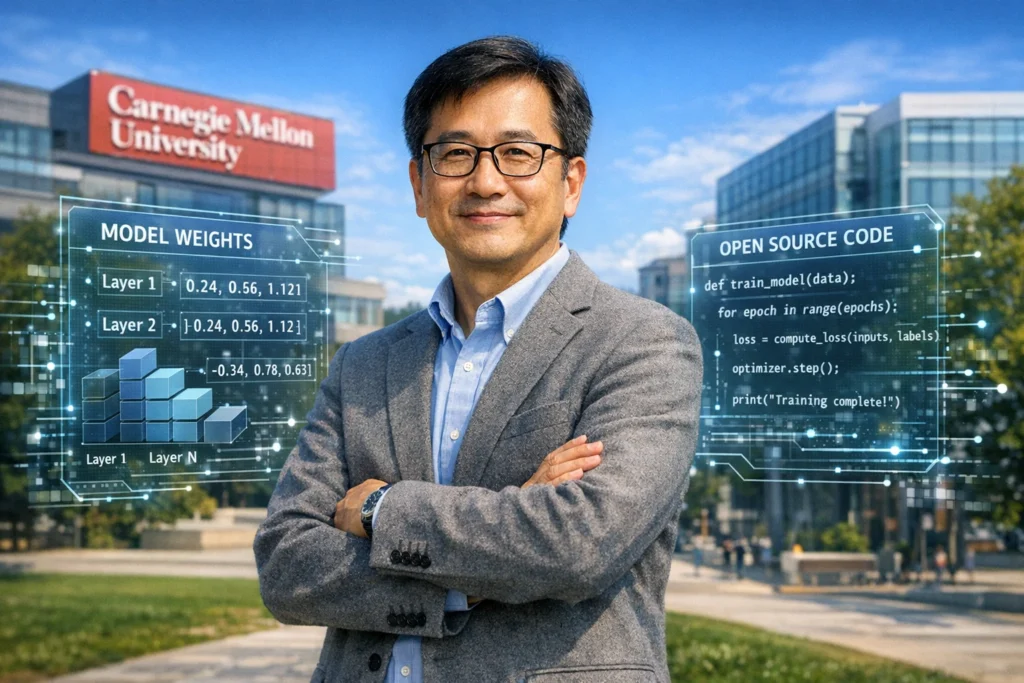
Russ Salakhutdinov, a computer science professor at Carnegie Mellon University and the PhD advisor of Moonshot AI founder Yang Zhiling, said Kimi K3’s most distinctive strength is its open model weights, while adding that it is still too early to make a firm call on the model’s actual standing against other top systems.
In an interview with National Business Daily, Salakhutdinov said the industry still needs more real-world use cases and more side-by-side comparisons before it can judge the true gap, if any, between Kimi K3 and other leading models.
Salakhutdinov on Yang Zhiling’s decision to start a company
Salakhutdinov said Yang’s doctoral thesis received more than 20,000 citations. Given that research record, he said, Yang could have taken a more conventional route by joining a top institution as a postdoctoral researcher and later moving into a faculty position. Instead, Yang wanted to build his own company. According to Salakhutdinov, he even turned down an opportunity from Apple and chose to return to China to launch a startup.
“If he didn’t try to start a business, he would definitely regret it,” Salakhutdinov said, recalling what Yang had told him.
The report said Yang was born in 1992 in Shantou, Guangdong. He entered Tsinghua University’s Department of Thermal Engineering in 2011, transferred to computer science in his second year, and graduated in 2015 at the top of his class. He then went to Carnegie Mellon for his PhD, where his advisors were Salakhutdinov and William Cohen, who was Google’s chief scientist at the time.
Carnegie Mellon’s computer science PhD program typically takes six years, but Yang completed it in four. During his studies, he interned at Google Brain and Meta and worked as a core contributor on the Transformer-XL and XLNet projects. The report said both papers have been cited more than 20,000 times. Salakhutdinov described him as “one of the best students at Carnegie Mellon at the time.”
Why he sees open source as Kimi K3’s defining feature
Salakhutdinov said it is premature to draw final conclusions about Kimi K3’s capabilities because models often continue to improve after release through additional tuning.
Even so, he endorsed Moonshot AI’s open-source direction and said he hopes the broader industry does not move entirely toward closed-source models.
He said he strongly supports open source because the open-source community has made an important contribution to the development of the AI industry. At Carnegie Mellon, he said, research has been able to move ahead with help from the open characteristics of models such as Google Gemma and Meta Llama.
If all major models were closed source, he said, researchers would be unable to access the underlying systems, making systematic research harder and limiting the ability to iterate on top of existing models.
Bloomberg report on Alibaba computing support
On the same day as the interview, Bloomberg reported that Moonshot AI had reached a computing partnership with Alibaba. Under that arrangement, Moonshot AI can use a cluster of about 20,000 Nvidia chips, which the report said accounts for a significant share of the total computing power behind the Kimi models.
Bloomberg also reported that Alibaba shares rose 7% early in the session, reaching their highest level since June 3.
The original report linked that development to the rapid expansion that followed Kimi K3’s open-source release, saying such growth requires substantial computing resources and that those chips come from the other side of export controls.
His view on AGI remains cautious
Salakhutdinov also spoke about artificial general intelligence, or AGI. He said laboratories in the United States, China, India, Japan and other countries are likely to keep releasing smarter models. In his view, future competition between models will center more on execution speed, intelligence and cost of use.
Still, he said he takes a conservative view on the timeline for AGI.
He said moving a technology from 0% to 80%, and then from 80% to 90%, is relatively easy. Getting from 90% to 99% is much harder.
According to Salakhutdinov, current AI systems have already shown capabilities that in some respects are close to AGI, and they have significantly improved efficiency in coding, copywriting and tool-based work. But he added that true AGI would also need the ability to act in the physical and real world, and in those areas there is still a long way to go.