
Yangtze Memory Technologies’ holding company has entered the accepted stage of its IPO review on Shanghai’s STAR Market, according to the Shanghai Stock Exchange website. The company plans to raise RMB 33 billion, with CITIC Securities and CSC Financial serving as sponsors.
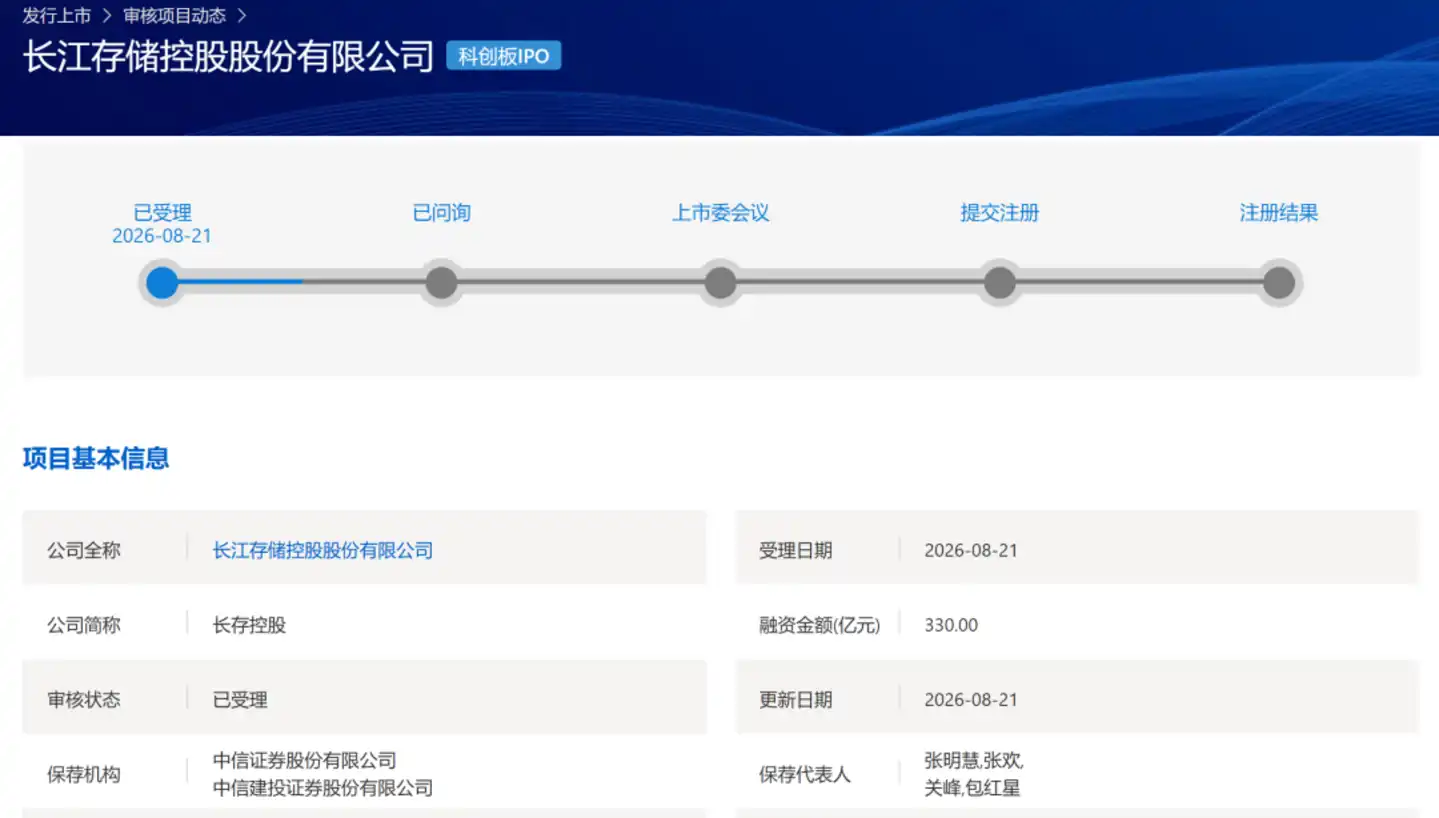
The report said the company completed tutoring registration on May 19 and passed tutoring acceptance on Aug. 19, taking three months to move through the process. It described that pace as a record for semiconductor IPO coaching and said the filing has moved the company closer to what could become the largest IPO in Wuhan’s history. Hurun Research Institute’s 2025 Global Unicorn List valued the company at RMB 160 billion, while the report said market expectations have been lifted to RMB 300 billion or higher as the listing process moves ahead.
From Wuhan Xinxin to Yangtze Memory
The report traces the story back well before 2016. In 2000, China’s State Council released the integrated circuit industry’s so-called Document No. 18, which helped trigger an early wave of domestic chip startups. Around the same period, Wuhan began planning its own push into the semiconductor sector.
In 2006, executives from Semiconductor Manufacturing International Corp. visited Wuhan. After further study and expert review, Hubei province, Wuhan city and the East Lake High-tech Development Zone jointly funded Wuhan Xinxin. The goal was to build central China’s first 12-inch integrated circuit production line, with SMIC initially taking charge of full-process management.
That plan was not universally supported at the time. According to the report, critics argued that an investment scale of roughly RMB 10 billion would be too small to generate economies of scale and that a full-process managed model would make later independent development harder. Even so, phase one of Wuhan Xinxin went ahead. The report said provincial and municipal governments invested RMB 10.7 billion, close to one-tenth of Hubei’s total state-owned economic investment for that year.
When the line went into production in 2008, it ran into the global financial crisis. The semiconductor sector entered a downturn, and Wuhan Xinxin came under heavy pressure. The company at one point turned to contract manufacturing for U.S. flash memory company Spansion, aiming to use China’s manufacturing cost advantage to secure orders, but Spansion soon went bankrupt. Wuhan Xinxin fell back into distress. SMIC was also unable to continue injecting capital, and global chipmakers including TSMC and Micron were said to have taken interest in the production line.
Wuhan ultimately chose to keep the project alive and push for independent development. In 2011, the two sides formed a joint venture. In 2013, SMIC formally exited. The East Lake High-tech Development Zone then brought in Yang Shining, a former SMIC chief operating officer who had spent more than 10 years at Intel, to serve as CEO of Wuhan Xinxin. The company began developing the market on its own while narrowing the gap in 3D flash memory technology with international players including SK Hynix, Micron and Toshiba.
With support from the new CEO and Wuhan’s state-backed system, Wuhan Xinxin secured orders from key customers including GigaDevice and gradually gained a foothold. In 2014, the National IC Fund launched a second round of large-scale investment into China’s semiconductor industry, and Wuhan decided to make another push into memory. In March 2016, the national memory base, with total investment of about $24 billion, was launched in Wuhan Optics Valley. Local media at the time described it as the largest single high-tech industrial investment project in the province since the founding of the PRC.
On July 26, 2016, Yangtze Memory was established on the foundation of Wuhan Xinxin, funded by Tsinghua Unigroup, the National Integrated Circuit Industry Investment Fund, Hubei Guoxin Industry Investment Fund and Hubei Science Technology Investment Group. From Wuhan Xinxin’s founding in 2006 to Yangtze Memory’s formation in 2016, Wuhan spent a full decade building out its memory industry position.
Ownership and financing structure
The report said Yangtze Memory currently has neither a controlling shareholder nor an actual controller.
Before the offering, Hubei Changsheng is the largest shareholder with a 26.54% stake. Xinfei Technology holds 25.35%. Phase I and Phase II of the National Integrated Circuit Industry Investment Fund hold 11.97% and 11.38%, respectively. Optics Valley Industrial Investment and Guoxin Fund hold 9.25% and 5.90%.
According to the prospectus cited in the report, the four shareholders with stakes above 10% have relatively similar ownership ratios and none holds more than 30%, meaning no single shareholder can exert major influence over shareholder resolutions. The filing also said that, on a look-through basis during the reporting period, the main funding bodies behind the company’s major shareholders were the Hubei SASAC, Wuhan SASAC, the East Lake High-tech Development Zone Administrative Committee, National IC Fund Phase I and National IC Fund Phase II.
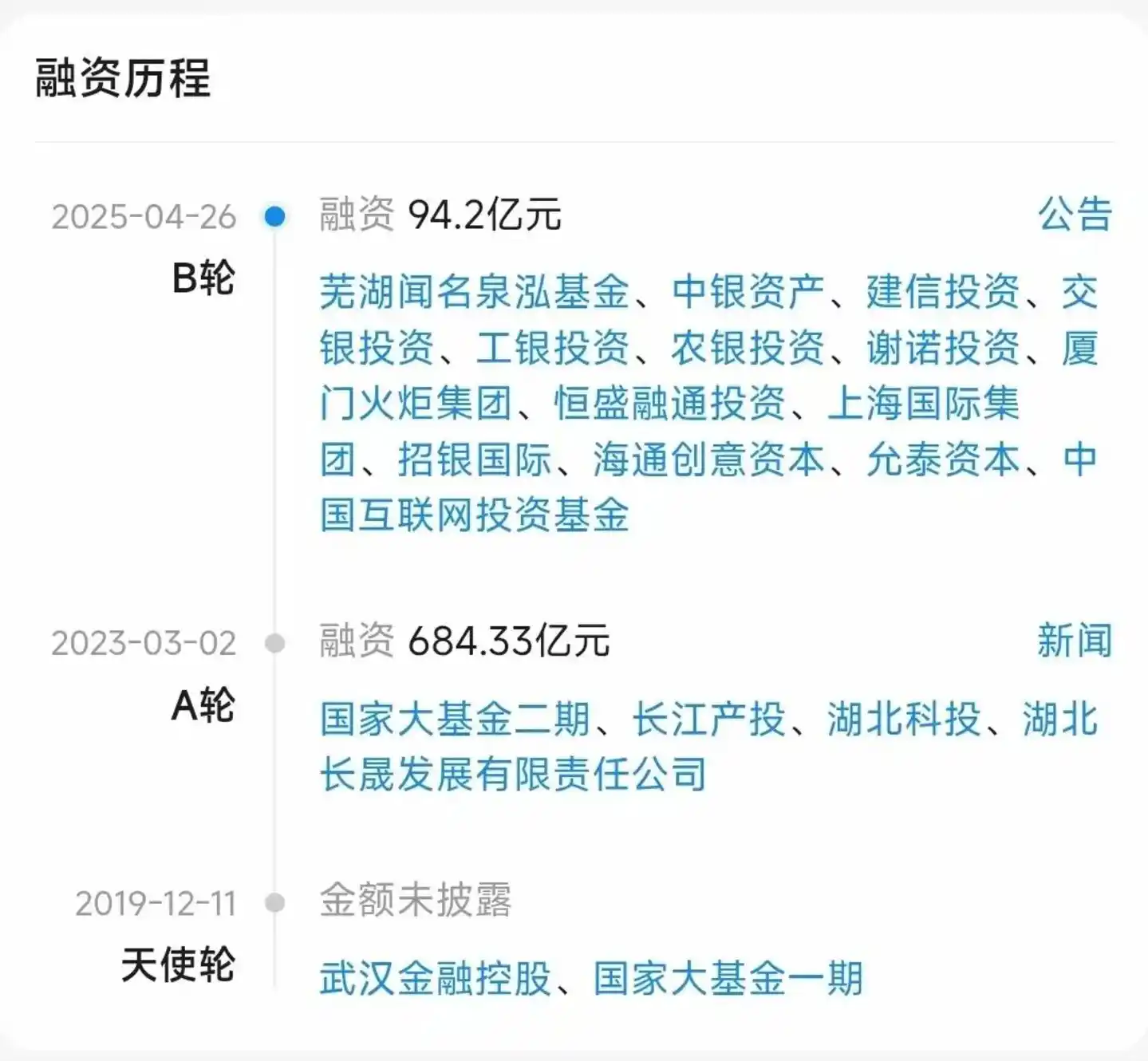
Qichacha data cited in the article show that the company completed an angel round in December 2019, bringing in Wuhan Financial Holdings and National IC Fund Phase I. In March 2023, it completed a Series A round worth RMB 68.433 billion, with Phase II of the National IC Fund, Changjiang Industrial Investment, Hubei Science Technology Investment and Hubei Changsheng participating. In April 2025, it completed a RMB 9.42 billion Series B round. Investors included Wuhu Wenming Quanhong Fund, BOC Asset, CCB Investment, Bank of Communications Investment, ICBC Investment, ABC Investment, Xie Nuo Investment, Xiamen Torch Group, Hengsheng Rongtong Investment, Shanghai International Group, CMB International, Haitong Creative Capital, Yuntai Capital and China Internet Investment Fund, along with more than 10 institutions in total.
The report said the combined size of the three financing rounds was well above that of typical market-driven projects, reflecting the company’s strong state-backed capital profile. It also noted that employee stock ownership platforms named Wuhan Zhixin Plan No. 1 through No. 6 were rolled out around the Series B financing and shareholding reform to tie the core technical team to the company’s long-term development.
The article added that Hubei province, Wuhan city and the East Lake High-tech Development Zone provided direct funding support multiple times over more than a decade. With the IPO now accepted, that early investment is moving toward market pricing. It said that, if the company ultimately lists, the book value of shares held by Wuhan state capital through different platforms could reach into the hundreds of billions of yuan.
Optics Valley’s broader listing pipeline
If the process goes smoothly, the listing would give Wuhan its biggest IPO on record. The report also places Yangtze Memory’s filing within the broader capital-market ambitions of Wuhan Optics Valley, where the company is based.
As of June this year, Optics Valley had 72 listed companies, with a combined domestic and overseas market capitalization of more than RMB 1.8 trillion. The total accounts for about one-third of Hubei’s listed companies and more than 60% of Wuhan’s, according to the report.
Optics Valley has rolled out a series of policy measures in recent years, including an action plan for high-quality development of listed companies, a package referred to as the “new 15 listing measures,” and another known as the “10 venture capital measures.” It has also launched a central China service base for the Beijing Stock Exchange and introduced a “listing nursery loan” for small and medium-sized technology companies. The report said a single company can receive as much as RMB 50 million in financing support, while the government’s risk compensation ratio for financial institutions can reach 30%.
The latest target is for Optics Valley to have more than 100 listed companies by 2030, while doubling the number of companies with market capitalizations above RMB 100 billion to eight.
Primary market capital is also being stepped up. At the World Optics Valley Technology Finance Ecosystem Co-building Conference on June 27, the district set up four industry-focused parent funds with a total size of RMB 18 billion. They are aimed at optoelectronic information, life and health, integrated circuits and future industries. Under the plan, the four funds are expected to mobilize no less than RMB 100 billion in new fund clusters by 2030 and drive more than RMB 300 billion in total investment.
The report said Optics Valley has already positioned itself in sectors including photonic integration, embodied intelligence and quantum technology. It cited examples including Liuxin Optoelectronics, whose 8-inch wafer photonic integrated chip technology is said to be industry-leading; Yuwei Optics, described as a domestic leader in full-spectrum industrial lidar and high-precision ranging products; and Langyi Robotics, which focuses on the “embodied cerebellum” for humanoid robots and whose products have become a preferred option for a number of robotics companies nationwide.
According to disclosures from Optics Valley cited in the report, public financing events involving science and technology companies in the district have reached at least 40 since 2026, covering rounds from million-yuan seed financing to industry rounds worth billions of yuan. Over the past three years, science and technology credit in Optics Valley has provided more than RMB 300 billion in support to nearly 6,000 companies, while the number of registered funds in the district has reached 426.
The report said seven major optical communications-related companies — Yangtze Memory, YOFC, HGTECH, Accelink Technologies, FiberHome, Guide Infrared and CICT Mobile — are forming the so-called “Optics Valley Seven Stars.” Among them, Yangtze Memory is the only company not yet listed. As its IPO advances, the report said, Optics Valley may be moving closer to a full capital-market lineup for that group.