

Animoca Brands chairman Yat Siu says AI agents can keep working while users sleep, scanning for new information and helping with crypto trading, but he warned that traders could one day lose access to the very services they have come to rely on.
Speaking to Cointelegraph on the sidelines of Token2049 Singapore, Siu said an agent can continuously search for fresh information and alert a user to developments they might otherwise miss.
He contrasted that with a standard chatbot by using conference planning as an example. A chatbot can return a list of events after being asked. An autonomous agent, by comparison, keeps watching for new announcements and can suggest attending when a worthwhile event appears.
The technology still has early-stage problems. Siu said his own agent became so focused on crypto trading and investment management that it started interpreting unrelated questions as if they were about crypto. His answer was not to make one agent do everything, but to run several specialized agents instead.
“If you have one agent that handles your personal schedule, that handles your family schedule, that handles your trips … and on top of it gives you advice on your crypto, that’s not just going to be confusing for the agent. It’s going to be confusing for you,” Siu said.
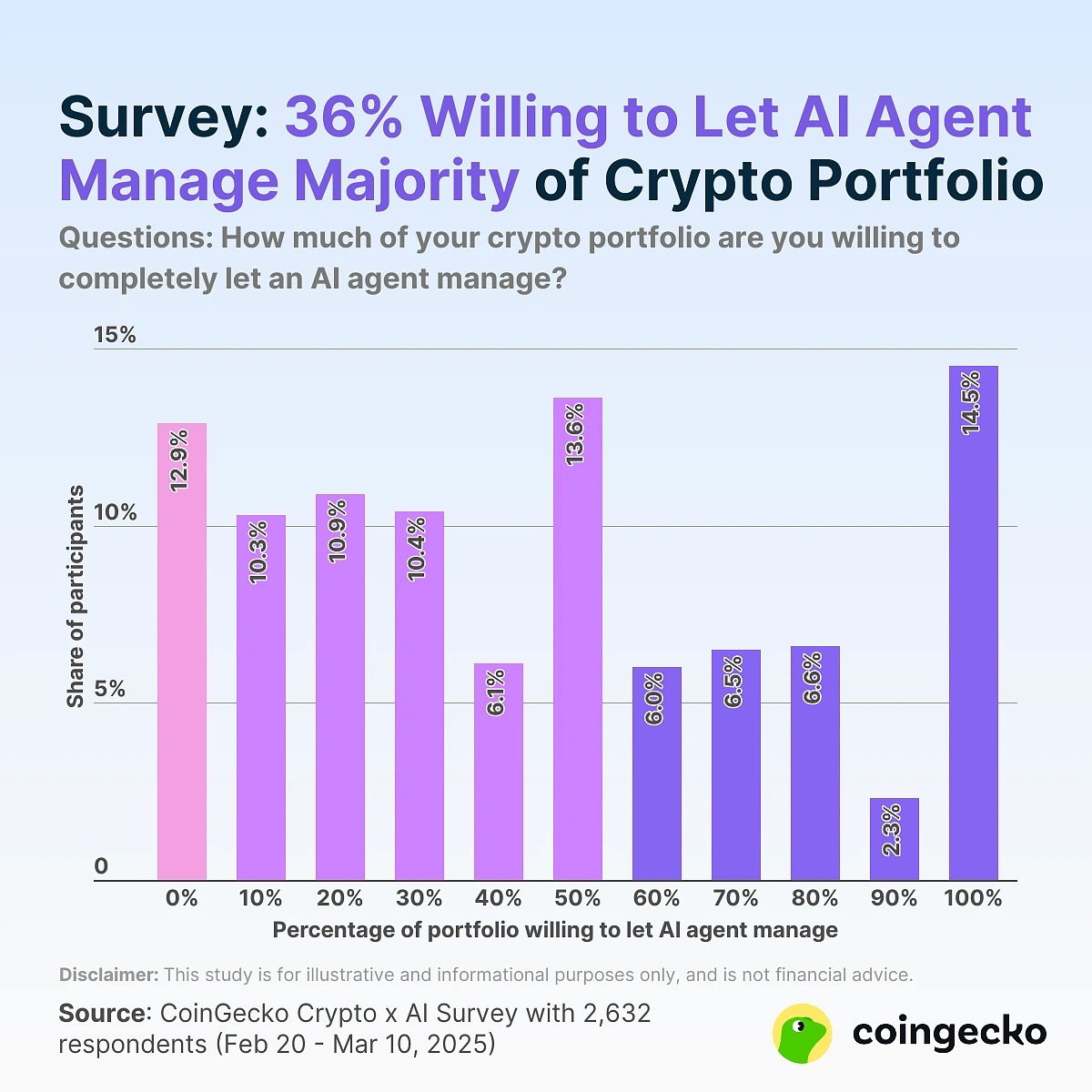
A 2025 survey from CoinGecko found that 14.5% of respondents said they would let AI agents manage their entire crypto portfolio.
The questions users ask are what separate trading strategies
Siu said using an agent does not automatically create an advantage. If 1,000 people ask AI about the same trade, they may get roughly the same answer.
Regulators have also flagged the risk that AI-driven traders could crowd into the same positions. In April 2025, the Bank of England’s Financial Policy Committee warned that widespread use of similar models could lead investors to take related positions during periods of stress and amplify market shocks.
Where responses begin to diverge is in the follow-up. Siu said users who bring their own knowledge, preferences and concerns into the conversation can shape very different outputs.
“Suddenly you query and you ask, and then your taste or your ideas or your thinking starts forming into it,” he said.
Over time, an agent can learn what its user prefers and begin trading in line with those preferences. Those inputs, he said, help form personalized crypto trading strategies.
Crypto firms are already giving agents wallets and execution tools
Crypto companies have started equipping AI agents with tools to handle money as well as information.
Coinbase introduced Agentic Wallets in February, allowing agents to spend and trade crypto within limits set by users. Binance launched AI Agent Skills in March, giving agents access to live market data and the ability to place and manage spot orders.
Those tools let users hand off more of the work needed to follow markets 24/7 and potentially catch opportunities that appear in the middle of the night, without giving up sleep.
Siu said human input will still matter through the ideas and questions that guide an agent. AI can learn a user’s preferences over time, but the user remains the one directing what deserves attention.
“By human input, I don’t mean human in the loop that approves it,” he said. “But the human is the one that ultimately is going to say, ‘Wait, you should look at this.’”
The more an AI knows, the higher the privacy cost
Siu said users should treat an AI assistant like a third-party adviser. Before handing over a document, they should think about what information the agent actually needs to answer the question and what can be left out.
“What about your personal finances, what income you make, who your closest friends are?” Siu said. “These are small little details that they don’t know about you, and now they have permission to know that about you.”
A trader may spend months teaching an agent which markets to watch and what information to digest before making a decision. The agent can remember those conversations, saving the user from repeating the same preferences again and again.
According to a 2026 survey from Pew Research Center, about 71% of US adults believe increased AI use will make their personal information less secure.
The problem, Siu said, is that the company operating the service still controls access. If an account is suspended, everything the user is doing through that system could be interrupted at once.
He asked users to imagine an assistant that has learned about them over years, only to disappear one morning.
“At minimum, you have the right to download your data so that you can basically transfer it somewhere else so that another agent might be able to take over,” Siu said.


