
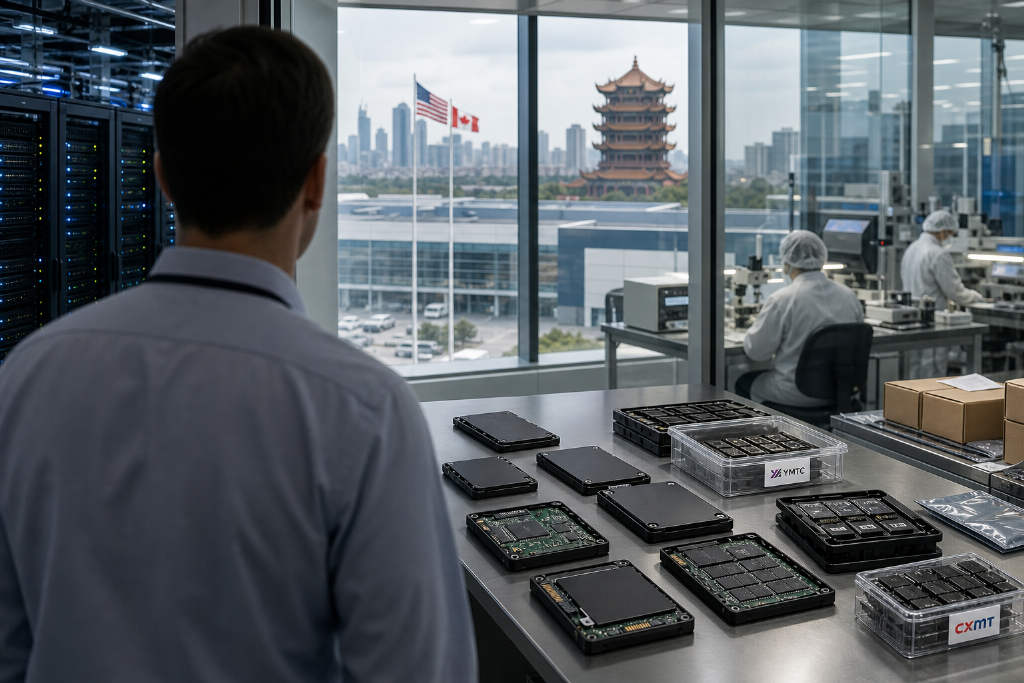
Chinese memory makers Yangtze Memory Technologies Co. (YMTC) and ChangXin Memory Technologies (CXMT) are seeking new routes into overseas markets as geopolitical pressure and export controls continue to weigh on the sector. One of those routes, according to DigiTimes, involves YMTC selling NAND chips to third-party module manufacturers, which then assemble the parts into enterprise SSDs for shipment to customers in North America.
YMTC NAND reportedly reaches U.S. neocloud providers through module makers
DigiTimes reported that YMTC has been selling NAND chips to independent module makers. Those companies then package the chips into enterprise SSDs and ship the finished products to several U.S. neocloud providers, a setup described in the report as a way to obscure the products’ Chinese origin.
Supply-chain sources cited in the report said U.S. private companies are still, in principle, able to purchase products from YMTC and CXMT under current rules. The report said the U.S. Commerce Department’s Entity List restrictions are mainly designed to prevent Chinese companies from using U.S. technology, rather than to impose a blanket ban on purchases by private-sector buyers. Instead, companies are expected to evaluate potential risks carefully. The same report said procurement for notebooks and consumer applications has also been gradually resuming.
YMTC moves up Wuhan Phase 3 schedule and enters DRAM
YMTC’s overseas push is backed by additional production capacity. Its Phase 3 Wuhan fab had originally been scheduled for mass production in the second quarter of 2027, but the timeline has now been brought forward to the fourth quarter of 2026, according to the report. Total monthly capacity is set at 100,000 wafers, with operations starting at 50,000 wafers.
The report added that YMTC plans to allocate 20% of Phase 3 capacity to LPDDR trial production. That would make the site the company’s first DRAM production base and mark YMTC’s move from NAND into the DRAM market. As output from the Phase 3 fab ramps up from 2027, the company’s share of external shipments is expected to keep rising.
CXMT starts qualification work with U.S. and Canadian cloud providers
On the DRAM side, CXMT is also moving to secure overseas customers. As DDR5 and LPDDR5 supply grows tighter, the company has already begun product qualification work with small and mid-sized cloud service providers in the U.S. and Canada, aiming to lock in customer commitments and capacity allocations early.
Supply-chain sources cited in the report said that, under the structural pressure of a global memory shortage, Chinese supply is increasingly seen by some market participants not as a sensitive option but as a practical one. The same sources estimated that China’s memory self-sufficiency rate could surpass 50% as early as late 2027 or sometime in 2028. They also linked the two companies’ aggressive overseas expansion to the policy role they are expected to carry.
Report says Apple has limited influence on current strategy
The market had previously heard reports that Apple was considering adding Chinese memory suppliers to its supply chain, a possibility that drew controversy. Still, the supply-chain view cited in the report was measured. The report said Apple’s ability to shape broader supply and demand dynamics has weakened significantly in the AI era.
From the perspective of YMTC and CXMT, the main value of entering Apple’s supply chain would be quality validation and market recognition rather than shipment volume or price competition, according to the report. It added that neither company is looking to supply Apple in large quantities. The report also said some Apple procurement staff have recently moved to NVIDIA, reflecting a shift in where industry resources are being concentrated in the AI era.
Even if Apple wanted to use Chinese suppliers’ capacity as leverage to push down procurement prices, that would be difficult to achieve in 2026, the report said. It added that allocable capacity for 2027 is already limited, leaving Apple with little bargaining power.