

YMTC Holding filed its prospectus with the Shanghai Stock Exchange after completing IPO counseling on Aug. 21, bringing fresh attention to a striking earnings comparison with CXMT, which listed earlier. For the first quarter of 2026, YMTC Holding reported revenue of RMB 47.042 billion and net profit attributable to shareholders of RMB 33.379 billion.
CXMT, by comparison, posted first-quarter revenue of RMB 50.800 billion, RMB 3.758 billion higher than YMTC Holding. But its attributable net profit was only RMB 24.762 billion, leaving it RMB 8.617 billion below YMTC Holding on that metric.
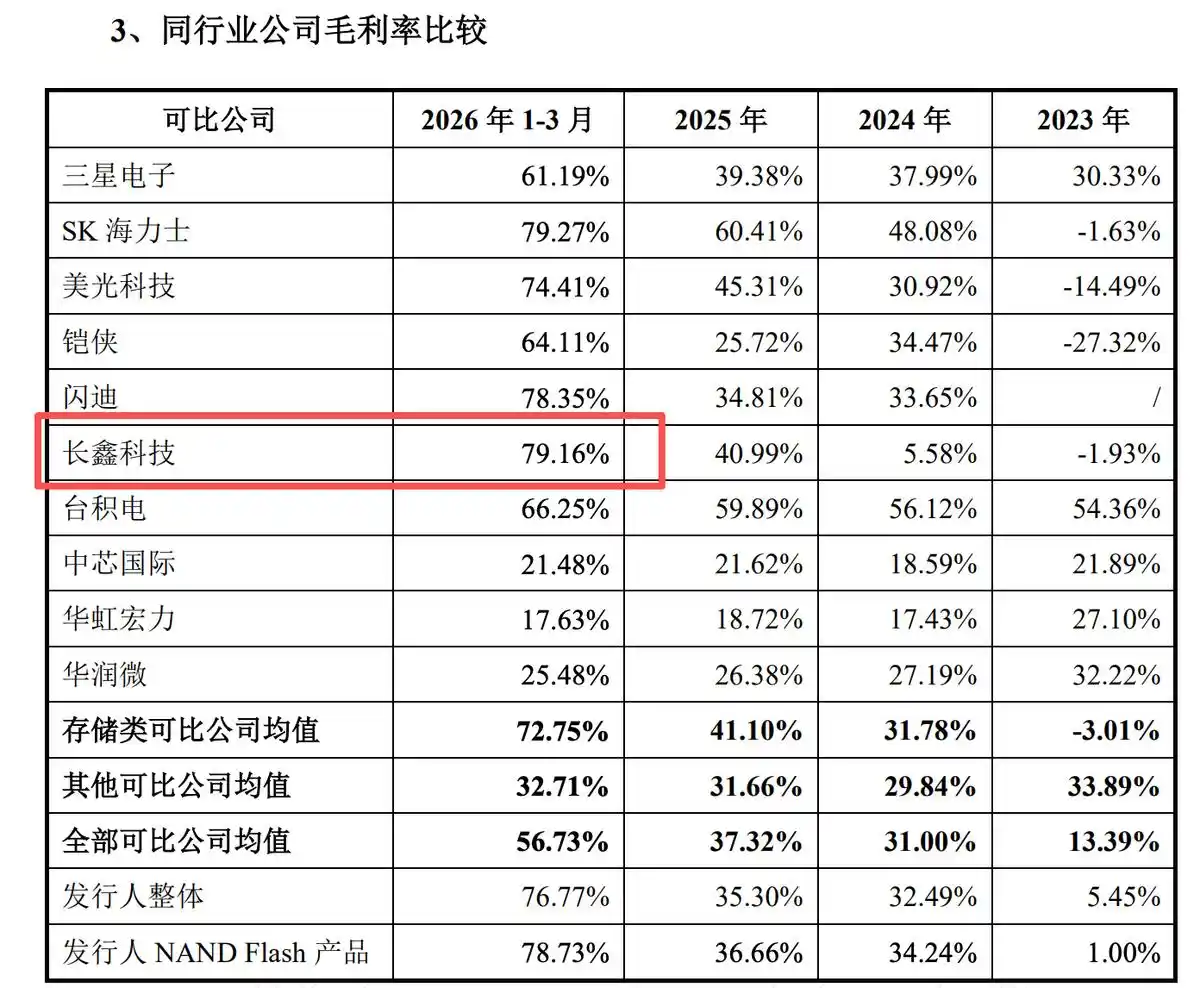
Higher attributable profit did not come from higher gross margin
The two companies focus on different memory segments. YMTC Holding targets the NAND Flash market, while CXMT is centered on DRAM.
Based on TrendForce data cited in the article, YMTC Holding ranked third globally and first in China among NAND Flash makers in the January-to-March 2026 period, measured by both sales value and shipment volume.
The industry upcycle has shown up clearly in YMTC Holding’s numbers. Revenue rose to RMB 45.203 billion in 2024, while attributable net profit turned positive at RMB 6.771 billion. In 2025, revenue climbed to RMB 63.185 billion, up 39.78% year over year, and attributable net profit reached RMB 14.211 billion, up 109.88%.
The acceleration became more pronounced in 2026. In the first quarter alone, YMTC Holding generated RMB 47.042 billion in revenue, already more than its full-year 2024 total. Attributable net profit of RMB 33.379 billion also exceeded the combined figure for 2024 and 2025.
At first glance, the obvious explanation would be that YMTC Holding earns a better margin because it sells different products. The prospectus data points the other way.
In the first quarter of 2026, YMTC Holding’s comprehensive gross margin was 76.77%, below CXMT’s 79.16%. Using the two companies’ revenue and gross margin figures as a rough guide, the article estimates YMTC Holding’s quarterly gross profit at about RMB 36.116 billion, versus RMB 40.213 billion for CXMT. That left YMTC Holding trailing by about RMB 4.1 billion at the gross profit level.
So the gap was not created by stronger revenue or better margin. CXMT was ahead on both counts. Yet YMTC Holding ended up ahead by RMB 8.617 billion in attributable net profit. From a roughly RMB 4.1 billion shortfall at the gross profit stage to an RMB 8.617 billion lead at the attributable profit stage, the swing between the two companies was about RMB 12.7 billion.
Minority interest was the main reason for the gap
Further down the income statement, YMTC Holding narrowed the difference step by step.
In the first quarter of 2026, its selling, administrative, and R&D expenses were about RMB 400 million lower than CXMT’s. Over the same period, CXMT recorded about RMB 1.579 billion in non-recurring losses, while YMTC Holding booked about RMB 207 million in non-recurring gains.
After those items, YMTC Holding’s pretax profit was about RMB 33.523 billion, compared with RMB 35.434 billion for CXMT. The gap had narrowed from roughly RMB 4.1 billion at the gross profit line to less than RMB 2 billion before tax.
Income tax reduced the difference even more. YMTC Holding recorded only RMB 38 million in income tax expense for the quarter, while CXMT reported RMB 2.423 billion.
At the consolidated net profit level, the two were then very close. YMTC Holding reported RMB 33.485 billion, while CXMT posted RMB 33.012 billion, a difference of just RMB 474 million. In other words, YMTC Holding did not out-earn CXMT by RMB 8.617 billion at the group level.
The major split came in the final allocation of those profits. Of YMTC Holding’s RMB 33.485 billion in consolidated net profit, RMB 33.379 billion was attributable to shareholders of the parent, and only RMB 106 million went to minority interests. CXMT’s picture was very different: out of RMB 33.012 billion in consolidated net profit, only RMB 24.762 billion was attributable to shareholders of the parent, while RMB 8.249 billion belonged to minority shareholders.
That means both companies earned more than RMB 33 billion in the quarter, but YMTC Holding kept almost all of it at the parent level, while roughly one-quarter of CXMT’s profit did not belong to the parent company. The article says the RMB 8.143 billion difference in minority interest was the main reason the final attributable profit gap reached RMB 8.617 billion.
How the core assets are housed shapes who gets the profit
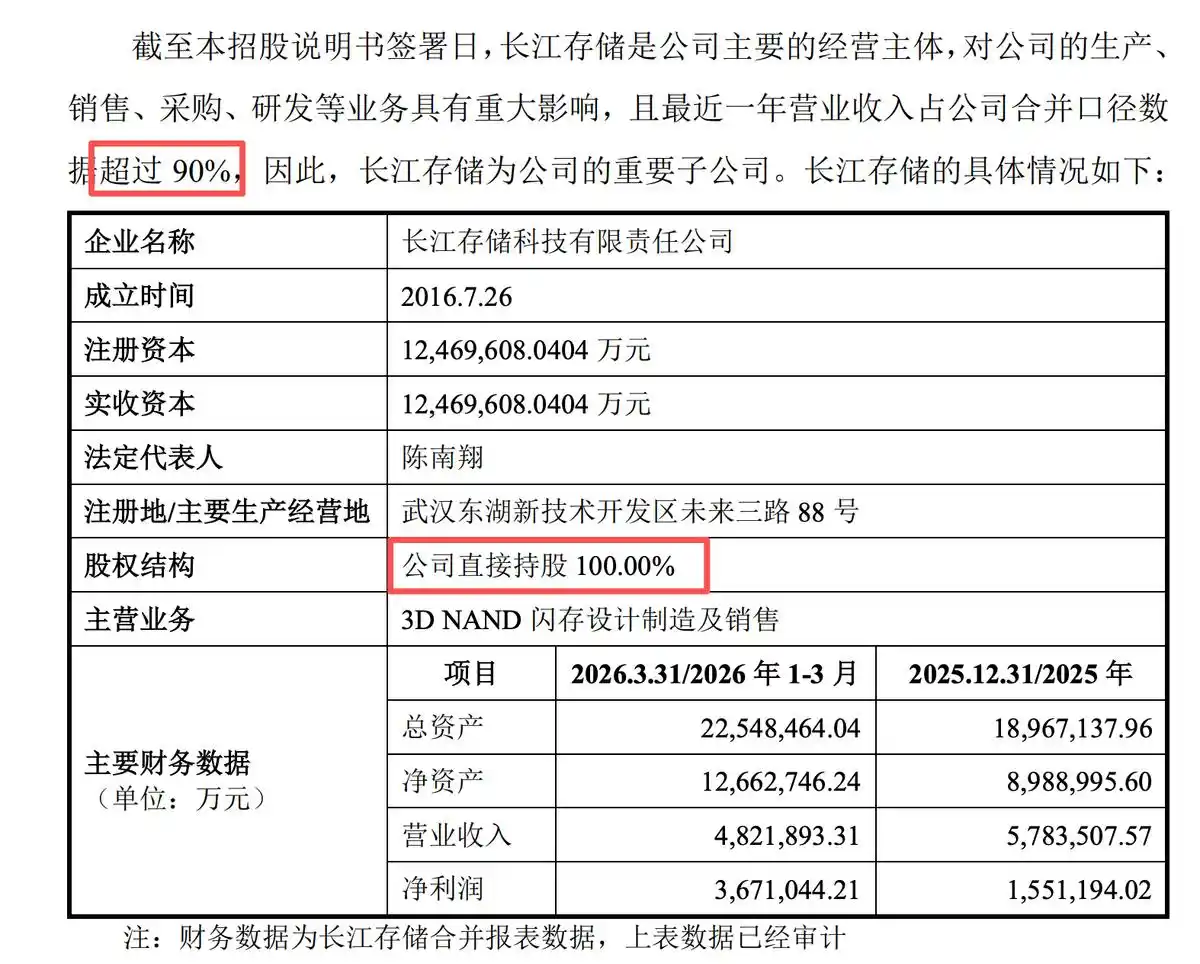
According to the prospectus, Yangtze Memory Technologies Co., Ltd. is YMTC Holding’s core operating entity, responsible for most of the group’s production, sales, procurement, and R&D functions. Over the latest year, it contributed more than 90% of YMTC Holding’s consolidated revenue.
More important, YMTC Holding directly owns 100% of Yangtze Memory. That places the company’s core 3D NAND design, manufacturing, and sales assets fully under the proposed listed entity, allowing profits from the main subsidiary to flow almost entirely to YMTC Holding’s shareholders.
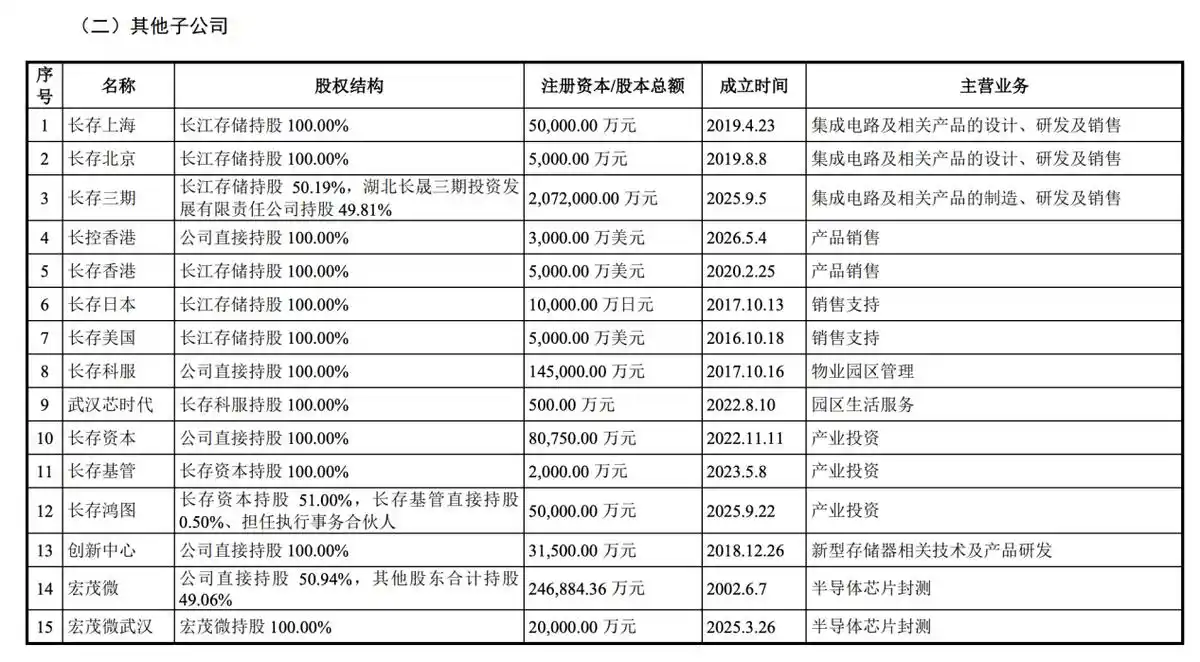
The article says Yangtze Memory’s subsidiaries handling R&D, sales, and overseas business — including Changcun Shanghai, Changcun Beijing, Changcun Hong Kong, Changcun U.S., and Changcun Japan — also largely use wholly owned structures. YMTC still has non-wholly owned subsidiaries such as Changcun Phase III and Hongmaowei, but their impact on total profit is currently limited. That helps explain why minority interest at YMTC Holding was only RMB 106 million in the first quarter of 2026.
CXMT uses a different setup. The CXMT system has about 30.68% economic interest in Changxin Xinqiao, but controls 73.01% of its voting rights through acting-in-concert arrangements. CXMT directly holds 31.72% of Changxin Jidian and controls 75.32% of the voting rights there through similar arrangements.
Put simply, CXMT can control these core production entities, so their revenue and profit are included in its consolidated financial statements. But because it does not own all of the economic interest, it cannot count all of those earnings as attributable net profit.
The article describes this as a trade-off. CXMT’s structure allows it to share the heavy capital spending burden of wafer fabs with external investors, but the profit generated by those projects must also be shared with other shareholders. Under YMTC Holding’s structure, profit from the core business can be attributed much more completely to the listed company’s shareholders.
That is why the numbers can look inverted at first sight. At the group level, both companies earned more than RMB 33 billion in consolidated net profit in the first quarter of 2026. After ownership allocation, however, YMTC Holding retained RMB 33.379 billion in attributable net profit, while CXMT retained RMB 24.762 billion.
Valuation depends on market opportunity as well as profit
For investors looking past the IPO, this is more than an accounting detail. Net profit attributable to shareholders feeds directly into earnings per share, return on equity, and common price-to-earnings valuation work. If a company generates RMB 10 billion in profit and nearly all of it belongs to listed-company shareholders, that is not the same as a case where only RMB 7.5 billion belongs to them.
Even so, the article argues that attributing more profit to the parent does not automatically translate into a higher valuation.
On June 25, Hurun Research Institute released the 2026 Global Unicorn List, with valuations calculated as of Jan. 1, 2026. On that list, CXMT ranked No. 28 with a valuation of RMB 197 billion, while Yangtze Memory ranked No. 32 with a valuation of RMB 150 billion.
A May research note from Guosheng Securities put the market’s expected IPO valuation for Yangtze Memory at about RMB 300 billion. Before CXMT’s listing, the institutional consensus for its “reasonable market value midpoint” was RMB 2 trillion to RMB 3 trillion.
The article’s explanation is that the market is pricing different industry ceilings. For CXMT, DRAM is a larger market to begin with, and rapid growth in AI servers has opened another avenue through HBM. Investors are not only asking how much the existing DRAM business can earn; they are also judging whether CXMT can enter the faster-growing, higher-value HBM segment.
YMTC Holding faces a different question. The overall NAND market is relatively limited in size, and there is a ceiling to how much room can be created by market-share gains alone. Beyond raising its NAND share, the article says YMTC’s future valuation upside will depend in large part on whether it can improve its product mix through higher-value products such as enterprise SSDs and lift the value and profitability of what it sells beyond the chip itself.
That leaves investors with two separate questions rather than one. Can CXMT deliver on expectations tied to HBM, and can YMTC Holding expand its growth room through product mix upgrades under the scale constraints of the NAND market?
The article was originally published by the WeChat account Paicaijing Guanwei, identified as ID paicj314, and written by Wang Zheping. It was republished by MarsBit.