
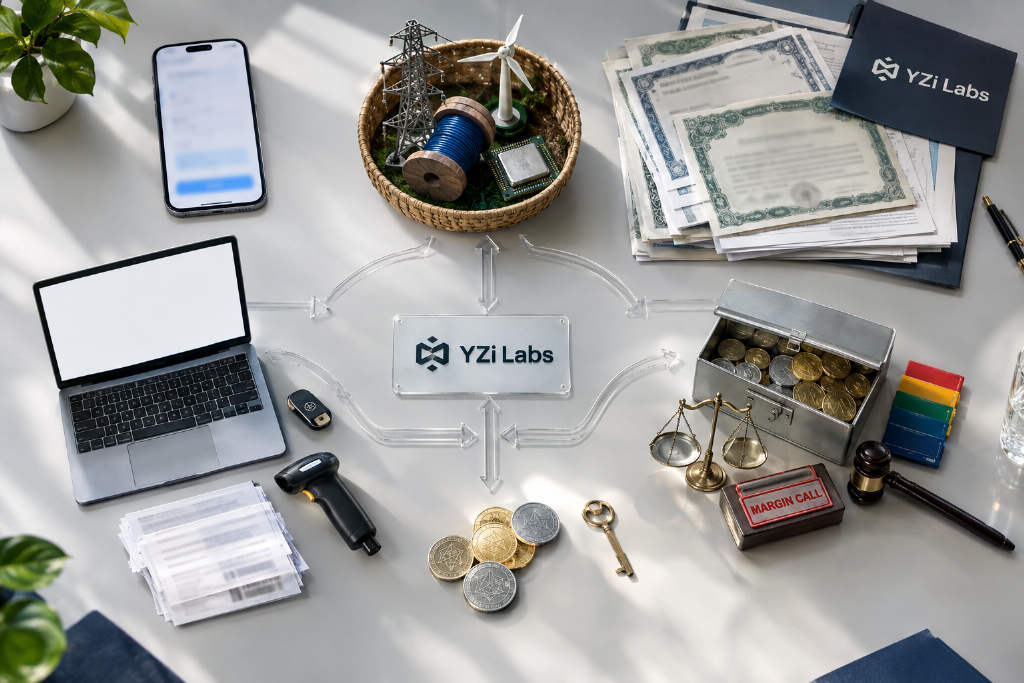
RickyW, an investment team member at YZi Labs, says the key issue in onchain equities is not the stock ticker that appears inside a wallet, but which parts of the stack actually change once stocks are brought onchain and where startups can build a real business.
He opens with a portfolio idea. If he has conviction in a trend, why shouldn’t he be able to turn that view into an investable basket, buy it with crypto, and let others follow it? His example is a view that AI will sharply increase power demand, which could lead him to a mix of power generation, grid, and related equipment manufacturing companies. What he wants is not a chatbot outputting five tickers, but a product that shows what the portfolio owns, lets him buy it, and keeps it usable and adjustable as his view changes.
That leads to a harder question: couldn’t something similar be built on top of a regular brokerage account? What, exactly, gets better once it moves onchain? Before getting excited about tokenized stock products, RickyW says he wants to understand the plumbing first: who holds the shares, what the token represents, how redemptions work, and where founders can insert themselves into the value chain.
What a buyer is actually getting
Buying stocks already feels digital. A user opens an app, taps a button, and a number changes. Blockchain is not what made equities digital in the first place. Behind that button, brokers process orders, trading venues match buyers and sellers, clearing and settlement systems calculate what cash and securities are owed and complete delivery, while custodians and recordkeepers safeguard the securities and maintain ownership records. In some setups, one institution handles more than one of those jobs.
In a common brokerage arrangement, the investor is the beneficial owner while an intermediary or nominee appears as the holder of record. In other words, there is already a full set of records and legal relationships between the investor and the listed company. RickyW notes that Investor.gov offers a simple explanation of that distinction.
He then groups “onchain stocks” into several different things:
- tokens linked to actual share ownership or legally recognized indirect securities interests;
- products issued by a third party and backed by stocks held somewhere else;
- derivatives that track a stock price but do not grant ownership of the stock.
The second category is where confusion builds most easily. A product can be fully backed by shares and still be nothing more than a certificate issued by another company rather than equity in the company named on the token.
He uses xStocks as an example. xStocks describes its products as fully collateralized tracker certificates rather than direct equity, and it explicitly says holders do not receive shareholder voting rights. RickyW also points to a U.S. Securities and Exchange Commission staff overview that explains why different tokenization structures can leave investors with different rights.
So he splits the due diligence into two simple questions: what asset backs the token, and what rights can the holder actually claim? A token carrying Apple’s name answers neither question. The same goes for issuer failure. If the issuer goes bankrupt, the outcome for the holder depends on the legal structure, not the label on the token.
How one share becomes a token
To explain the mechanics, RickyW lays out a simplified stock-backed product. Assume one Apple share is worth $100. He makes clear that figure is only for illustration and not a live market price.
In the example, an issuer arranges for real shares to be placed in a designated brokerage or custody account. The issuer sets up the product, a broker helps buy and sell the shares, and a custodian safekeeps the assets. Apple itself does not have to be the token issuer.
The issuer then creates, or mints, tokens according to the product terms. Assume one token initially maps to one share. That does not mean another Apple share has been created. It means a token has been created to represent rights tied to an existing asset. Over time, the exchange ratio can change because of dividends, stock splits, or the way the product is designed.
Some systems let authorized institutions convert between shares and tokens. Others allow eligible customers to subscribe to and redeem tokens directly once they have completed onboarding and review checks. RickyW cites Alpaca’s authorized participant guide as one concrete example.
After that comes distribution. Exchanges or investing apps offer the product to eligible users. Market makers quote two-sided prices and use their own inventory and capital to take risk. The exchange is the venue; the market maker is one participant inside it.
Users may hold the token through a platform, or in their own wallet if the product supports self-custody. But self-custody of the token does not remove the underlying custodian. A blockchain can show token balances. By itself, it cannot prove that the corresponding shares are actually sitting in a securities account.
The exit routes are also different from each other:
- Sell: another buyer takes over the token you already hold.
- Redeem: the issuer follows its redemption process, the token leaves circulation, and you receive the asset specified in the product terms, which could be cash, a stablecoin, or securities.
Buying a token does not automatically mean the holder is eligible for direct redemption. Minimum size, fees, timing, and eligibility all matter. RickyW also stresses that if one token changes hands ten times, that does not mean the market has bought ten shares of stock. Trading volume and the size of the backing asset pool are separate numbers.
Why token prices stay near stock prices
He gives a straightforward arbitrage example. If the stock trades at $100 while the token trades at $105, an eligible institution may be able to buy the stock, create tokens, and sell those tokens. If the spread covers costs and risk, the trade makes sense. More token supply can push the token price back down. If the token trades too low, buying and redeeming can work in the opposite direction.
That is the arbitrage mechanism. The real question is whether those trades can actually be executed, not whether a screen shows a live quote.
He then shifts to a Sunday scenario. The token is still trading, but the underlying equity market is closed. How easily can market makers hedge? Is anyone available to process redemptions? At what price? For that reason, he says he would not treat “24/7 trading” as equivalent to being able to transact at a reasonable price whenever he wants. Spreads can widen, and token prices can move away from stock prices. He adds that xStocks’ explanation of primary and secondary markets is worth reading on this point.
Who does what in the stack
RickyW’s simplest map of the sector is this:
- stocks;
- brokerage and custody;
- legal structuring and token issuance;
- trading and distribution;
- portfolios, lending, and other applications.
Upstream players control the assets and the rights attached to them. The middle of the stack turns those rights into products people can access and trade. The downstream layer builds applications people actually want to use.
Several supporting functions keep the whole system running:
- blockchains and smart contracts record balances and execute preset rules;
- stablecoins and payment rails move funds, while adding issuer and redemption risk of their own;
- wallets and security systems manage keys, approvals, and permissions;
- market data feeds and oracles bring prices and outside information into applications, though a price oracle is not proof of reserves;
- compliance systems determine who may buy, hold, transfer, and redeem under the relevant rules;
- lifecycle services handle dividends, splits, mergers, and similar events;
- reconciliation checks whether token balances, custody records, and customer accounts match.
He makes one point plainly: finality onchain does not mean every securities and banking leg underneath has settled at the same moment. Institutions, operational workflows, and legal obligations still sit below the token layer.
Each participant also needs a business model. Brokers and custodians charge service fees. Issuers may charge product fees or subscription and redemption fees. Exchanges collect trading fees. Market makers earn spreads while managing risk. Infrastructure providers sell software. Applications need revenue from users or distribution channels.
From an investor’s perspective, the question is who is solving a problem and getting paid for it. Large transaction flow through a network does not automatically mean that network captures large revenue. A company can be well run without token holders sharing in its profits.
Why put equities onchain at all
RickyW says traditional brokerages already offer fractional shares, portfolios, and securities-backed lending. None of that came from crypto. What interests him is what happens when people can invest in stocks, hold stablecoins, trade, borrow, lend, and build financial products on a shared piece of infrastructure.
He highlights five reasons this direction matters.
1. Stablecoin funding makes access easier
Not everyone around the world can easily open a useful brokerage account. For someone who already holds stablecoins, converting into fiat in a bank account and then wiring money into another account adds one more layer of friction. Tokenized equities can offer eligible investors a more direct route from stablecoin holdings into stock exposure.
That makes investment products easier to distribute across different markets, especially among people who already use crypto. RickyW is careful here: it does not remove local regulations or onboarding checks, and specific products can still be geographically restricted. It can, however, simplify funding and distribution.
2. Developers can build without rebuilding the stack
If someone wants to turn the “AI will drive electricity demand” thesis into a portfolio, they need more than a list of companies. They need a way to buy the assets, hold them, rebalance them, and plug in financing when needed. With interoperable tokens and protocols, developers can reuse existing wallets, venues, lending rails, and smart contracts.
That creates room for indices, derivatives, automated portfolios, and products no one has thought of yet. The advantage is lower startup cost for experimentation. A small team can focus on the part of the experience where it actually has an edge.
3. Investors can move positions, not just money
If a better app appears, an investor may prefer to transfer an existing position rather than sell, withdraw cash, and buy again somewhere else. Traditional brokerages already support moving positions without liquidating them. The onchain opening is that positions may become easier to move and use across compatible wallets, apps, and protocols.
Transferable stock tokens could make that possible across compatible wallets and platforms. RickyW notes that xStocks is designed to work across wallets, exchanges, and DeFi protocols. Compatibility still matters. But once investors can leave with their assets, applications need to keep earning the business.
4. A position does not have to sit idle
Eligible stock tokens can be posted as collateral for borrowing or margin. RickyW says this is already happening, pointing to Kamino, which lets users pledge some xStocks products to borrow USDC.
Where products and platforms allow it, holders can also lend tokens for interest paid by borrowers, or provide liquidity to an automated market maker and collect trading fees. He points to Uniswap’s fee mechanism as an example of fees generated by real trading activity.
These are additional choices, not free yield. Borrowing creates liquidation risk. Lending assets or providing liquidity introduces risks beyond simply holding the asset.
5. Trading and settlement can keep running
News does not stop when a securities exchange closes. Token markets with extended hours can keep running at night and on weekends, letting investors react without waiting for the next opening bell.
Settlement brings a separate advantage. A stock token and a stablecoin can be exchanged in one onchain atomic transaction, which means both sides deliver at the same time or neither side does. That reduces the risk that one side has delivered an asset and not received the other side’s asset in return.
He again draws a hard distinction: 24/7 token trading does not guarantee 24/7 access to the underlying stock market, nor does it mean primary issuance and redemption are always open. A market staying open also does not guarantee tight spreads.
Taken together, these are the reasons he likes the direction. More people may be able to access the assets, developers can build products around them, and investors may be able to put their holdings to work in more ways. That shortens the path between “I think the world is moving this way” and owning a portfolio that can be bought, moved, and used. To him, that is much more interesting than dropping a stock ticker into a crypto wallet.
Three startup opportunities
RickyW closes by pointing to three areas that deserve close attention. They map to consumer investment products, operational software for financial institutions, and infrastructure for lending against stock tokens.
1. Turn an investment view into a product people can actually buy
A thesis such as “AI will drive electricity demand” still leaves users with a lot of work: choosing assets, understanding risk, executing trades, and updating the portfolio over time. Startups can package those steps into a single experience and, where rules permit, allow others to invest alongside the strategy.
The opportunity, he argues, is to build the full user experience for a specific audience. An AI-generated list of tickers is easy to copy. Distribution, a credible performance record, and a product users keep allocating money to are much harder. Bringing the product onchain has to improve how the portfolio is held, transferred, or used elsewhere.
2. Help tokenized stock operations scale across service providers
Even when trades fail, redemptions are delayed, or the underlying shares go through dividends or splits, records across issuers, brokers, custodians, and apps have to stay in sync. Startups can sell software that reconciles those records, coordinates information updates, and helps operations teams handle edge cases.
RickyW calls the practical entry point a costly workflow with a clear paying customer. If the product works across multiple providers, it can become more than an internal tool for one issuer. Reliable integrations and experience dealing with messy real-world cases can raise switching costs for customers. But if every customer needs endless customization, it will be difficult to build a scalable software company.
3. Make eligible stock tokens usable as collateral
A stock token becomes useful collateral only if a lender can value it, understand the legal rights behind it, and recover funds by liquidating the collateral when a borrower cannot repay. Market closures, redemption limits, and issuer-by-issuer differences make that much more complex than plugging into a stock price feed.
That opens the door for startups to build collateral assessment, risk management, and liquidation tools for lending platforms without becoming lenders themselves. The value is in helping platforms decide which collateral to accept, how much to lend against it, and how to exit under stress. RickyW says that depends on reliable data and real liquidity. A smart contract alone is not enough.
He frames these as three different businesses: user-facing investment products, institutional operating software, and infrastructure for lending. Each one needs a clear customer and a reason to exist that goes beyond simply putting a token onchain.