

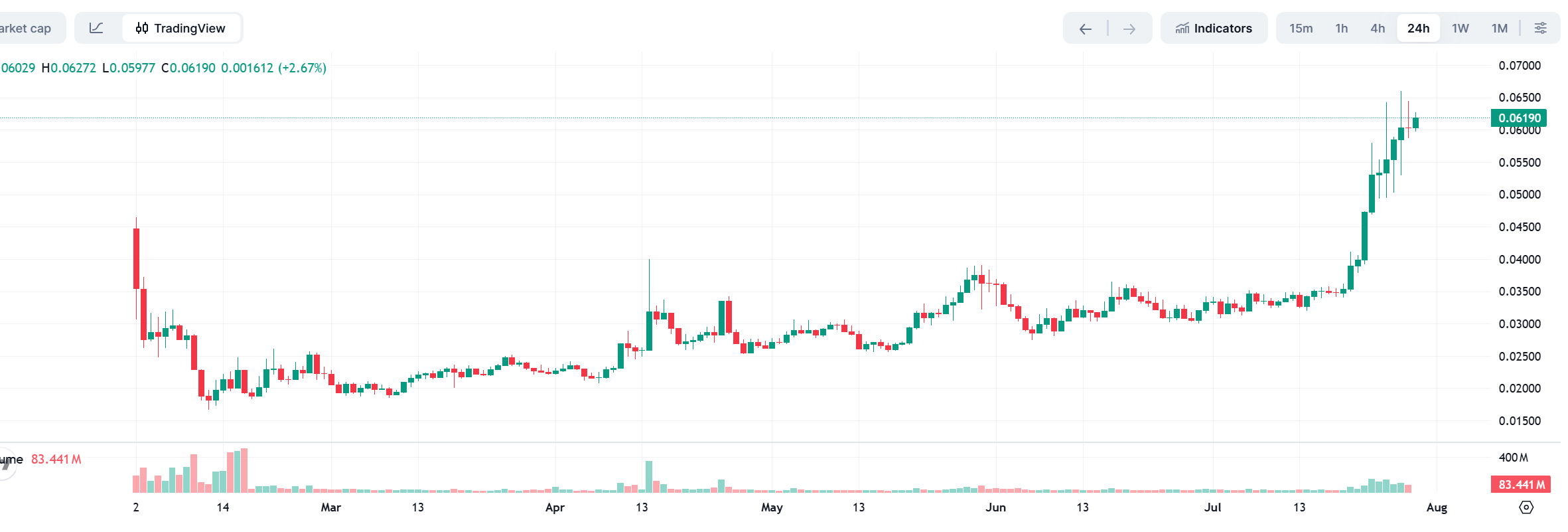
ZAMA rose from $0.035 to above $0.065 in less than two days, setting a new all-time high and gaining nearly 100%. Based on the figures cited in the report, the token’s market capitalization stands at $188 million and its fully diluted valuation has climbed to $700 million. Earlier this year, after its TGE in February, ZAMA had fallen from $0.046 to around $0.017.
Zama is not building a new blockchain. Its product is positioned as a confidentiality layer that can be deployed on public chains such as Ethereum, with fully homomorphic encryption, or FHE, at the center of the design. In practice, that allows smart contracts to compute directly on encrypted data. Transaction amounts, balances and state remain encrypted throughout processing, and only parties explicitly authorized by contract rules can decrypt them. The report argues that this avoids the transparency tradeoff built into public chains: large trades no longer have to expose positions and direction, and trading strategies become harder to front-run.
For institutional capital and professional trading desks, that gap has been persistent. Large trades have typically been handled off-exchange, or participants have accepted the risk of information leakage on-chain. Zama is trying to remove that friction. The protocol supports programmable confidentiality, letting developers define who can see what while preserving composability with existing contracts and assets. Foresight described it as adding an HTTPS-like layer to public blockchains rather than starting over with a separate chain.
Funding, mainnet rollout and early confidential products
Zama completed a $73 million funding round in March 2024, then raised another $57 million in June 2025. The report said the project’s venture backers are high-profile.
The mainnet has already been live for some time. In January this year, the team used its own protocol to run a sealed-bid Dutch auction. In early February, the token began circulating. After that, Zama rolled out confidential stablecoin transfers and a confidential USDC yield vault built with Morpho and Steakhouse. Users can shield assets before depositing them to earn yield while keeping positions encrypted.

In mid-July, Zama partnered with Elliptic to add compliance wallet screening. According to the report, that gives institutions a way to complete necessary risk checks without decrypting all data.
Confidential RFQ becomes the immediate catalyst
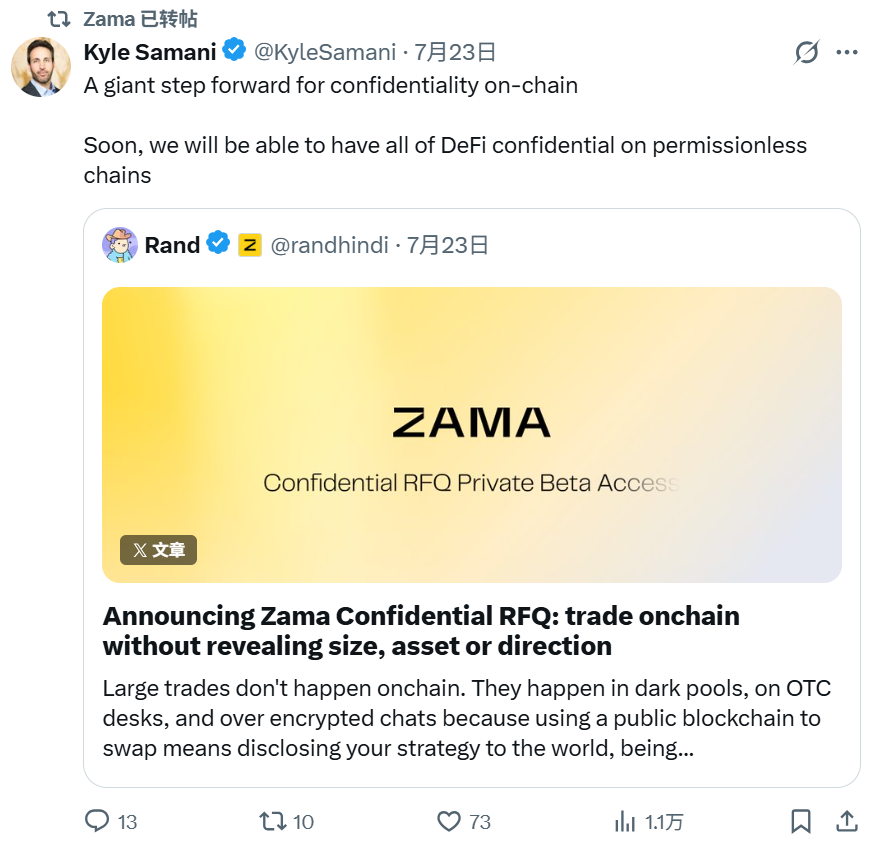
On July 23, Zama announced the test version of Confidential RFQ, a fully on-chain sealed-bid RFQ trading protocol. Trade size and direction stay encrypted throughout the process, professional market makers compete on quotes, and settlement still happens on-chain.
The product currently supports cUSDT/cUSDC, cZAMA/cUSDC and trading pairs tied to confidential yield positions. A public version is planned for September. The report framed the product as a direct response to a core institutional trading problem: market participants want transparent and verifiable on-chain settlement without showing the entire market their positions and trade direction.
Zama co-founder and CEO Rand Hindi said that is also why crypto OTC remains so large. He cited daily settlement by trading desks at about $50 billion to $60 billion, a 109% year-over-year increase in spot OTC volume, and almost no growth in exchange trading volume over the same period.
In its official announcement, Zama said 100% of trading fees from Confidential RFQ will go to buying back and burning ZAMA tokens, with no front-end fees charged.
How the RFQ process works
Traders submit encrypted trade intent to the RFQ smart contract and deposit the confidential assets they want to trade. The intent hides trade size, slippage tolerance and direction.
Whitelisted market makers receive the intent on-chain, decrypt it and submit encrypted quotes. Once the quote window closes, the RFQ smart contract runs an on-chain sealed-bid auction to select the highest encrypted quote and notify the winning market maker. Only at that point is the winner allowed to know the trade direction, after which settlement is completed.
When the auction ends, the winning market maker transfers confidential assets to the RFQ contract through a two-way transfer process, and the contract returns the trader’s originally deposited funds.
Multicoin Capital co-founder and Forward Industries board chair Kyle Samani called it “a major step forward for on-chain privacy.”
Performance, shielded TVL and staking
On July 27, the team published benchmark results showing confidential transfers at about 1,000 TPS on commodity GPUs, roughly a year ahead of its original roadmap. The report said infrastructure cost per transfer had already fallen to a very low level. That performance is not yet fully live on mainnet, with deployment planned around the end of the year.
If performance becomes reliable at that level, the report said, expansion to more chains and higher-frequency financial use cases becomes much more practical.
On fundamentals, the article said the protocol is moving from demonstration to actual use. Total shielded value has reached the hundreds of millions of dollars, current shielded TVL is around $40 million to $50 million, and the confidential vault itself has built up meaningful deposits.
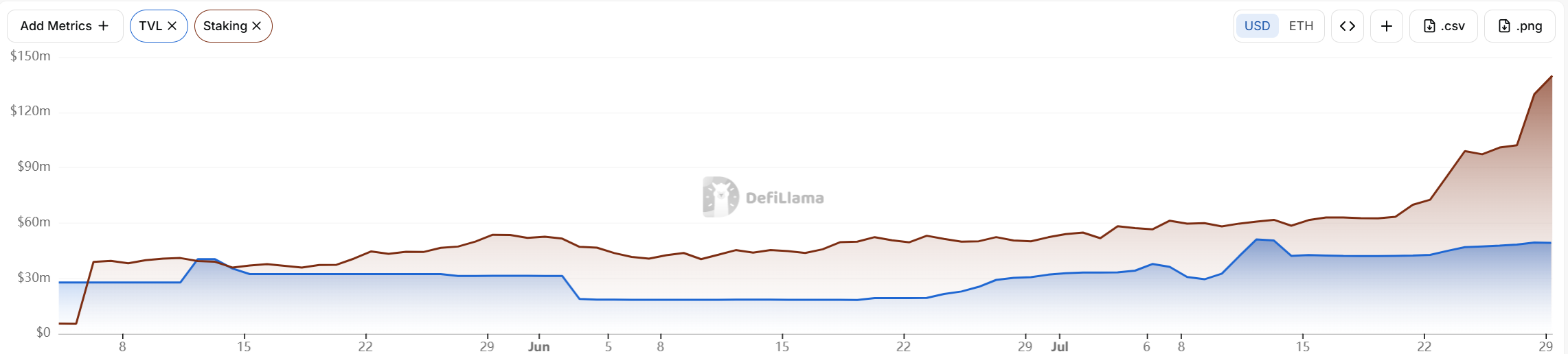
According to DefiLlama data cited in the report, ZAMA staking has risen from $50 million to $130 million. A relatively high share of circulating tokens is staked. The article said that not only removes some liquid supply from the market, but also shows that network security has real economic alignment behind it.
Token utility and unlock schedule
ZAMA is mainly used to pay protocol fees, including encrypted verification and decryption, and those fees are fully burned. Operators receive issuance rewards through staking, with initial annual inflation at about 5%, adjustable through governance.
Total token supply is about 11 billion. The report said public sale allocations, TGE activity and liquidity portions were mostly released at launch. Team, VC and angel allocations are subject to longer lockups, while treasury and growth fund allocations unlock linearly.
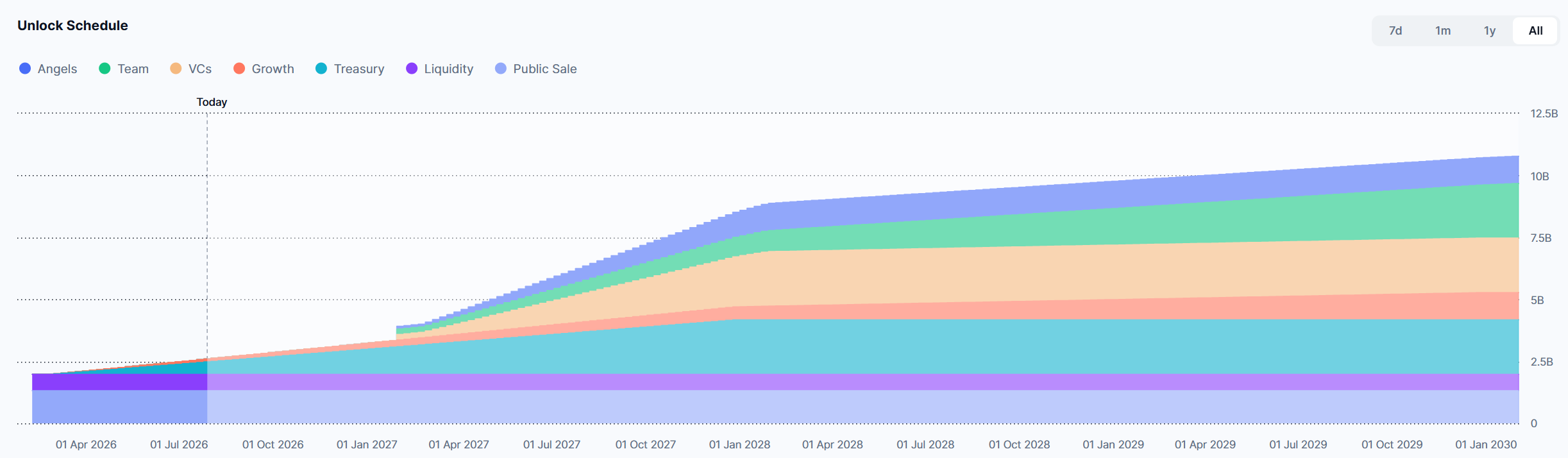
There are smaller periodic unlocks in the near term, but larger allocations remain locked until Feb. 2, 2027, when VC and team shares are due to unlock.
What the market is repricing
Foresight concluded that the move reflects a repricing of an FHE protocol that already has a running mainnet, live trading and staking use cases, and a performance narrative that has started to show evidence.
Samani has also said that confidentiality remains the biggest unresolved open problem in crypto, and that Zama is a leading candidate to answer it.
The next key milestone, according to the report, will be what happens after the full launch of Confidential RFQ in September.