
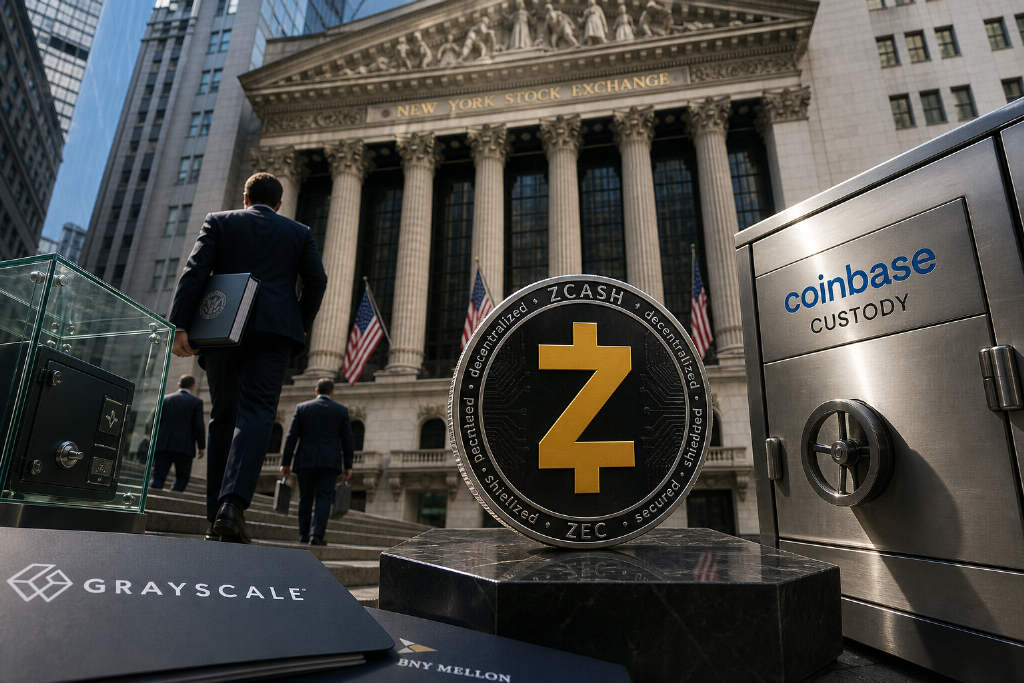
On Aug. 21, Grayscale filed its fifth amended S-3 with the U.S. Securities and Exchange Commission for a spot Zcash exchange-traded fund. The filing set out a 2.5% annual fee, the ticker ZCSH, a planned NYSE Arca listing, Coinbase Custody as custodian, and BNY Mellon as transfer agent. Trading was expected to begin around Aug. 25, subject to SEC approval.
That same day, ZEC climbed to its highest level in eight years, with gains approaching 40% over the week. The simple headline was that the world’s first spot ETF tied to a privacy coin was close. The longer version starts much earlier.
Zcash’s ETF moment did not begin in August
The article argues that the current episode should not be framed as the first time Wall Street accepted a privacy coin. DOT spot ETFs had already started trading in March 2026, and spot products tied to LTC had appeared in the U.S. even earlier. What made ZEC different, in this telling, was not first-mover status. It was that Zcash crossed a hurdle other public blockchains had not: a three-year securities-law overhang tied to its historical structure.
That is the center of gravity in the story. Zcash was not propelled into an ETF wrapper because regulators suddenly endorsed privacy technology. It moved in that direction because its legal history, governance changes, capital relationships, and market infrastructure made it possible to refit the asset into a regulated product.
From the start, Zcash looked more institutional than most privacy coins
The piece says many observers assume ZEC made it to an ETF track because privacy technology finally won recognition. It rejects that view.
Zcash began with a cryptography paper on zk-SNARKs, the zero-knowledge system that can hide transaction details while still proving validity. After the paper came a company, Electric Coin Company. After the company came venture financing. The article names Digital Currency Group, Barry Silbert, Pantera, Naval Ravikant, Fenbushi, Fred Ehrsam, and Roger Ver among the early backers. In 2016, 17 investors put in $2 million.
Once the blockchain launched, the first four years included a Founder’s Reward that directed 20% of each block reward to founders, employees, advisers, and early shareholders. Over four years, that amounted to 2.1 million ZEC, or 10% of the eventual supply.
That history cut both ways. Bitcoin did not have a corporation, equity investors, or an internal distribution record of that type. Zcash did. The article says a securities lawyer applying the Howey test could easily ask whether that structure looked like an unregistered investment contract. SEC scrutiny later moved in that direction.
At the same time, the same features made Zcash easier to institutionalize than a community-driven project such as Monero. It had a corporate entity, a foundation, a development team, and venture investors from the first day. In the article’s framing, that made it more packageable, not less.
The institutions pushing the asset forward
Grayscale had been packaging ZEC since 2017
The first institution in the chain is Grayscale. The article notes that Grayscale created a Zcash Trust in 2017, years before the ETF push. Grayscale’s parent is Digital Currency Group, and Barry Silbert had already invested in Zcash’s 2016 seed round.
So the relationship was not new in 2026. The wrapper changed from a closed-end trust to an ETF. The underlying asset did not.
Coinbase sat across custody, brokerage, derivatives, and venture
The second institution is Coinbase. According to the article, Coinbase occupied four separate roles in the ZEC stack:
- custodian for the ETF,
- prime broker,
- operator of ZEC perpetuals through Coinbase Derivatives, which cleared CFTC filing in January 2026 and is already trading,
- investor through Coinbase Ventures in ZODL.
The point made in the piece is straightforward: this was not a single directional bet on ZEC. It was exposure to fees and activity at several layers of the asset’s financialization.
ZODL emerged after the ECC team split away
The third institution is ZODL. It appeared in January 2026 after the engineering team at Electric Coin Company left and formed Zcash Open Development Lab. The former Zashi wallet was renamed Zodl. The new effort was led by former ECC chief executive Josh Swihart.
The official reason for the split was to get out from under the Development Fund structure. The article translates that into a simpler business conflict: a nonprofit framework was not attracting venture capital, was not hiring fast enough, and was not suited to shipping products at startup speed. If the team wanted to operate like a venture-backed company, it had to leave the foundation-centered system.
On Jan. 7, 2026, ECC’s entire engineering and product team resigned. Swihart accused Bootstrap’s board, the nonprofit that oversaw ECC, of “malicious governance” on social media and said the team was “forced to resign.” The flashpoint was the wallet. ECC wanted to spin Zashi out of the nonprofit structure into a standalone commercial company that could raise capital and expand. Bootstrap’s board opposed that move, saying a 501(c)(3) transferring assets into private hands created major legal risk and could expose the organization to donor lawsuits.
ZEC fell by more than 10% on the news and briefly dropped below $400.
The financing came quickly anyway. In March, ZODL announced a seed round of more than $25 million. The investor list in the article includes Paradigm, a16z crypto, Winklevoss Capital, Coinbase Ventures, Cypherpunk Technologies, Maelstrom, Balaji Srinivasan, David Friedberg, and Haseeb Qureshi.
The article treats that shift as part of a broader redesign: a development team that once lived inside a nonprofit structure was turned into a startup backed by large crypto and venture names.
A connected network, not isolated actors
The article does not describe Grayscale, Coinbase, and ZODL as separate efforts. It presents them as nodes in the same network.
- Coinbase is custodian for Grayscale’s product.
- Coinbase invested in ZODL.
- Winklevoss is among ZODL’s investors.
- Through Cypherpunk, Winklevoss-linked capital controls about 18% of Zcash network hash rate.
- DCG is both Grayscale’s parent and an early Zcash investor.
In the article’s reading, each node in that web benefits from stronger prices, deeper liquidity, and greater institutional participation in ZEC.
The main regulatory problem was structural
The piece says ZEC’s biggest regulatory risk was never simply that it was a privacy coin. The issue was its history.
Founder’s Reward. The Development Fund. ECC as a commercial company. The foundation receiving protocol-level rewards. Early equity investors. Put together, the article says, those features offered raw material for an investment-contract theory.
In 2020, the community approved ZIP 1014, which created a Development Fund that continued the 20% block reward carve-out. Roughly 7% went to ECC, 5% to the Zcash Foundation, and 8% to a community grants pool called Major Grants. The article stresses that the foundation did not receive the full 20%, but argues the key point was the mechanism itself. ECC and the foundation kept getting protocol money regardless of performance, and both also shared dual-signature control over the trademark. From the SEC’s perspective, the article says, that could look like evidence of an ongoing investment contract.
How the SEC overhang was reduced
On Aug. 31, 2023, the SEC issued a subpoena to the Zcash Foundation in a matter titled “In the Matter of Certain Crypto Asset Offerings,” case number SF-04569. The investigation ran for more than two years.
The old structure started to come apart in 2024. ECC first announced that it would stop accepting direct grants. By the end of the year, the NU6 upgrade changed distribution to 80% for miners, 8% for the community grants pool, and 12% for a protocol lockbox. That 12% could not be accessed automatically. It would require a vote by ZEC holders, and the arrangement expires at the third halving in 2028, when another vote would be needed. ECC and the foundation stopped receiving automatic block rewards. In the same year, both organizations also gave up dual-signature control over the trademark.
The article describes the solution in plain terms: move the question of who gets paid from two institutions to a voting mechanism.
On Jan. 14, 2026, the Zcash Foundation said the SEC had completed its review and would not recommend enforcement action or other measures. The article is careful on this point. It says the SEC did not affirmatively declare that Zcash was problem-free. But the practical result was the removal of a major tail risk.
Its explanation for the timing is political and institutional rather than factual exoneration. When the subpoena went out in 2023, Gary Gensler was still chair and the SEC was pursuing regulation through enforcement. After the 2025 change in administration, the SEC created a Crypto Task Force and enforcement pressure eased. Under new chair Paul Atkins, cases involving Coinbase and Kraken were dropped, and investigations involving Robinhood, Uniswap Labs, OpenSea, and Gemini were closed. Ondo Finance’s matter also faded. In that account, the Zcash Foundation was one case in a broader line of releases.
The article also lingers on chronology. The SEC’s no-action outcome came on Jan. 14. One week earlier, on Jan. 7, the core ECC team had resigned. Regulatory relief and governance breakdown arrived almost back to back.
The same law firm appeared on both sides of the timeline
One detail gets its own emphasis. In the Zcash Foundation’s 2023 Form 990, legal expenses show payments of more than $317,000 to Davis Polk & Wardwell LLP, the firm that helped with the SEC matter.
Davis Polk also appears in the current Grayscale ZEC ETF legal paperwork. Richards, Layton & Finger is listed on Delaware law matters.
The article does not suggest misconduct. Large firms often represent multiple clients. Still, it highlights the overlap because of Davis Polk’s standing in crypto ETF work. It cites Joseph A. Hall as helping shepherd the first bitcoin ETF over the line, and Zachary Zweihorn as counsel in Grayscale Bitcoin Trust’s successful appeal overturning the SEC’s denial of GBTC’s listing, a case involving $12.4 billion in assets.
The point is that these were not wholly separate legal episodes in market terms. On the timeline set out in the article, one set of lawyers first helped a client through SEC scrutiny and then helped another client package the asset into an ETF.
Why DCG and Grayscale had strong incentives
The article argues that DCG’s own balance-sheet and litigation pressures help explain the urgency behind the ZEC ETF push.
In November 2022, Genesis, DCG’s crypto lending unit, froze withdrawals. In January 2023, Genesis filed for bankruptcy protection with $3.5 billion in liabilities. The article says the immediate trigger was an unrecoverable $1.1 billion loan to Three Arrows Capital, but it goes on to describe a deeper problem: DCG’s use of Genesis as a funding source.
According to litigation documents cited in the piece, DCG borrowed $575 million from Genesis for investments and spent more than $770 million buying GBTC shares in the secondary market in an effort to narrow the trust’s discount to net asset value. When Genesis was insolvent, DCG covered the hole with a 10-year low-interest promissory note for $1.1 billion and publicly maintained that conditions were normal.
In January 2025, DCG paid $38.5 million to settle with the SEC. In the same month, it reached a $2 billion settlement with the New York attorney general. In May 2025, Genesis’ litigation oversight committee sued DCG and Barry Silbert in both Delaware Chancery Court and bankruptcy court, alleging fraud, breach of fiduciary duty, and unjust enrichment while seeking $3.3 billion. The complaint said Silbert and others treated the insolvent Genesis as DCG’s treasury. In July 2026, a federal court allowed a securities fraud class action against Silbert and DCG to continue.
That same month, Barry Silbert returned as Grayscale chairman. The article says Grayscale was preparing for an IPO at a $33 billion valuation, while Genesis-related litigation threatened to complicate that effort.
Against that backdrop, the article says DCG needed new assets under management, new fee income, and a fresh growth story for Wall Street. ZEC fit the bill in a way that BTC and ETH ETFs did not. Those markets had already become crowded and fee levels had fallen below 0.2%. The proposed ZEC ETF carried a 2.5% annual fee and had little direct competition.
The piece adds another layer. Grayscale was discussing injecting roughly 200,000 ZEC held by DCG International Investments into the ETF. At then-current prices, that was worth about $110 million. If completed, the contribution could account for more than a third of the expanded fund. In the article’s framing, DCG had reason to support ZEC from several angles at once.
Hash rate, treasury, and the miner calculus
Cypherpunk launched a large Zcash mining position
On Aug. 18, 2026, Nasdaq-listed Cypherpunk Technologies said it had launched the world’s largest Zcash mine.
The article puts the operation at 4.2 GSol/s of Equihash capacity, or about 18% of the network. The rigs are Bitmain Z15 Pro machines deployed entirely in the United States. Funding came from a $33.33 million equity investment by Winklevoss Capital through pre-funded warrants, with ownership capped at 19.99%.
Cypherpunk was not only mining. The article says it was also the largest corporate holder of ZEC, with about 323,000 coins, more than 1.9% of circulating supply, and a stated target of reaching 5% of circulating supply.
For a proof-of-work network, the article argues, a single entity with close to one-fifth of total hash rate is already a major power center. Add a large treasury on top and both operating influence and market influence begin to concentrate in the same place.
It also notes that Cypherpunk came public through the shell of biotech company Leap Therapeutics, and identifies Gemini founders Cameron and Tyler Winklevoss as the ultimate controllers.
Why miners moved toward ZEC
Kevin Zhang, who leads Cypherpunk’s mining business, offered a simple comparison in the article:
- Zcash mining earns $450 per megawatt-hour,
- AI data-center power hosting earns $223 per megawatt-hour,
- bitcoin mining earns $133 per megawatt-hour.
On equipment spending, the article says Zcash mining infrastructure costs about $2.4 million per megawatt-hour, while AI infrastructure requires $10 million to $12 million.
The conclusion drawn is that miners were reacting to economics, not ideology. With post-halving bitcoin margins under pressure and AI infrastructure demanding far larger upfront capital, ZEC offered a more attractive return profile.
Fortitude expanded while posting losses
Before Cypherpunk’s announcement, DCG-affiliated Fortitude Mining Holdings had already been building out. Fortitude focuses on ZEC mining and was spun out from Foundry in early 2025.
In June 2026, Fortitude published a financing deck claiming it had “no debt,” and Barry Silbert posted “Zcash good times” on social media the same day. But because Fortitude planned to merge with public shell company HeartSciences and list on Nasdaq, fuller SEC disclosures followed. Those disclosures showed that on June 1, three weeks before the presentation, the company had signed a $26 million credit facility and had already drawn more than $8.3 million.
The article adds that Fortitude had posted annual losses since 2024, recorded a $4.6 million net loss in the first quarter of 2026, and reported adjusted EBITDA that excluded $32 million in depreciation.
Even so, the company was expanding aggressively. The article says Fortitude bought a 12.5-megawatt data center in Nebraska for $4.7 million, lifting owned power capacity above 60 megawatts, and signed a $31.5 million order with Bitmain for 9,000 Antminer Z15 Pro machines. That fleet would represent more than 28% of the network’s hash rate, with a target mining cost of about $40 per ZEC.
The article’s point is not that this is internally inconsistent. It is that the whole model depends on firm ZEC prices.
Four policy gates had to open
The article says the SEC’s closure of the foundation probe was not enough by itself. Several other policy and market changes had to line up.
1. A looser setting for digital commodity classification
In March 2026, the SEC and the Commodity Futures Trading Commission issued interpretive guidance placing BTC, BCH, LTC, DOT, AVAX, and SOL into a digital commodity bucket. ZEC was not in the initial list, but the broader climate shifted.
2. NYSE Arca’s generic listing standards
In September 2025, the SEC approved NYSE Arca’s generic listing standards. Qualifying commodity-based crypto ETPs no longer needed case-by-case approval, which reduced both time and friction.
3. Grayscale was converting a long-running trust
The Zcash Trust dates back to 2017. It was not a new product built from scratch. It already had SEC filing history and an existing custody and market-making framework.
4. Congress was moving toward clearer asset classification
The CLARITY Act had not completed the legislative process, but the article says its direction was clear enough: establish what an asset is before dealing with the rest.
The ten-year line
The article arranges the story as a continuous sequence rather than a collection of headlines.
- 2016: Zcash launches. ECC operates it. Venture funding comes in. Founder’s Reward begins. DCG and Barry Silbert are early investors.
- 2017: Grayscale creates the Zcash Trust and wraps ZEC in a financial product.
- 2020: ZIP 1014 passes and the 20% Development Fund is created, continuing protocol payouts to ECC and the foundation.
- Aug. 2023: The SEC subpoenas the Zcash Foundation, case SF-04569.
- 2024: NU6 changes distribution to 80% for miners, 8% for community grants, and 12% for a protocol lockbox. ECC and the foundation stop receiving direct block rewards.
- Sept. 2025: The SEC approves NYSE Arca’s generic listing standards.
- Jan. 2026: The SEC ends its Zcash Foundation investigation without recommending action. In the same month, the ECC team leaves and forms ZODL.
- Jan. to March 2026: Coinbase Derivatives lists ZEC perpetuals, ZODL raises more than $25 million, and the SEC and CFTC publish joint digital commodity guidance.
- May 12, 2026: Grayscale files its first S-3 to convert the Zcash Trust into a spot ETF.
- Aug. 18, 2026: Cypherpunk launches the world’s largest Zcash mining operation, with about 18% of network hash rate, backed by Winklevoss capital.
- Aug. 19, 2026: ETF documents disclose non-binding talks about injecting around 200,000 ZEC, worth about $110 million, from a DCG subsidiary into the fund. If completed, DCG-related entities could hold about 34% of the fund.
- Aug. 21, 2026: Grayscale files its fifth S-3 amendment with a 2.5% fee, the ticker ZCSH, and an expected Aug. 25 launch pending SEC approval.
That sequence is the article’s main argument. De-risking. Governance redesign. Capital formation. Market infrastructure. Productization. Each stage prepared the next one.
The final irony: privacy became a regulated exposure
The article closes where Zcash originally began, with privacy.
Zcash was designed around zero-knowledge proofs, shielded addresses, and untraceable transactions. Yet the ETF’s ZEC holdings, as described in the piece, would sit in transparent Coinbase addresses rather than shielded addresses. They would be auditable, traceable, and supervisable.
In that sense, institutions are not buying privacy as an active transactional feature. They are buying price exposure and a compliant market label tied to the privacy category. Wall Street, the article says, does not need anonymous ZEC. It needs packageable ZEC.
The ETF would not use the shielded pool or the privacy function. Investors would own an auditable fund tied to the market value of an asset associated with privacy, not privacy itself.
That is the article’s central irony. Zcash could be selected precisely because it was never a wild, structureless privacy coin. It had a company, equity backers, a foundation, developers, a long-running trust, regulated custody, and listed derivatives. Technically, it was one of the most privacy-focused assets in crypto. Organizationally, it was one of the easiest to institutionalize.
The final claim is restrained on one point. The article says there is not enough public evidence to assert that the SEC’s closure of the investigation and the ETF filing were coordinated in advance. What can be said, it argues, is that nearly every important step along the way carried a clear economic logic for someone involved.
In that account, Wall Street did not bring privacy into finance. It turned privacy itself into an asset that could be priced, custodied, and traded.