
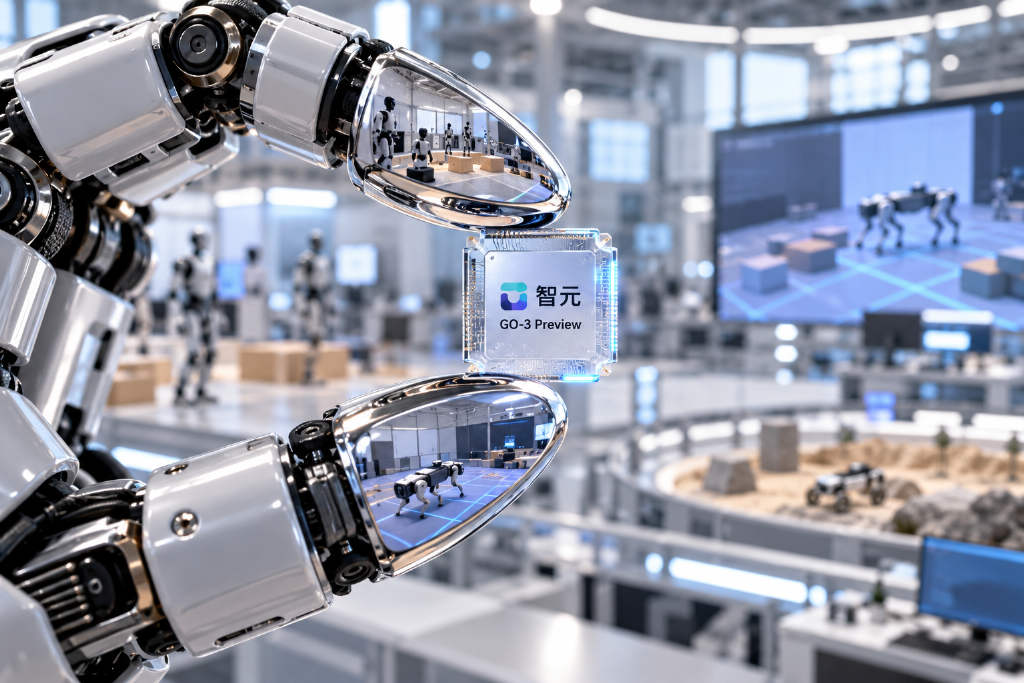
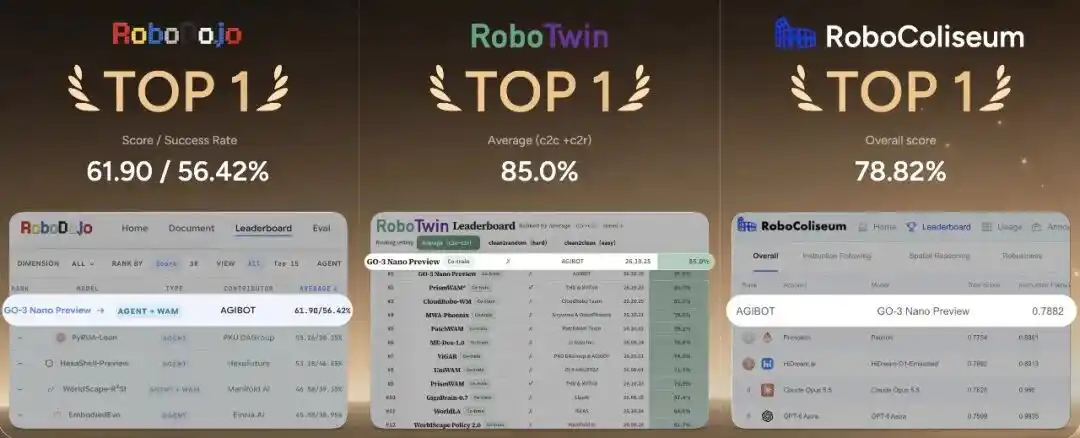
On Oct. 29, Zhiyuan rolled out GO-3 Preview, an embodied model built to support scalable learning across pre-training, post-training, and deployment. The company said it took first place in three benchmark evaluations: RoboDojo, RoboTwin, and RoboColiseum.
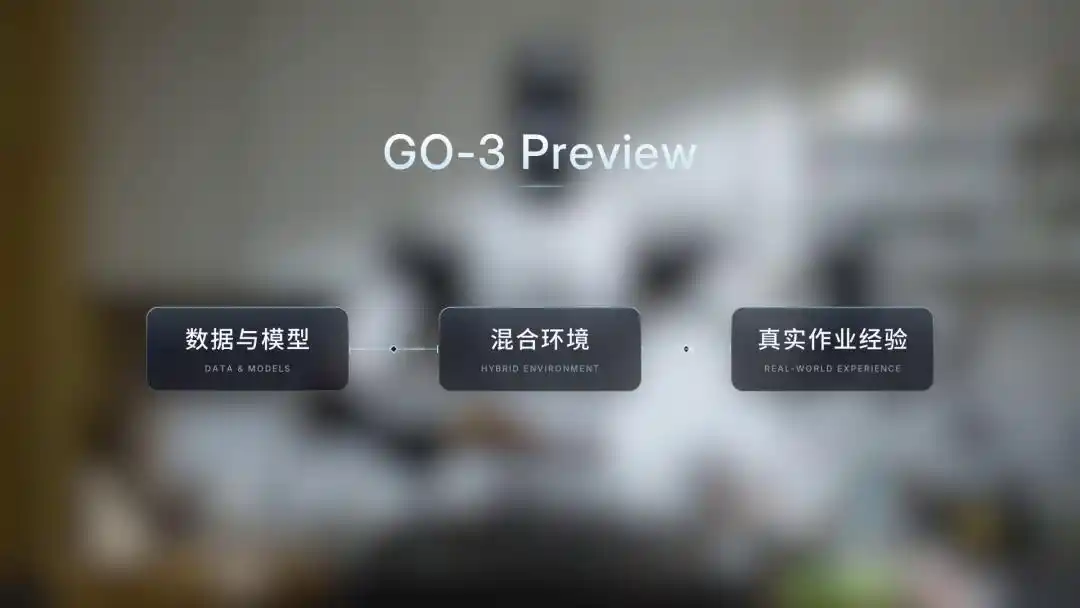
This release pushes forward the line Zhiyuan has been sketching for a while: from the ViLLA architecture in GO-1, to the "chain of action thought" in GO-2, and now to full-lifecycle scalable learning in GO-3 Preview. The basic point is simple. Robots should not stop learning when training is over. They should keep getting better after they start doing real jobs.
Pre-training starts with human first-person video
Zhiyuan said roughly 90% of GO-3 Preview’s pre-training data comes from human first-person data, which it says spans more scenes and skills than robot demonstrations by themselves.
But watching humans does not hand a robot a ready-made action plan. Human posture, joint motion, and hand trajectories do not map cleanly onto robot joints and end-effector control. So the model still has to turn what it sees into motions that fit the robot’s own body.
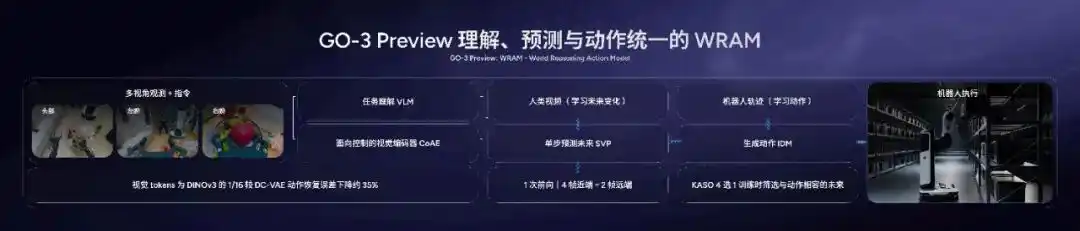
That is where GO-3 Preview uses WRAM, short for World Reasoning Action Model. The architecture ties together task understanding, future-state prediction, and action generation, so the robot can predict how a physical state might change and learn the actions needed to make that change happen.
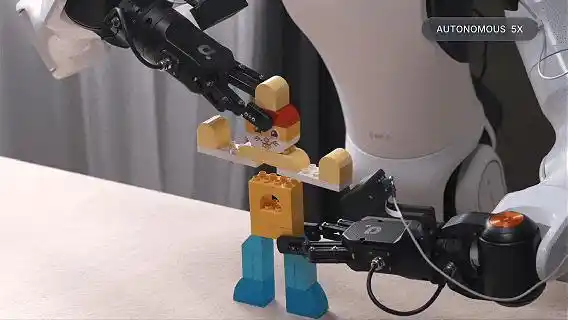
Zhiyuan used Lego assembly to make the point. A robot needs to identify the spatial relationship between a part and a slot, figure out the target position and pose, and then control the arm through grasping, alignment, and insertion while dealing with changing contact conditions.
WRAM splits that flow into modules that work together. First comes CoAE, a control-oriented visual representation module that pulls out operational details such as object position, shape, and relationships from camera input, while trying to balance visual richness with real-time inference efficiency.
Once the current scene has been represented, SVP, the single-step visual planner, predicts visual states at multiple future moments from the current observation and task condition in one forward pass. Then an inverse dynamics model mixes those predictions with the robot’s own state and converts them into executable actions.
In this setup, human video and robot trajectories do different jobs. Human video shows the model how physical states change. Robot trajectories supply the training signal that connects those state changes to control actions.
Future prediction brings another headache. The same task can often be finished in more than one valid way. A robot placing a cup at a target location might come in from the left or from the right. Either route can work.
Zhiyuan said GO-3 Preview handles that with KASO, short for Knowledge-Aligned Selective Optimization. The method produces multiple candidate futures, checks how well each prediction matches real actions, and keeps the better candidates for joint training so future-state prediction stays aligned with action learning.
The company said that, under the tested conditions, scaling up training data improved performance on new scenes and new objects, and also delivered gains across different robot embodiments.
Zhiyuan splits GO-3’s post-pretraining task capability into two settings: zero-shot and few-shot. Zero-shot measures transfer without task-specific real-robot supervised fine-tuning. Few-shot uses a small number of demonstrations to raise precision and coordination in more complicated operations.
According to Zhiyuan, GO-3 Preview already supports hundreds of tasks out of the box. In a Lego assembly demo, the model completed fine-grained actions including grasping, alignment, and insertion after a small amount of demonstration-based fine-tuning, and then carried out continuous assembly under agent orchestration.
The company also showed cross-embodiment operation. On the bipedal humanoid robot X2, the model performed actions such as opening a door while holding an object with both hands and kneeling to pick up an item.
Post-training mixes real robots, simulation and world models
Zhiyuan’s view is that pre-training widens a robot’s skill range, but harder physical tasks need repeated practice through interaction, not just video observation.
Take tabletop curling. The job is to control force and angle so the robot knocks an opponent’s stone out of the scoring area while keeping its own stone inside. In the real task, friction, collision, and trajectory all matter, and a tiny force error can change the final position.
Based on Zhiyuan’s experimental case, GO-3 Preview trained in real environments and in a world model for only a few hours and then posted a win rate above ordinary human players in tabletop curling.
That result points to a bigger post-training target in embodied AI: getting better execution on complex actions through interaction, feedback, and policy updates.
The problem is cost. Every physical interaction burns real resources, including hardware runtime, environment reset, and data collection. Repeated trials also mean wear and safety costs. So if you want robot skill learning to scale, you need both more interaction experience and better data efficiency.
Zhiyuan said GO-3 Preview uses Genie Evolver at this stage, a distributed hybrid-environment post-training system that combines real robots, physics simulation, and world models.
Real robots provide physical feedback
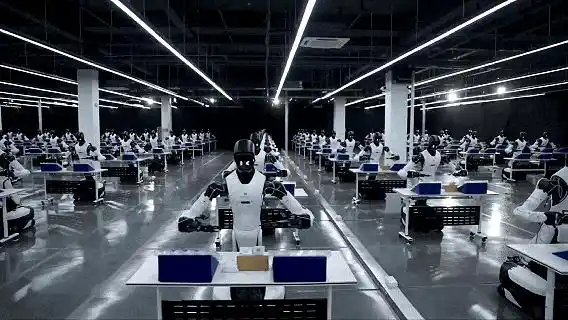
On the real-robot side, Genie Evolver depends on a cluster at the scale of hundreds of robots and uses CEL, or Collective Experience Learning, to pool execution experience.
Zhiyuan offered a simple example. When different robots try to grasp an object, some succeed and some drop it. The system pulls successful action segments, analyzes the context around failures, and updates a shared policy so one robot’s experience can help the whole group.
The company said that scaling the number of real robots improved results in a phone-packaging task under the same training time. Success rates climbed from 50.8% to 98.3%. In a multi-stage long-horizon phone-packaging test, failures across 120 runs dropped from 25 to 2, a 92% reduction.
Simulation expands repeatable practice
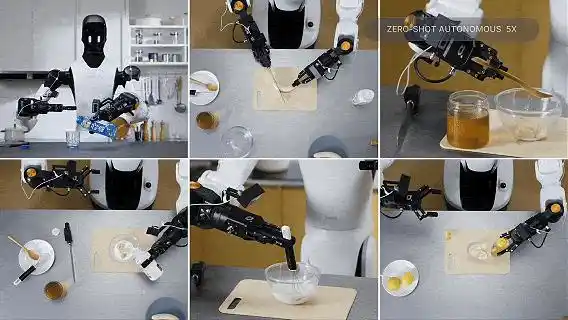
The second environment is physics simulation. There, the system can vary object position, friction coefficients, and collision conditions so the robot can try different strategies.
For tabletop curling, simulation covers more initial states and release conditions, which makes it easier to compare the outcomes of different policies.
World models widen the search over candidate actions
The third environment is the world model. In the curling example, if one throw misses the target, the world model can jump back to an earlier decision point and predict what would happen under different force and angle choices. So one real experience can become the launch point for exploring multiple candidate actions.
The system uses feedback generated by the world model to optimize policy and then sends the updated policy back into the real environment for validation, improving the efficiency of real interaction data. Zhiyuan added that real-robot verification is still needed because world models can still misread physical processes such as friction and collision.
Zhiyuan also described a block-removal experiment. GO-3 Preview had to pull out stacked red blocks one by one, but each move changed the position, pose, and force relationships of the remaining blocks. So the robot had to keep observing and adjusting its next action. Long-horizon work. Constant adaptation.
At the system level, Genie Evolver is supposed to raise the amount of effective interaction a robot can use: real robots provide physical feedback, simulation widens the training range, and world models search candidate futures.
Deployment turns real work into new learning data
Zhiyuan’s next step is to keep the robot learning after it enters a real workplace. One deployment setting it described is a convenience store.
In that environment, a robot has to identify products in a restocking task, plan the order of operations, and finish grasping, moving, and placement. Shelf space, product position, and packaging material all vary. And odd cases can happen, like slipping items or changes in available placement space. Zhiyuan treats the use of that operational data in the next training cycle as the core of deployment-stage scaling.

To support that, the company built Genie Master, an embodied agent framework that handles task planning, execution checks, exception recovery, and experience memory.
Genie Master also brings in EEP, an embodied execution protocol that links capability invocation, execution guidance, result feedback, and task continuity. After a robot acts, information about whether it succeeded and where it got stuck is sent back to the agent. If a task is interrupted, the system can preserve progress and replan from the breakpoint.
In the convenience-store restocking example, Genie Master can arrange operation steps, check execution results, and adjust the plan after an exception. Zhiyuan said the success and failure experience gathered during work feeds back into capability improvement through two paths.
Memory improves planning
The first path stores successful cases, failures, and recovery cases as memory, pulling out operation order, key constraints, and points to watch. When the robot runs into a similar task again, it can retrieve that experience to support planning and exception handling.
Zhiyuan said that during convenience-store hanging tasks, the robot once failed to locate a hook because the head camera could not see clearly and a label blocked the view. After tracing the failure record, the agent changed the execution method: the left hand moved closer to the target, the wrist camera provided a close-range view, and the right hand completed the hanging action. That handling method can then be stored and reused in later similar tasks.
Execution and recovery data update action policy
The second path sends successful and failed trajectories from real work into action-model training.
Zhiyuan gave a food-delivery packing example. A water bottle and the gripper could get tangled with a white carrying strap. The agent answered with more specific action prompts, guiding the gripper to retract first and then try again to place the item into the bag. After processing, the related execution and recovery data can be used in later action-policy training.
Zhiyuan described this as the industry’s first validation of Physical RSI, or embodied recursive self-improvement, in a real business setting outside simulation and outside the lab. In its telling, successful operations, failures, and recovery experience from real work all become material for the next round of capability updates.
According to the company, Genie G2 equipped with Genie Master has already been tested in a real convenience store. Without relying on manual demonstrations or tuning, the robot kept improving in prepared-food packing, item retrieval, and restocking by identifying problems, adjusting execution methods, and accumulating experience.
A continuous learning path from training to work
In Zhiyuan’s framework, GO-3 Preview builds general manipulation capability, Genie Evolver improves policy through mixed real-and-virtual interaction, and Genie Master lets the robot keep learning from actual work.
Put together, the system sketches a continuous path: learn skills from human first-person video and robot trajectories, practice again and again in real robots, simulation, and world models, then feed success, failure, and recovery from real operations back into the next capability update.
The article was sourced from the WeChat public account "Heart of the Machine" (ID: almosthuman2014), with the author line shown as "Following embodied intelligence."



