BackZhiyuan

Zhiyuan

embodied ai
2026-08-26 04:11:13

10-Minute One-Take Robot Demo Featuring Unitree and Zhiyuan Draws Industry Attention

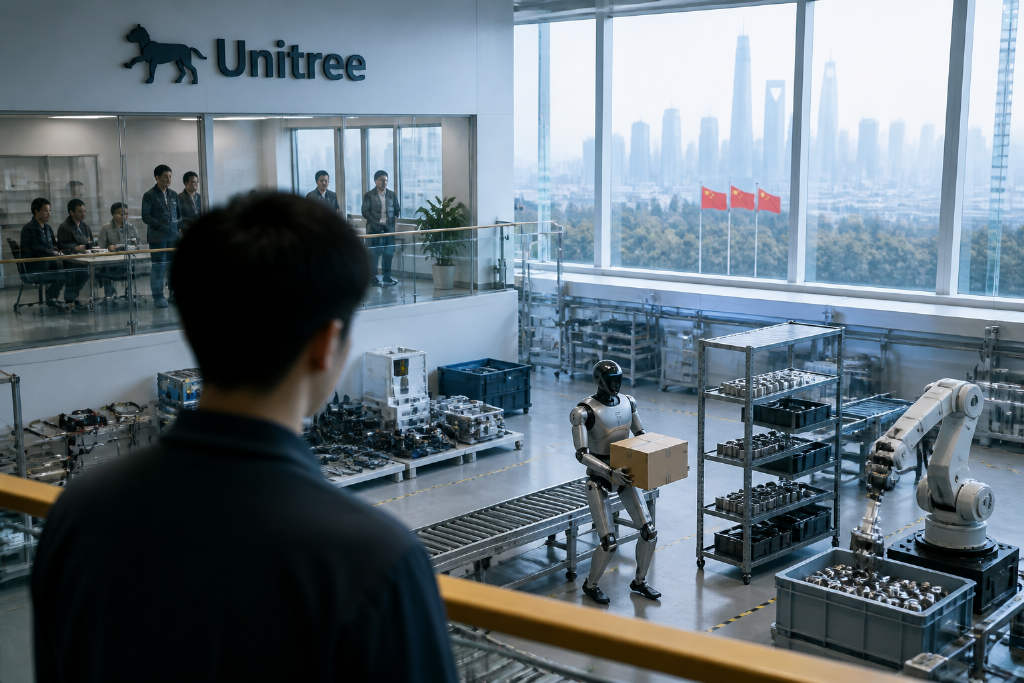
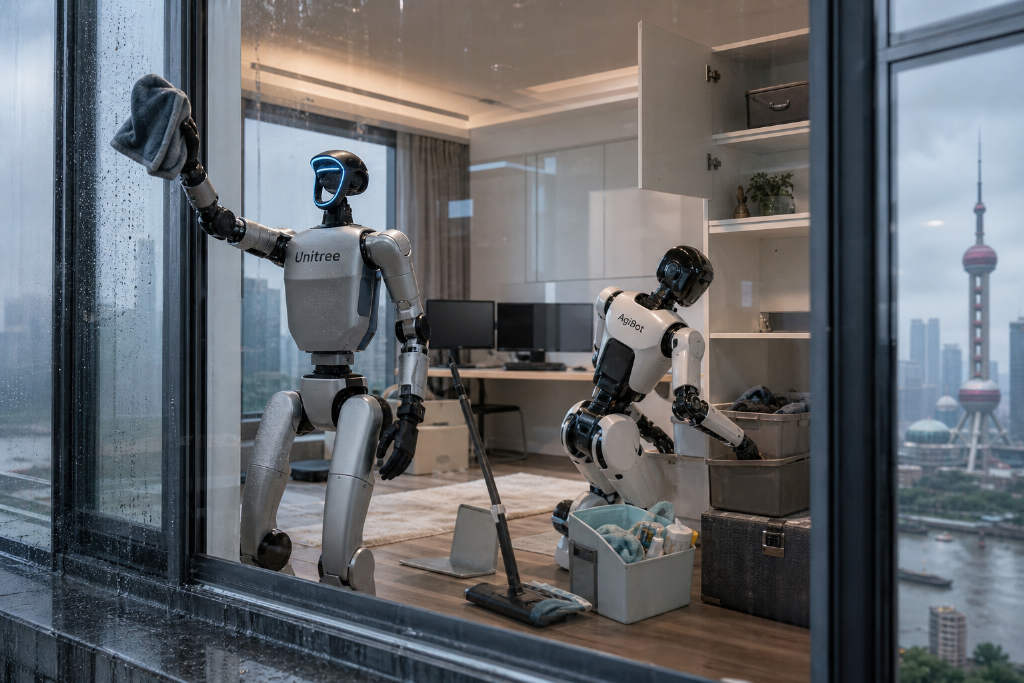
A MarsBit article, republished from the WeChat account QbitAI and written by Noah, has spotlighted a 10-minute embodied AI demo shot in a single take with no visible edits. The video, as described in the report, shows robots from Unitree and Zhiyuan — two different hardware platforms with different architectures, degrees of freedom and sensor systems — operating under what the author calls a shared “brain.” The report walks through a series of scenes in detail: a robot cleaning a window and extending its arm outside after inferring the dirt was on the exterior side; household sorting tasks completed in a cramped roughly 15-square-meter apartment; interruption by an alarm followed by a return to the prior task; and a cross-platform cooperation sequence in which one robot places a scarf around the other so both can carry more items. Another sequence shows a Unitree G1 trying to reach a higher cabinet shelf, then moving a box and attempting to use it as a step. The article also cites unnamed “informed sources” saying the model breaks from prevailing VLA, WAM and traditional world-model approaches. It claims the system was trained on only dozens of hours of video data, though the model’s developer has not been identified and the technical claims remain those of the original author and cited source.
10
10-Minute One-Take Robot Demo Featuring Unitree and Zhiyuan Draws Industry Attention
Zhiyuan
2026-08-23 13:53:12

Zhiyuan Leads the Medal Table at the Second World Humanoid Robot Games

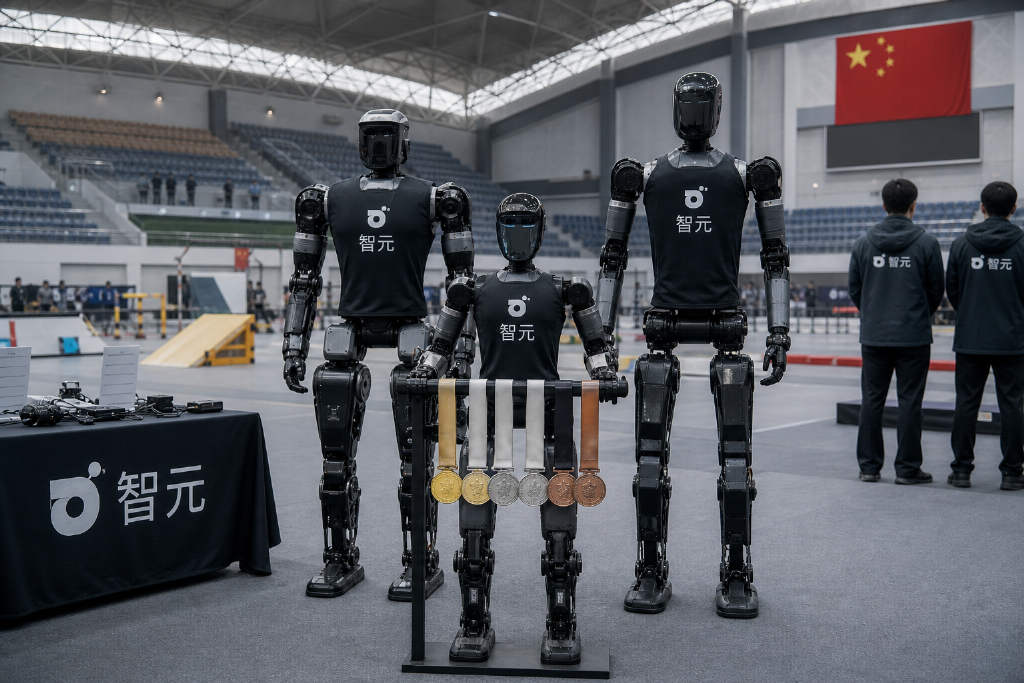
Zhiyuan’s core products — Genie G2, Lingxi X2 and Yuanzheng A3 — took part in the Second World Humanoid Robot Games. In the completed “scenario” events, Zhiyuan’s Genie G2 won two gold medals, three silver medals and two bronze medals. Zhiyuan is currently ranked first on the medal table. The information was reported by Securities Times.

380
Zhiyuan Leads the Medal Table at the Second World Humanoid Robot Games
Embodied AI
2026-08-23 05:19:00

Embodied AI’s valuation surge runs ahead of proven demand, technology, and pricing logic

A Late Post report cited by PANews paints a crowded and overheated embodied AI market in China, where capital has rushed into humanoid robots, dexterous hands, data collection, joint modules, and tactile sensors long before the sector has established durable industrial demand or a broadly accepted valuation framework. In the first half of 2026 alone, domestic embodied AI financing exceeded RMB 90 billion, and 22 companies were valued above RMB 10 billion, according to IT Juzi. Yet field observations described in the report show many robots still move too slowly for real factory deployment, while some revenue is tied to research, education, data collection loops, channel stocking, or related-party structures rather than large-scale end-user adoption. Unitree’s listing has become the market’s closest thing to a public benchmark. Morgan Stanley said more than 10,000 embodied robots were actually shipped in China last year, with Unitree accounting for 5,215 units. Its 2025 revenue reached RMB 1.699 billion, but the report notes that more than 70% of revenue as of last September came from research and education, and less than 10% came from industry applications. The broader question now is whether public markets will price Unitree as a high-growth embodied AI platform with future "brain" capabilities, or more like a strong engineering and hardware company. That answer may shape how long today’s private-market valuations can hold.

390
Embodied AI’s valuation surge runs ahead of proven demand, technology, and pricing logic
Unitree
2026-08-19 04:30:46

Unitree opens on STAR Market at 1,100 yuan, briefly pushing valuation to 445 billion yuan

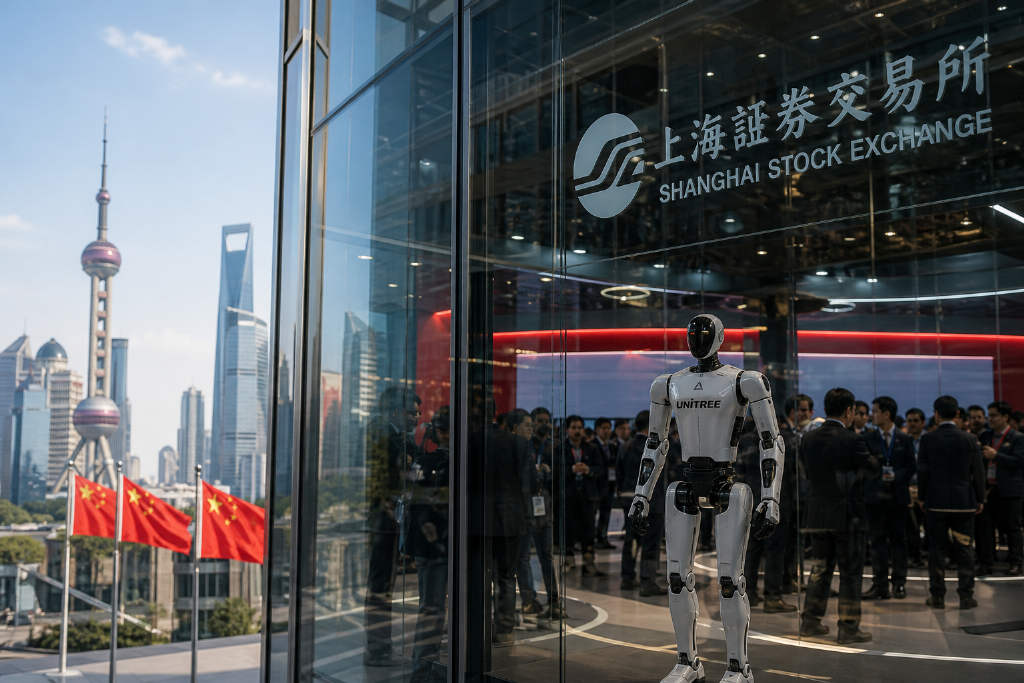
Unitree Technology made its debut on Shanghai’s STAR Market on Aug. 19, turning the long-discussed label of “A-share’s first humanoid robot stock” into a listed reality. The stock opened at 1,100 yuan, up 629.44% from its 150.80-yuan issue price, and its market capitalization briefly climbed to 445 billion yuan before pulling back. At the time of writing cited in the source article, the shares were trading around 892 yuan, valuing the company at roughly 361 billion yuan, with turnover reaching 55.25% and trading volume exceeding 15.3 billion yuan. The listing stood out not only for its first-day price action but also for its unusually tight float. Unitree’s post-listing unrestricted shares amounted to 30.0877 million, or 7.44% of total share capital. The online allotment rate was just 0.0181%, setting records on the STAR Market for both the lowest winning rate and the highest number of participating accounts. Strategic investors including the National Social Security Fund, DeepSeek, Tencent, PetroChina Kunlun Capital, China Southern Power Grid and China Telecom’s Tianyi Capital took part in the placement. The source article frames Unitree’s listing as both a wealth-creation event and a valuation test for China’s embodied AI and robotics sector. It also tracks founder Wang Xingxing’s holdings, compares Unitree with Figure AI, Boston Dynamics and Tesla’s Optimus, and lays out the company’s own responses on valuation, FCC restrictions, international competition and commercialization pace.

340
Unitree opens on STAR Market at 1,100 yuan, briefly pushing valuation to 445 billion yuan
Unitree
2026-08-14 02:23:28

Unitree’s IPO valuation faces scrutiny as industrial-use robot revenue stays below 3%

Unitree Technology’s Sci-Tech Innovation Board IPO has drawn intense retail demand and equally sharp valuation criticism. The company set its offering price at RMB 150.80 per share on Aug. 6, implying a market capitalization of RMB 60.993 billion and a price-to-earnings ratio of 219.23 times. On Aug. 10, the day of online subscription, 9.78 million retail investors participated, and the preliminary valid subscription multiple reached 8,288.82 times, resulting in a record-low winning rate for the STAR Market. At the same time, offshore and crypto-linked premarket pricing moved even higher: Hiive quotes reportedly touched $61.63 per share, while the UNITREE-USDC perpetual contract on Hyperliquid briefly traded near $90, implying a valuation of roughly $35.47 billion, or about RMB 239 billion, nearly four times the IPO market cap. Odaily’s original article argues that the valuation premium rests heavily on expectations for humanoid robots, even though Unitree’s own disclosures show most humanoid revenue still comes from research, education, and demonstration use cases rather than scaled industrial deployment. The report also points to slowing profit growth, revised risk disclosures, and cautious comments from analysts and investors as reasons the company’s valuation may face a tougher fundamental test over time.

220
Unitree’s IPO valuation faces scrutiny as industrial-use robot revenue stays below 3%
Strategy
2026-08-11 09:41:00

Strategy builds a $4.65 billion cash reserve as Trump Media posts $360.6 million crypto loss in the first half

PANews’ daily roundup on Aug. 11 centered on two balance-sheet stories with direct relevance to crypto markets. Strategy said it sold 1,690 BTC last week and lifted its U.S. dollar reserve to about $4.65 billion, while also raising roughly $653 million through its at-the-market equity program. CEO Phong Le said the company had adjusted its approach because bitcoin alone could not meet investor demand, adding that institutional investors place greater value on cash and that Strategy now holds $4.75 billion in cash, enough to cover roughly 2.7 years of preferred dividends. Trump Media, by contrast, reported a first-half loss of $360.6 million tied to the decline in crypto asset prices. As of June 30, the company held 9,477.16 BTC with a fair value of $557.1 million, down by 65 BTC from the end of March, while its Cronos holdings stayed unchanged at about 756.1 million tokens but fell in fair value from $68 million at the end of 2025 to $40.6 million. The report also noted that most of its bitcoin had been pledged as collateral. Elsewhere, South Korea approved tougher crypto rules that tighten scrutiny of exchange major shareholders and remove the 1 million won threshold for the Travel Rule, extending it to all transfers. U.S. spot bitcoin ETFs recorded a net outflow of $145 million on Aug. 10, with BlackRock’s IBIT seeing the largest single-day net outflow at $53.56 million.

1010
Strategy builds a $4.65 billion cash reserve as Trump Media posts $360.6 million crypto loss in the first half
Rimini Street
2026-08-10 09:31:06

Rimini Street built a business by undercutting Oracle and SAP maintenance fees

Rimini Street has built a business around a simple pitch to large enterprise customers: keep the Oracle or SAP software you already run, but stop paying the vendor’s full maintenance bill. Instead, hand that support work to Rimini at a lower price. The MarsBit article tracks how that model emerged, why so many companies remain on older systems, and how founder Seth Ravin spent years testing the idea first at PeopleSoft, then at TomorrowNow, and later at Rimini Street itself. The report also lays out the legal fight that shaped the company. Oracle sued, appeals followed, and several courts narrowed the scope of liability over time. A key point in the article is that third-party support was recognized as lawful competition with Oracle’s own maintenance business, even though PeopleSoft-related issues continued and a later settlement required Rimini to exit that product line. Beyond maintenance, the article says Rimini Street has been expanding into managed services, security offerings, and AI tools layered on top of legacy systems. That strategy can save clients money up front while making them more dependent on Rimini over time. At the same time, Oracle and SAP are pushing customers toward cloud and SaaS models, where the option to separate software from support becomes much harder to preserve.

960
Rimini Street built a business by undercutting Oracle and SAP maintenance fees
Shenzhen
2026-08-10 05:18:11

Shenzhen IPO wave delivers gains to state-backed investors across Chinese cities

Shenzhen is emerging as a major source of IPO-driven returns for state-backed investors across China, according to the article republished by MarsBit from the WeChat account Zhengjieju. The piece says Shenzhen has added 26 domestic and overseas listed companies so far this year, the highest total among large and mid-sized Chinese cities, and argues that many of those listings have created sizable paper gains for government capital and industry funds from outside the city. The article highlights several cases. AI storage chip company Dapu Micro listed on ChiNext on April 16 at RMB 46.08 per share and now has a market value above RMB 200 billion. Shenzhen’s Longgang district guidance fund, which invested RMB 20 million in 2019, still held 5.6991 million shares at the time of listing, with a market value above RMB 2 billion. Nanjing Qilin Venture Capital, which invested RMB 80 million in 2020 for a 5.18% stake, is described as the company’s largest state-owned shareholder. It also points to HKC Corp., listed on the Shenzhen Stock Exchange main board on June 26, where state-backed investors from Mianyang, Liuyang in Changsha, Chongqing, Gui’an and Chuzhou recorded gains after earlier strategic investments. The article frames this as a model of regional coordination: Shenzhen incubates technology companies, outside cities invest through equity, and manufacturing capacity is then deployed in multiple locations.

960
Shenzhen IPO wave delivers gains to state-backed investors across Chinese cities