News

Ethereum
2026-07-14 09:43:26

Ethereum’s Lean Roadmap Returns as Foundation Reshuffle and Staking Design Changes Converge

Ethereum is entering a new phase of self-reduction rather than simple expansion, according to an analysis published by Foresight and written by imToken. The piece argues that recent developments — including Vitalik Buterin’s renewed framing of Lean Ethereum, staffing and scope changes at the Ethereum Foundation, and research around 0x02 compounding validators — are part of the same long-term shift. On July 4, Buterin revisited Lean Ethereum using an updated long-range roadmap and described it as Ethereum’s “third major iteration” after The Merge. The concept stretches well beyond throughput. It centers on protocol simplification, lighter verification, quantum resistance, native privacy, and changes to the consensus layer aimed at reducing the burden on validators and light clients. At the organizational level, the Ethereum Foundation has cut about 20% of staff and narrowed its focus to work that only the foundation can or must do. At the same time, some functions have moved outward: Ethlabs, launched June 22 by five former core Ethereum Foundation researchers, is focused on protocol research and infrastructure, while Ethereum Institutional, launched July 1, has taken over institutional outreach work previously handled by the foundation’s market expansion team. The article also highlights the 0x02 validator model introduced through Pectra. It raises the maximum effective balance per validator to 2048 ETH and lets rewards continue staking in 1 ETH increments, a change that the article says could improve consensus-layer APR by about 5% on a relative basis for smaller stakers.

00
Ethereum’s Lean Roadmap Returns as Foundation Reshuffle and Staking Design Changes Converge
Hyperliquid
2026-07-14 08:44:00

Trade.XYZ drives nearly half of Hyperliquid volume as token speculation stirs concerns over HYPE dilution

Hyperliquid has kept gaining ground even as broader crypto trading activity remains soft, with its share of the global perpetual futures market rising to a record 9.2% from 5.4% at the start of the year. A major force behind that growth is the HIP-3 market, which has expanded rapidly since launching last October and has now generated more than $386.7 billion in cumulative volume, according to Hyperscreener. On-chain equity products account for more than 61.5% of that turnover. Trade.XYZ has emerged as the dominant player inside HIP-3. As of July 14, it accounted for 93.9% of HIP-3 trading volume and 99.8% of open interest, while HIP-3 itself represented 44.7% of Hyperliquid’s daily volume and 33.4% of daily open interest, up sharply from 4.92% and about 3.5% at the start of the year. That rise has fueled market expectations that Trade.XYZ could eventually launch its own token. The prospect has also raised concerns. A standalone token, some market participants fear, could divert traffic, capital and attention away from the Hyperliquid ecosystem and weaken HYPE’s value capture. PANews argues that such a move may be less likely for now, citing Trade.XYZ’s deep alignment with HYPE through staking and ticker auctions, its $15.91 million in cumulative protocol revenue, and regulatory sensitivity around its RWA-linked products, including U.S. equities, indexes and Pre-IPO instruments.

00
Trade.XYZ drives nearly half of Hyperliquid volume as token speculation stirs concerns over HYPE dilution
Robinhood
2026-07-14 08:36:00

Robinhood CEO Vlad Tenev says retail is the real smart money, tokenization is the next frontier, and AI won’t replace human traders

Robinhood CEO Vlad Tenev used a wide-ranging appearance on the Master Investor podcast to lay out how he views today’s market, why he believes retail investors are often more durable than institutions, and where Robinhood wants to push next in crypto and private markets. Tenev argued that many institutional investors have become overly driven by macro signals, tariffs, and portfolio rebalancing, while retail traders tend to stay focused on company products, revenue growth, margins, and long-term conviction. He also said today’s market looks different from the 2020-2021 meme-stock era because Robinhood users are now concentrating more on large, profitable, industry-leading companies such as Nvidia, Tesla, SpaceX, and chip names, rather than businesses tied to nostalgia trades during the pandemic era. On crypto, Tenev described Robinhood Chain as an Ethereum Layer 2 built with Arbitrum technology and aimed at real-world assets. He said the company plans to launch stock tokens in more than 120 countries and regions, starting with about 2,000 U.S.-listed equities available for 24/7 trading, with support for both non-custodial wallets and Robinhood Wallet. He said those tokens will be backed 1:1 by real underlying assets. Tenev also discussed Robinhood Ventures, a closed-end fund structure designed to give retail investors access to private companies including Stripe, OpenAI, SpaceX before IPO, and Revolut. On AI, he said better tools matter, but human beings will continue to make trades, even as automation gets more sophisticated.

260
Robinhood CEO Vlad Tenev says retail is the real smart money, tokenization is the next frontier, and AI won’t replace human traders
Coinbase
2026-07-14 08:33:27

Coinbase CEO says Base's content coin push failed as ZORA drops 95%, focus shifts to trading and AI

Coinbase chief executive Brian Armstrong has publicly conceded that Base's content coin strategy did not work, drawing a line under a year-plus push built around the Zora platform. In a July 13 post on X replying to critic @smileyXBT, Armstrong said he agreed with the criticism, adding that the effort had already been abandoned earlier this year and that the team had "messed up" and needed to move on. The remark is notable because senior crypto executives rarely describe a core strategy in such direct terms after it fails. The market record behind that admission is stark. CoinMarketCap data cited in the source shows ZORA, the token tied to the broader experiment, falling from its all-time high of $0.1471 on Aug. 11, 2025 to about $0.0067 at publication, a decline of roughly 95.4%. The article also traces a series of setbacks, from a Base-linked token created through a post on Zora that briefly topped a $17 million market cap before collapsing more than 99%, to later creator-token drawdowns and Zora's decision to deploy its "Attention Markets" product on Solana rather than Base. Armstrong rejected criticism that Base's interest in AI agents is just another trend chase. He said Base's priorities remain trading, payments and agents, in that order, with most resources going to trading infrastructure. Base still leads Layer 2 networks by TVL, according to CoinGecko data cited in the report.

200
Coinbase CEO says Base's content coin push failed as ZORA drops 95%, focus shifts to trading and AI
U.S. governme
2026-07-14 07:47:22

U.S. government moves $288 million in seized BTC and ETH to Coinbase Prime

The U.S. government transferred about $288 million in seized crypto assets to Coinbase Prime on July 14, according to CoinDesk, citing on-chain data from Arkham Intelligence. The transfer included 3,800.714 BTC and 30,007 ETH. Arkham’s data shows the BTC moved through an intermediary wallet before reaching Coinbase Prime, while the ETH was sent directly to a Coinbase Prime deposit address. The assets came from several separate cases. The bitcoin was linked to the Ryan Farace, or “xanaxman,” case and the defunct BTC-e exchange, while the ether was tied to the Brian Krewson case involving Christopher Castelluzzo and Luke Atwell. CoinDesk noted that a transfer to Coinbase Prime can be read in more than one way: exchange inflows are often seen as a sign of a pending sale, but Coinbase Prime also offers custody, financing, and staging services. U.S. Marshals Service and the Department of Justice had not issued statements at the time cited in the report. That leaves the move as a confirmed wallet transfer, but not proof of an imminent sale.

340
U.S. government moves $288 million in seized BTC and ETH to Coinbase Prime
Taiwan
2026-07-14 07:41:47

Taiwan telecom bill clears first review, easing legal barriers for Starlink entry

Taiwan’s legislature has taken a first step toward loosening restrictions that have blocked Starlink from launching commercial service in the market. A telecom law amendment cleared initial review on July 13, removing the requirement that the chair of a satellite telecom operator’s local telecom business be a Republic of China national and relaxing foreign ownership rules to a 60% cap regardless of direct or indirect holdings. The move is widely seen as opening a path for SpaceX’s Starlink, which reportedly failed to reach a deal with regulators in 2021 after insisting on a wholly owned operating structure that conflicted with existing rules. Taiwan’s three major carriers — Chunghwa Telecom, Taiwan Mobile, and Far EasTone — backed the direction of the amendment, but all called for safeguards tied to national security, cybersecurity, communications resilience, oversight, and industrial policy. The debate is now shifting to whether those requirements will be written directly into law or left to future rules set by regulators.

320
Taiwan telecom bill clears first review, easing legal barriers for Starlink entry
Robinhood Cha
2026-07-14 07:38:16

Two meme-fueled scam episodes hit Robinhood Chain as SpaceXAI and founder-linked wallet are exploited

Robinhood Chain’s meme boom is drawing in more than traders. Over the past two days, two separate incidents used recognizable names and trusted accounts to create short-lived hype around tokens on the network before late buyers were left exposed. The first involved the X accounts of SpaceXAI and Starlink, which were compromised and used to amplify a post promoting SCATMAN, a meme token on Robinhood Chain. The token’s market cap briefly climbed to about $2 million before the deployer pulled liquidity, sending the price close to zero. On-chain tracker Lookonchain said the attacker minted 10 trillion SCATMAN tokens and sold them through two linked wallets for 59 ETH and 14.7 ETH. The second centered on Robinhood co-founder and CEO Vlad Tenev. After a wallet tied to Tenev was compromised, the address bought meme token $1 on July 12, triggering copycat buying after traders saw activity from what appeared to be a founder-linked wallet. The token’s market cap jumped from about $500,000 to $14 million, with roughly $20 million in trading volume in two hours, before falling back near $1 million. The back-to-back cases highlight how Robinhood Chain’s recent meme trading surge has also opened the door to account hijacks, liquidity pulls, and rapid cash-outs.

140
Two meme-fueled scam episodes hit Robinhood Chain as SpaceXAI and founder-linked wallet are exploited
ARK Invest
2026-07-14 07:22:57

ARK Invest research head says Ethereum captured just 0.15% of Robinhood Chain revenue

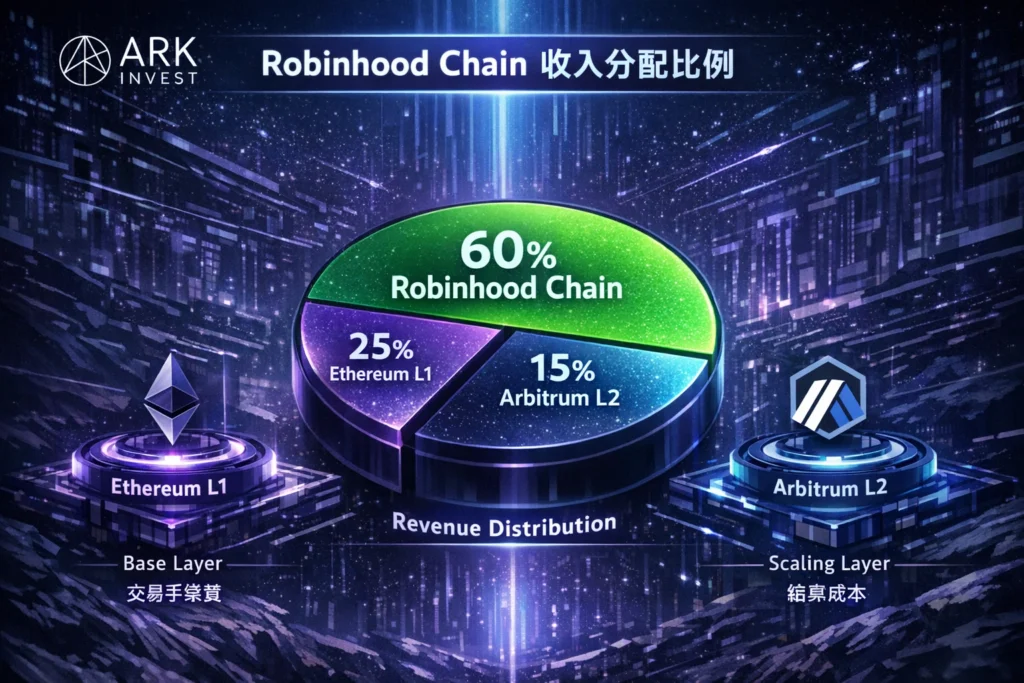
ARK Invest Director of Research Lorenzo Valente criticized the way revenue has been split on Robinhood Chain since launch, arguing that Ethereum, the network serving as the final settlement layer, has collected only about $1,538, or roughly 0.15% of total revenue. Based on the figures he cited on X on July 14, Robinhood has kept about 89% of the roughly $816,000 generated so far, while Arbitrum, described as the middleware or L2 layer, has taken around 10%, or about $80,000. Valente said that if ETH is viewed as money, Robinhood building on Ethereum is bullish, but if ETH is treated as a revenue-generating asset, the current setup looks bearish. He argued that a fairer split would be 75% for Robinhood, 10% for Arbitrum, and 15% for Ethereum. His comments came on the same day Ethereum co-founder Joseph Lubin said L1 fees should remain low, and Uniswap founder Hayden Adams shared data showing Uniswap generates $5.2 million in daily fee revenue, a sharp contrast with Robinhood Chain’s roughly $116,000 in average daily revenue over its first two weeks.

00
ARK Invest research head says Ethereum captured just 0.15% of Robinhood Chain revenue