News

South Korea s
2026-07-14 03:46:13

Kospi Slides Into Bear Market as Forward P/E Falls to 6x and Retail Investors Turn Sellers

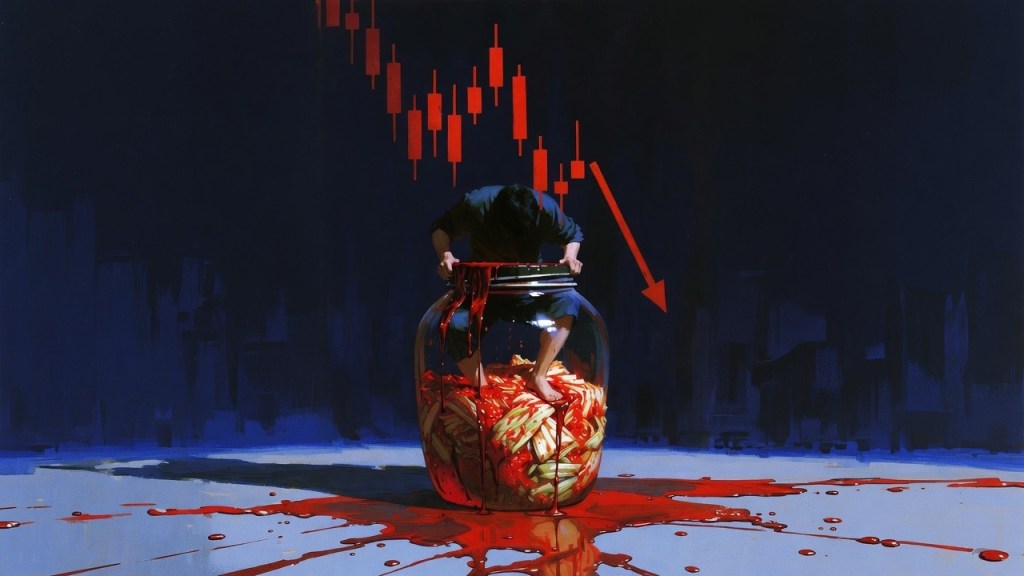
South Korea’s stock market has fallen into bear-market territory after a sharp one-month correction driven by heavy losses in semiconductor bellwethers SK Hynix and Samsung Electronics. Bloomberg data cited in the report showed the Kospi’s 12-month forward price-to-earnings ratio falling to about 6x, described as a record low. The selloff has also been marked by a shift in investor behavior: local retail traders, who had recently been buying dips, turned into net sellers on July 13, offloading about KRW 2 trillion, or roughly $1.3 billion, in equities. Foreign institutional investors, by contrast, returned to buying after a stretch of net selling. Analysts also pointed to leveraged exchange-traded funds tied to semiconductor themes, saying their rebalancing trades amplified short-term swings and helped push local trading halts to a record high. Even with volatility rising, some overseas institutions said Korean equities now look relatively attractive against other emerging and developed markets at current valuation levels.

20
Kospi Slides Into Bear Market as Forward P/E Falls to 6x and Retail Investors Turn Sellers
Coinbase
2026-07-14 03:41:55

Brian Armstrong says Base content-coin push failed as ZORA falls about 95% from its peak

Coinbase CEO Brian Armstrong said on July 13 that Base’s year-long content-coin strategy did not work and that the company had already changed course earlier this year. His comments amount to the clearest public acknowledgment yet that Base’s attempt to tie social posting, creator tokens and onchain trading into one consumer product fell short. Base had pushed the model through Zora, whose tools allowed each post to be turned into a tradable ERC-20 token while also linking activity back to account-level creator coins. The structure helped drive token issuance and trading activity on Base, at one point making it the most active Layer 2 chain for new token launches. But the article says the model failed to produce durable demand or stable user retention. ZORA, the token tied to the infrastructure behind that strategy, is down about 95% from its August peak last year, with market capitalization shrinking from roughly $550 million to about $30 million. Armstrong had still defended the model in January, but Base App later ended Creator Rewards, removed its Farcaster-powered social feed, and shifted focus toward tradable assets, payments and stablecoins. Base also disclosed that it processed more than $17 trillion in stablecoin volume in 2025 across 26 local currencies and 17 countries.

00
Brian Armstrong says Base content-coin push failed as ZORA falls about 95% from its peak
Coinbase
2026-07-14 03:41:55

Brian Armstrong says Base’s content-coin push failed as ZORA falls about 95% from its peak

Coinbase CEO Brian Armstrong said on July 13 that Base’s year-long push into content coins did not work, delivering the clearest admission yet that the strategy has been abandoned. Base had leaned heavily on Zora’s tooling from 2025, building content-token creation into its wallet product and later into Base App, which combined social feeds, chat, payments, trading, and app discovery. The effort briefly helped Base become the largest L2 chain by new token issuance, but the momentum did not produce durable user retention. Armstrong wrote on X that the experiment "didn’t work," that the company had already changed course earlier this year, and that it was time to move on. ZORA, the token tied to the infrastructure behind the model, is down about 95% from its all-time high in August last year, with market value shrinking from about $550 million to roughly $30 million. The shift had been building for months. In January, Armstrong was still defending the model. By the following month, Base App had ended Creator Rewards and removed its Farcaster-powered social feed. In March, Armstrong said the app’s SocialFi features were not performing well. Base’s 2026 strategy later put trading and stablecoin payments at the center, while Armstrong said most resources are now focused on trading, with payments and AI agents also part of the roadmap.

00
Brian Armstrong says Base’s content-coin push failed as ZORA falls about 95% from its peak
Solana
2026-07-14 03:41:16

Sanctum TVL rises 10% in a month, leading growth among Solana’s top five protocols

Sanctum, a liquid staking protocol in the Solana ecosystem, posted a 10% increase in total value locked over the past month, the fastest growth rate among Solana’s five largest protocols, according to Techub, citing CryptoBriefing. The protocol now ranks second in Solana by TVL and accounts for more than 20% of the network’s total DeFi TVL. Data cited in the report links the increase to rising demand for liquid staking tokens, or LSTs, across the Solana ecosystem. The market is also watching how upcoming Solana network upgrades such as Alpenglow, along with broader macro factors, may affect DeFi activity. The report said Sanctum’s TVL moves may offer a read on how much capital is staying on-chain.

00
Sanctum TVL rises 10% in a month, leading growth among Solana’s top five protocols
Bitcoin
2026-07-14 03:37:00

Analysts see Bitcoin panic selling fading, but spot demand still looks weak

Bitcoin is down 28% so far this year, yet several analysts say the long stretch of selling pressure may be losing force. They point to three signals in particular: Bitcoin held above $62,000 even as U.S.-Iran tensions escalated and oil prices climbed; U.S. spot Bitcoin ETFs posted $197.4 million in net inflows last week, ending an eight-week run of outflows; and on-chain data cited from Glassnode showed daily spot selling dropping from an average of 2,000 BTC in June to just 53 BTC in July. Still, the analysts are not calling for an immediate bull-market restart. FxPro’s Alex Kuptsikevich said the rebound from this year’s low of $57,700 has been driven more by speculative activity in derivatives than by strong spot buying. In his view, if spot liquidity does not improve, Bitcoin may remain range-bound in the months ahead. This week’s U.S. CPI release and congressional testimony from Fed Chair Kevin Warsh are also seen as key events for broader market direction.

00
Analysts see Bitcoin panic selling fading, but spot demand still looks weak
Bitcoin
2026-07-14 03:37:00

Analysts see Bitcoin selling pressure easing, but spot demand is still missing

Bitcoin’s multi-month sell-off may be losing steam after the asset fell 28% so far this year, with analysts pointing to three signs that panic selling is fading: firmer price action during a rise in geopolitical risk, a return to net inflows for U.S. spot Bitcoin exchange-traded funds, and a sharp drop in on-chain spot selling pressure. Still, they are not calling for an immediate bull run. Jasper De Maere, an OTC trader at Wintermute, said Bitcoin held above $62,000 even as tensions between the U.S. and Iran escalated and concerns grew over a possible closure of the Strait of Hormuz. He said that suggested weaker holders had largely been flushed out of the market. Fund flows offered another signal. U.S. spot Bitcoin ETFs posted $197.4 million in net inflows last week, ending an eight-week run of outflows. Nexo analyst Dessislava Ianeva added that the last 10 days showed alternating inflows and outflows, but the overall direction had turned slightly positive. On-chain data cited from Glassnode showed daily Bitcoin sold on spot markets fell from an average of 2,000 BTC in June to 53 BTC in July. Even so, FxPro analyst Alex Kuptsikevich said the rebound from Bitcoin’s yearly low of $57,700 had been driven mostly by speculative activity in derivatives rather than strong spot buying, leaving the market vulnerable to more range-bound trading in the months ahead.

00
Analysts see Bitcoin selling pressure easing, but spot demand is still missing
Aspecta
2026-07-14 02:51:17

ASP falls about 98% from peak despite YZi Labs backing and Binance Wallet integration

Aspecta’s token ASP fell to around $0.015 on July 14, down roughly 98% from its all-time high of $0.73 reached on its July 24, 2025 token generation event. The project had strategic backing from YZi Labs and was later integrated into Binance Wallet’s pre-TGE trading model, yet that support did not prevent a prolonged slide. Aspecta positions itself as infrastructure for pricing illiquid assets on-chain through its BuildKey product, which lets users trade tokenized claims before a project’s official token launch. Its website highlights headline return figures, including an average valuation increase of 1,934% and average asset returns of 3,573%, while 77 projects have reportedly used the system for early pricing and settlement. The report points to a highly concentrated token distribution, with the top five addresses holding 81.49% of total supply, and a long unlock schedule still ahead. It also compares ASP with other projects shown on Aspecta’s site, including Sign, GAIB and Solayer, all of which have seen steep declines from their highs. The broader takeaway is that venture backing, platform integration and pre-market paper gains did not translate into durable secondary-market price support.

60
ASP falls about 98% from peak despite YZi Labs backing and Binance Wallet integration
Aspecta
2026-07-14 02:51:17

ASP drops about 98% from its TGE peak as Aspecta’s Binance Wallet tie-up fails to reverse the slide

Aspecta’s token ASP fell to around $0.015 on July 14, down about 98% from its all-time high of $0.73 reached on the July 24, 2025 TGE day. The project had strategic backing from YZi Labs and later integrated with Binance Wallet’s pre-TGE trading model, making it one of the more closely watched pre-market infrastructure names in the Binance orbit over the past year. According to the report, ASP’s ownership remains highly concentrated, with the top five addresses holding 81.49% of total supply, while a large portion of supply is still locked and scheduled to be released monthly. The article also points to examples on Aspecta’s own platform where BuildKey certificates posted huge paper gains before corresponding tokens showed weak liquidity or limited access to mainstream exchanges. The report argues that backing from YZi Labs or cooperation with Binance Wallet did not translate into price support in the secondary market, as a short-lived rally following Binance Wallet’s September 17, 2025 announcement faded within a week.

300
ASP drops about 98% from its TGE peak as Aspecta’s Binance Wallet tie-up fails to reverse the slide