2 nm

AMD
2026-07-22 07:32:58

AMD Helios rack is reportedly priced about 40% above Nvidia Vera Rubin, with Microsoft Azure as first buyer

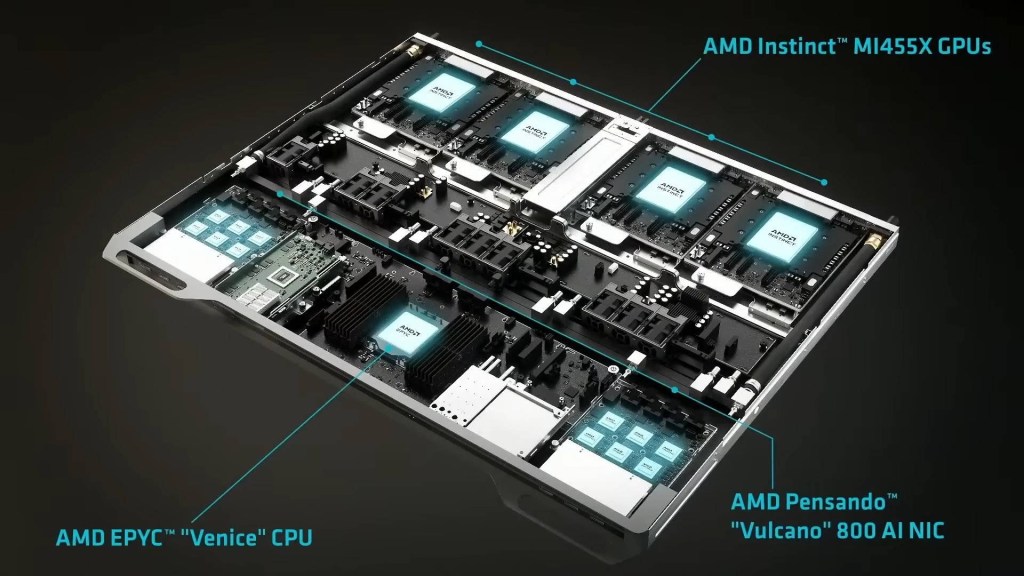
Advanced Micro Devices is no longer being framed as the low-cost alternative in AI infrastructure. Citing a new report from research firm Futurum, Wccftech said AMD’s Helios AI rack is expected to sell for $5 million to $5.5 million per rack, compared with an estimated $3.5 million to $4 million for Nvidia’s second-generation Vera Rubin rack. That puts Helios roughly 40% higher on price, though the figure is based on bill-of-materials analysis rather than an official AMD quote. Helios is AMD’s first rack-scale, full-stack system built for AI workloads. It combines the Instinct MI455X GPU, sixth-generation EPYC Venice CPUs, Pensando Vulcano 800 AI NICs, Salina DPUs, Infinity Fabric interconnect and the ROCm software platform in one architecture. On specs, Nvidia’s Vera Rubin leads in FP4 compute and HBM4 bandwidth, while AMD leads in FP8 compute and memory capacity, with 432 GB of HBM4 versus Rubin’s 288 GB. Microsoft has confirmed it will deploy Helios in Azure AI services. OpenAI, Meta, Oracle, Celestica, Nutanix and the U.S. Department of Energy were also listed as customers, giving AMD an early roster across cloud, enterprise IT and government.

1170
AMD Helios rack is reportedly priced about 40% above Nvidia Vera Rubin, with Microsoft Azure as first buyer
Samsung Elect
2026-07-16 10:16:52

Samsung Holds Back High NA EUV Production Rollout as Foundry Profitability Takes Priority

Samsung Electronics has installed two High-NA extreme ultraviolet lithography systems for its foundry business, but it is not yet putting the tools into mass-production lines. The decision reflects a cautious capital allocation stance rather than a clear technology bottleneck. According to the report, Samsung’s foundry unit is seen as one of the businesses most likely to return to profit as early as the fourth quarter this year after years of losses. Bringing expensive equipment fully online now would lift depreciation and operating costs, increasing fixed expenses at a sensitive point in the unit’s earnings recovery. At the same time, Samsung’s reported 2 nm yield has reached about 55%, close to the roughly 60% threshold that the industry commonly views as sufficient for stable mass production. That suggests the company’s hesitation is not mainly about process readiness for High NA EUV. Korean media said Samsung is keeping equipment spending to a minimum until the foundry business has a clearer path to sustainable profitability. The move shows a practical balance in the advanced-node race: the company has the technology and tools in place, but financial discipline is being treated as more urgent than accelerating the catch-up pace.

1090
Samsung Holds Back High NA EUV Production Rollout as Foundry Profitability Takes Priority
ASML
2026-07-15 14:54:59

ASML lifts guidance and maps out 2027-2028 capacity expansion as Wall Street turns broadly bullish

ASML’s second-quarter results came in well ahead of expectations, prompting a swift and broadly positive response from major Wall Street banks. The company reported stronger-than-expected revenue, margins and earnings, then raised its 2026 full-year outlook and, more importantly, laid out a rare capacity roadmap for 2027 and 2028 covering both low-NA EUV and immersion DUV tools. That disclosure directly addressed a key market concern: whether AI-driven semiconductor demand can hold up long enough to justify a more aggressive equipment cycle. Goldman Sachs, JPMorgan and Barclays all maintained or reiterated positive ratings after the release, while several analysts argued the update strengthens the case that supply bottlenecks tied to AI infrastructure remain real. The discussion also extended beyond logic chips into memory, where ASML said tight DDR and HBM supply is pushing customers to invest faster. Goldman’s trading desk said that view challenges the bearish narrative that memory pricing will peak by 2028 or that supply tightness will ease materially before then. Investors reacted quickly. ASML shares in Amsterdam rose about 4%, Nasdaq 100 futures added roughly 40 basis points, and SK Hynix’s Seoul-listed shares jumped 8.8%.

260
ASML lifts guidance and maps out 2027-2028 capacity expansion as Wall Street turns broadly bullish
SK Hynix
2026-07-11 04:02:11

SK Hynix’s Nasdaq listing points to valuation reset more than a funding need

SK Hynix’s July 10 Nasdaq debut was framed by the source article as something larger than a conventional capital raise. The company priced its shares at $149, rose nearly 13% on its first trading day, and reached a $1.23 trillion market value. Its $26.5 billion IPO topped Alibaba’s 2014 deal as the largest U.S. fundraising by a foreign issuer, according to the article. The central argument is that SK Hynix did not come to the U.S. because it lacked cash. The company posted a 77% net margin in the first quarter and earned about 40 trillion won, or roughly $30 billion, in net profit in a single quarter, more than the IPO proceeds. The source says the offering represented less than 3% of total market value, with only 2.5% new shares issued. Instead, the article ties the move to a long-standing “Korea Discount,” under which South Korean equities trade at structurally lower valuations than U.S. peers. It contrasts SK Hynix’s roughly 8x forward earnings framework in Seoul with Micron’s 23x multiple in the U.S., despite SK Hynix holding 56.4% of the HBM market and supplying about 70% of HBM4 orders for Nvidia’s next-generation NVL72 Vera Rubin platform, based on figures cited in the piece. The article argues that access to deeper global capital pools is becoming critical as HBM4, advanced foundry outsourcing, and AI infrastructure spending drive much larger capital needs.

1090
SK Hynix’s Nasdaq listing points to valuation reset more than a funding need